Small Fleets: Fleet Maintenance Schedule Using 5,000–7,500 mi
Use whichever-comes-first scheduling, mileage, engine hours, or calendar time, as your baseline for every vehicle class in your fleet. Start today by auditing each vehicle’s last service date and current odometer or engine-hour reading. That single habit, applied consistently, is what separates fleets that budget for repairs from fleets that get blindsided by them.
TL;DR:
- Using a “whichever-comes-first” model with mileage, engine hours, and calendar time ensures timely maintenance across diverse vehicle duty cycles.
- Auditing each vehicle’s last service, classifying assets, and adjusting OEM intervals for severe duty help build a reliable and tailored preventive maintenance schedule.
- Automating notifications, parts tracking, and work orders minimizes shop bottlenecks and reduces missed services, especially when scaling beyond five vehicles.
- Maintaining a PM compliance rate of at least 85 percent improves schedule effectiveness and identifies issues like scheduling bottlenecks or driver noncompliance.
- Regularly reviewing and adjusting maintenance intervals based on actual data prevents fleet failures caused by static scheduling.
Table of Contents
- What Is a Fleet Maintenance Schedule and Why Does It Matter?
- Which Maintenance Trigger Should You Use: Mileage, Hours, or Calendar Time?
- How Do You Build a Fleet Preventive Maintenance Schedule?
- What Should a Fleet Maintenance Checklist Include Each Month, Quarter, and Year?
- How Do You Schedule Fleet Maintenance Without Bottlenecking Your Shop?
- Should You Automate Fleet Maintenance Scheduling or Stick With Spreadsheets?
- How Do You Know if Your Maintenance Schedule Is Working?
- What Mistakes Wreck Most Fleet Maintenance Programs?
- How Kwik Kar Supports Local Fleet Maintenance Programs
- What Fleet Managers Get Wrong About Maintenance Scheduling
- Get a Fleet Maintenance Audit From Kwik Kar Oil Change & Auto Care
- Where to Learn More About Fleet Maintenance Standards
- Sources
- FAQ
What Is a Fleet Maintenance Schedule and Why Does It Matter?
A fleet preventive maintenance (PM) schedule is a documented plan that tells you when each vehicle needs service, based on measurable triggers rather than guesswork or a phone call after something breaks. The goal isn’t just clean engines. It’s predictable uptime and a maintenance budget you can actually forecast instead of absorbing as a surprise.
The contrast with reactive maintenance is stark. Reactive shops fix what fails, which means unplanned downtime, rushed parts orders, and repairs that cost more because a small problem was left to become a big one. A structured PM program flips that sequence: you catch wear before it becomes failure, and you schedule the vehicle out of service on your terms, not the transmission’s.
Every solid PM schedule rests on a handful of trigger types working together:
- Mileage — distance driven since the last service
- Engine hours — runtime for vehicles that idle heavily or run auxiliary equipment
- Calendar time — a backstop for low-mileage vehicles whose fluids still age
- Condition or fuel-based triggers — real-time signals like oil-life monitors or fuel consumption anomalies
The next section breaks down when to lean on each one.
Which Maintenance Trigger Should You Use: Mileage, Hours, or Calendar Time?
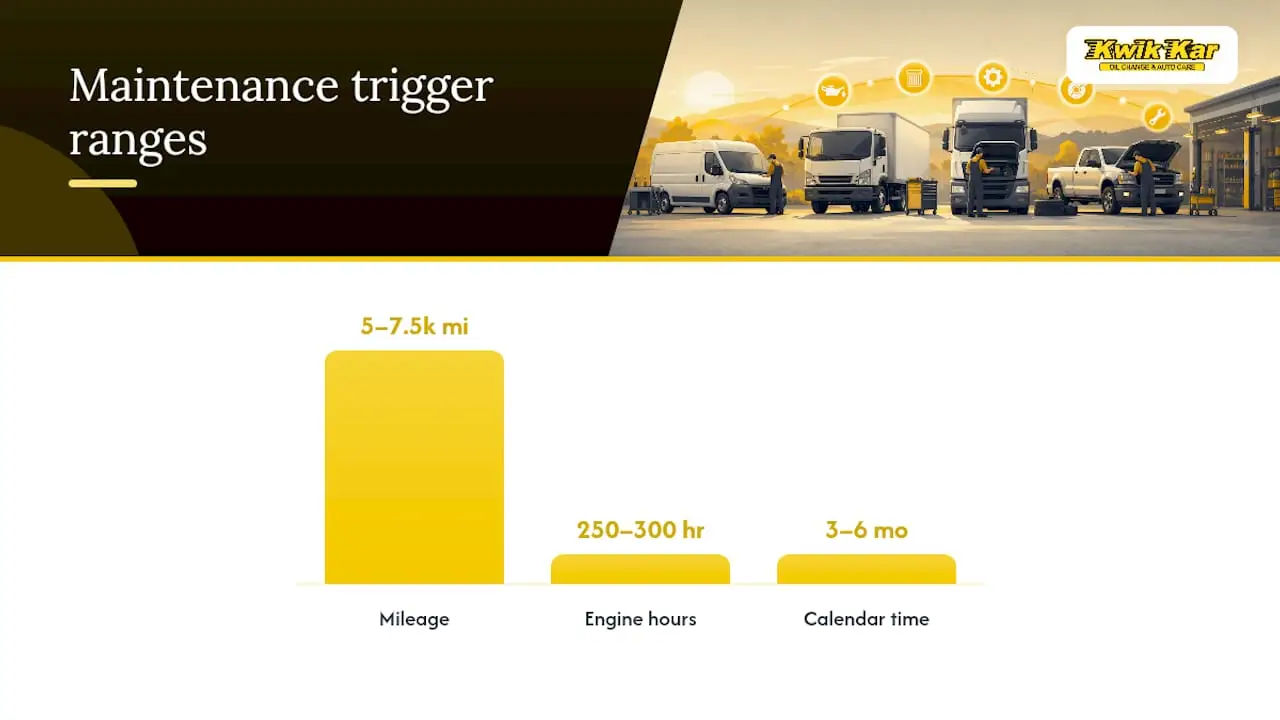
The answer, for almost every mixed fleet, is all three at once. The industry standard for effective PM scheduling is a “whichever-comes-first” model: you set a mileage threshold, an engine-hour threshold, and a calendar threshold for the same service, and whichever one arrives first triggers the work order. A typical oil-change interval under this model runs 5,000 to 7,500 miles, 250 to 300 engine hours, or 3 to 6 months, whichever comes first.
Why not pick just one trigger? Because duty cycles vary too much across a real fleet. Consider three vehicles on the same route sheet:
- A long-haul delivery van racks up miles fast but spends little time idling, so mileage is the dominant trigger.
- A landscaping truck with a PTO-driven mower deck barely moves some days but runs its engine for hours, so engine hours matter more than odometer reading.
- A reserve or backup vehicle might sit for months between uses, meaning calendar time, not mileage or hours, is what ages the oil and rubber components.
A single-trigger schedule misses at least one of these vehicles every time. Hybrid whichever-comes-first scheduling assigns all relevant triggers in parallel, which protects mixed fleets from the gaps that single-trigger logic leaves behind.
Statistic to remember: the standard oil-change trigger window of 5,000 to 7,500 miles, 250 to 300 hours, or 3 to 6 months isn’t arbitrary. It reflects how fast lubricant additives break down under normal versus heavy-duty use, and it’s the baseline most OEMs build their own recommendations around.
How Do You Build a Fleet Preventive Maintenance Schedule?
A PM program that holds up under real operational pressure starts with an honest audit, not a template pulled off the internet. Here’s the sequence that works for fleets of almost any size.
- Audit every vehicle. Record the last service date, current odometer or engine-hour reading, any open defects from recent inspections, and upcoming state inspection deadlines.
- Classify assets by duty type. Group vehicles into categories like light-duty passenger cars, medium-duty delivery trucks, and severe-duty or off-road equipment. Each class needs its own PM template.
- Set baseline intervals from OEM guidance. Start with the manufacturer’s recommended service schedule, then adjust for severe duty conditions such as frequent towing, extreme heat, stop-and-go traffic, or dusty environments. Document the adjustment factor and the reasoning, typically 20 to 40 percent shorter intervals for genuinely severe-duty vehicles.
- Configure advance notification windows. Build in lead time so your shop or technician knows a service is coming before the vehicle is due, not the day it crosses the threshold.
- Pilot the program on a subset of vehicles. Run it on 10 to 15 vehicles for six to eight weeks before rolling it fleet-wide. Setting up per-vehicle PM schedules and notification windows during a pilot exposes gaps in your template before they cost you a breakdown on the full fleet.
Pro Tip: Don’t skip the recall check during your audit. The NHTSA recalls database is free, searchable by VIN, and catches safety issues that no oil-change interval will ever flag.
This structured approach also builds the recordkeeping habit you’ll need later. A documented PM program that pairs recordkeeping with compliance management is one of the traits that separates fleets with low downtime from fleets that are always reacting.
What Should a Fleet Maintenance Checklist Include Each Month, Quarter, and Year?
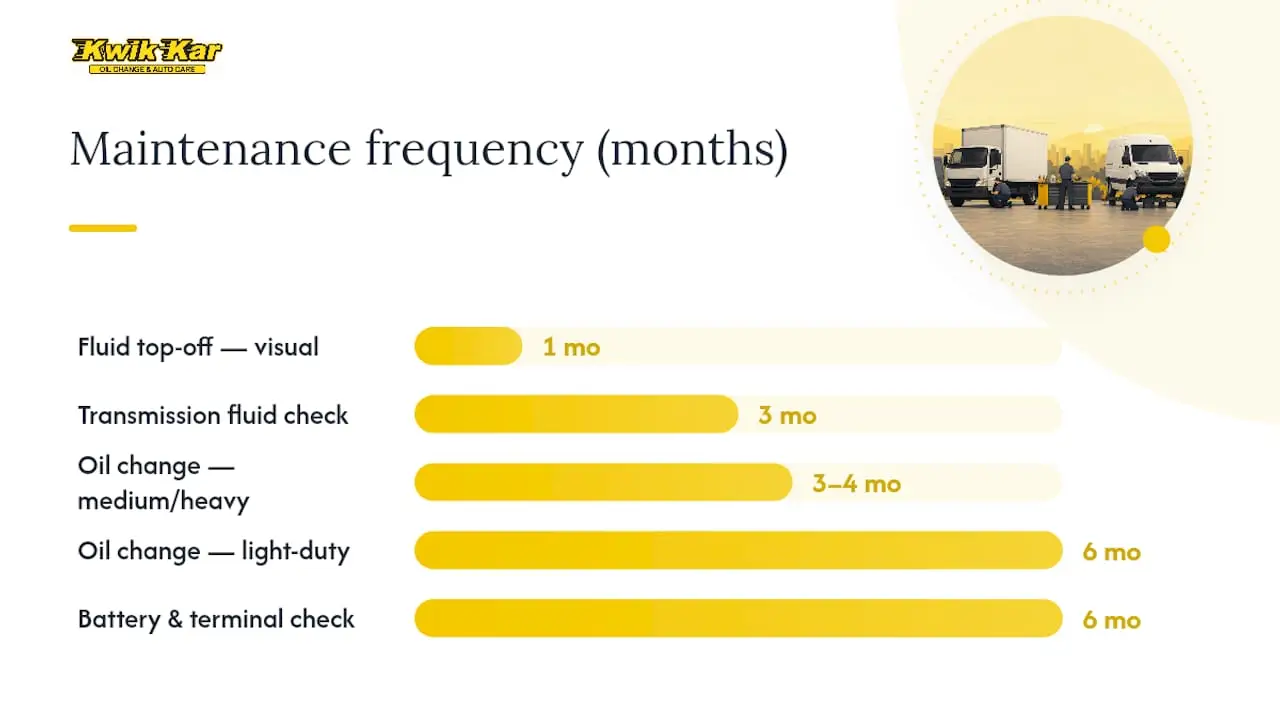
Interval-based checklists give you a starting point you can adjust once real data comes in. These numbers assume normal duty; shorten every interval for severe-duty vehicles.
Light-duty vehicles (sedans, light trucks, vans):
- Oil and filter change: every 5,000 to 7,500 miles or 6 months
- Tire rotation: every 5,000 to 8,000 miles
- Brake inspection: every 10,000 to 12,000 miles
- Battery and terminal check: every 6 months
- Fluid top-off (coolant, brake, power steering): monthly visual check
- Air filter replacement: every 12,000 to 15,000 miles
- State inspection and emissions testing: per your local renewal cycle
Medium and heavy-duty vehicles:
- Oil and filter change: every 250 to 300 engine hours or 3 to 4 months
- Brake system inspection: monthly, given higher wear from cargo loads
- Transmission fluid check: quarterly
- Suspension and wheel alignment check: quarterly for vehicles hauling regularly
For every checklist item, log which parts were used, the technician who performed the work, and how long the service took. That documentation isn’t paperwork for its own sake. It’s what lets you spot a pattern, like a brake pad wearing out three months early on the same route, before it turns into a roadside call.
How Do You Schedule Fleet Maintenance Without Bottlenecking Your Shop?
Lead time is what turns a maintenance schedule from a wish list into something your shop can actually execute. Vehicles need advance notice before they hit a threshold, not a same-day surprise.
- Set an advance notification window sized to your flexibility. A common starting point is 500 miles, 10 to 25 engine hours, or 30 days before the due date, giving your shop time to order parts and block a bay.
- Stagger services across your fleet. Don’t let every truck bought in the same quarter hit its 5,000 mile mark in the same week. A practical rule: cap scheduled services at 10 to 15 percent of your fleet in any given week, so you always have vehicles available for dispatch.
- Close the loop with dispatch and drivers. Every PM appointment should sync with the dispatch calendar, and every driver vehicle inspection report (DVIR) that flags a defect should feed directly into the scheduling system rather than sitting in a glovebox.
A 10 percent scheduling window built around your mileage interval gives you enough flexibility to avoid shop congestion without letting vehicles run past their due date.
Should You Automate Fleet Maintenance Scheduling or Stick With Spreadsheets?
Spreadsheets work fine for five vehicles. They start breaking down around fifteen to twenty, once you’re tracking multiple trigger types, notification windows, and defect histories across every asset simultaneously. That’s usually the point where the manual math stops catching problems before they become downtime.
When you’re ready to upgrade, prioritize these features over flashy dashboards:
- Telematics integration that pulls odometer and engine-hour data automatically, so nobody’s manually logging readings
- Automated work-order generation the moment a vehicle crosses a threshold
- Parts and inventory tracking tied to upcoming services
- Notification alerts to drivers, dispatch, and your shop simultaneously
Automated maintenance software increases PM effectiveness precisely because it removes the manual tracking step that causes most missed services.
Pro Tip: Don’t buy a full platform to fix one weak link. If your real problem is DVIR follow-through, not scheduling, look for a tool that solves that specific gap first.
How Do You Know if Your Maintenance Schedule Is Working?
Three numbers tell you almost everything: PM compliance rate (percentage of scheduled services completed on time), missed-service rate, and cost per mile. Track unscheduled downtime too, since a rising trend there usually means your intervals are too loose somewhere.
A reasonable target is a PM compliance rate of 85 percent or higher. Below that, you’re likely looking at scheduling bottlenecks, driver noncompliance, or shop capacity that doesn’t match your fleet size. Review these numbers quarterly, and adjust intervals based on what the data shows rather than what the manual says.
What Mistakes Wreck Most Fleet Maintenance Programs?
Even well-intentioned programs fail in predictable ways.
- Blindly following OEM intervals without adjusting for severe duty leaves heavy-use vehicles under-serviced. Document your severe-duty adjustment factor and the failure data behind it.
- Treating the schedule as static. Fleets that never revisit their intervals miss the wear patterns that show up as vehicles age. Review annually, and after any change in duty cycle.
- A broken driver-technician feedback loop. If DVIR reports don’t get closed out and communicated back to drivers, small defects get reported once and then ignored. Requiring DVIR closure and follow-up communication keeps drivers engaged instead of just filing paperwork nobody reads.
How Kwik Kar Supports Local Fleet Maintenance Programs
A local auto care center works with fleets using ASE-certified technicians and recognized service quality standards. Every service generates a digital work order and warranty documentation, so you get a clean maintenance record for each vehicle instead of a shoebox of receipts. That paper trail matters when you’re building the audit history your PM schedule depends on, and it’s what lets a fleet manager hand over a summary report instead of reconstructing service dates from memory.
What Fleet Managers Get Wrong About Maintenance Scheduling
Most fleets don’t fail because they lack a schedule. They fail because they built one once and never touched it again. A schedule is only as good as your last review, and your last review should follow real data, not the calendar reminder you set two years ago. Run the audit, pilot the changes on a handful of vehicles, and let the compliance numbers tell you where to tighten up.
— Kwik Kar
Get a Fleet Maintenance Audit From Kwik Kar Oil Change & Auto Care
Professional fleet maintenance providers offer service from ASE-certified technicians using actual service history rather than generic interval charts. Fleet accounts often receive oil changes, brake service, engine diagnostics, and preventive maintenance packages with detailed digital work orders for record keeping.

Setting up a fleet maintenance account typically begins with an initial consultation to assess vehicles, service history, and recurring issues to create a PM schedule tailored to actual duty cycles. If brake wear or battery failures have been your recurring headache, our certified auto repair services team can build those checks directly into your interval plan. Call or stop by our Richardson shop to set up a fleet audit and see what a documented PM program looks like for your vehicles.
Where to Learn More About Fleet Maintenance Standards
For deeper reading: the NHTSA recalls database for safety checks, and J. J. Keller’s six elements of a vehicle maintenance program for program structure.
Sources
- Preventive maintenance scheduling guide
- How to build a fleet preventive maintenance program
- Preventive maintenance scheduling
- Fleet preventive maintenance scheduling: complete guide
FAQ
What is a fleet maintenance schedule?
A fleet maintenance schedule is a documented plan that triggers service on each vehicle based on mileage, engine hours, or calendar time, whichever occurs first, to prevent breakdowns and control repair costs.
How often should fleet vehicles get oil changes?
Most fleets use a trigger window of 5,000 to 7,500 miles, 250 to 300 engine hours, or 3 to 6 months, whichever comes first, then shorten that window for severe-duty vehicles.
What is PM compliance rate and why does it matter?
PM compliance rate measures the percentage of scheduled services completed on time. A rate below 85 percent usually signals scheduling bottlenecks, shop capacity issues, or a breakdown in the driver reporting loop.
Should small fleets use software or spreadsheets for maintenance tracking?
Spreadsheets work for very small fleets but tend to break down once you’re tracking fifteen to twenty vehicles across multiple trigger types. At that scale, automated software with telematics integration catches missed services that manual tracking misses.
Does Kwik Kar Oil Change & Auto Care work with local business fleets?
Yes. Kwik Kar supports fleet accounts with ASE-certified technicians, digital work orders, and preventive maintenance packages built around each vehicle’s actual service history.