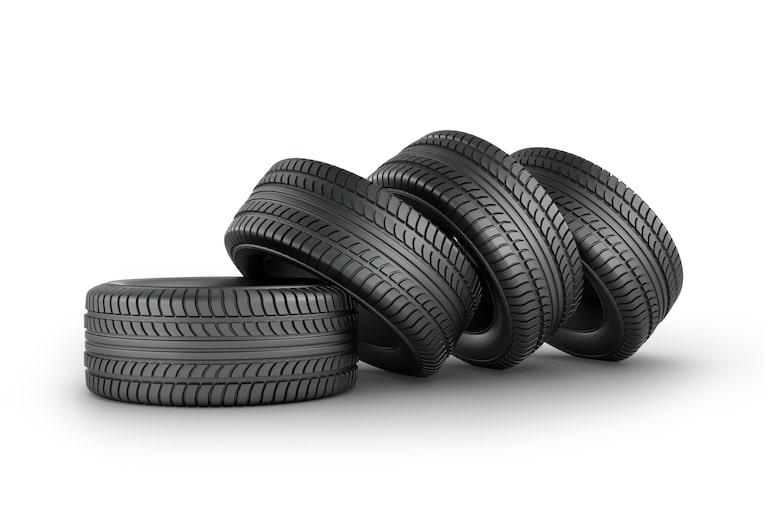
Figuring out how to find tire size is simpler than you might think. All the information you need is printed right on your car—you just need to know where to look. Usually, it's a series of numbers and letters on the tire's sidewall or a sticker inside the driver's door jamb.
This code, which looks something like P215/65R15, is the key to buying the right replacement tires for your vehicle.
Your Quick Guide to Finding the Right Tire Size
Getting new tires shouldn't be a guessing game. Whether you’re planning an upgrade or just dealing with an unexpected flat, knowing your vehicle's exact tire size is the first step to ensuring your safety and your car's performance.
Here’s a quick visual guide to the most common places you'll find this crucial information.
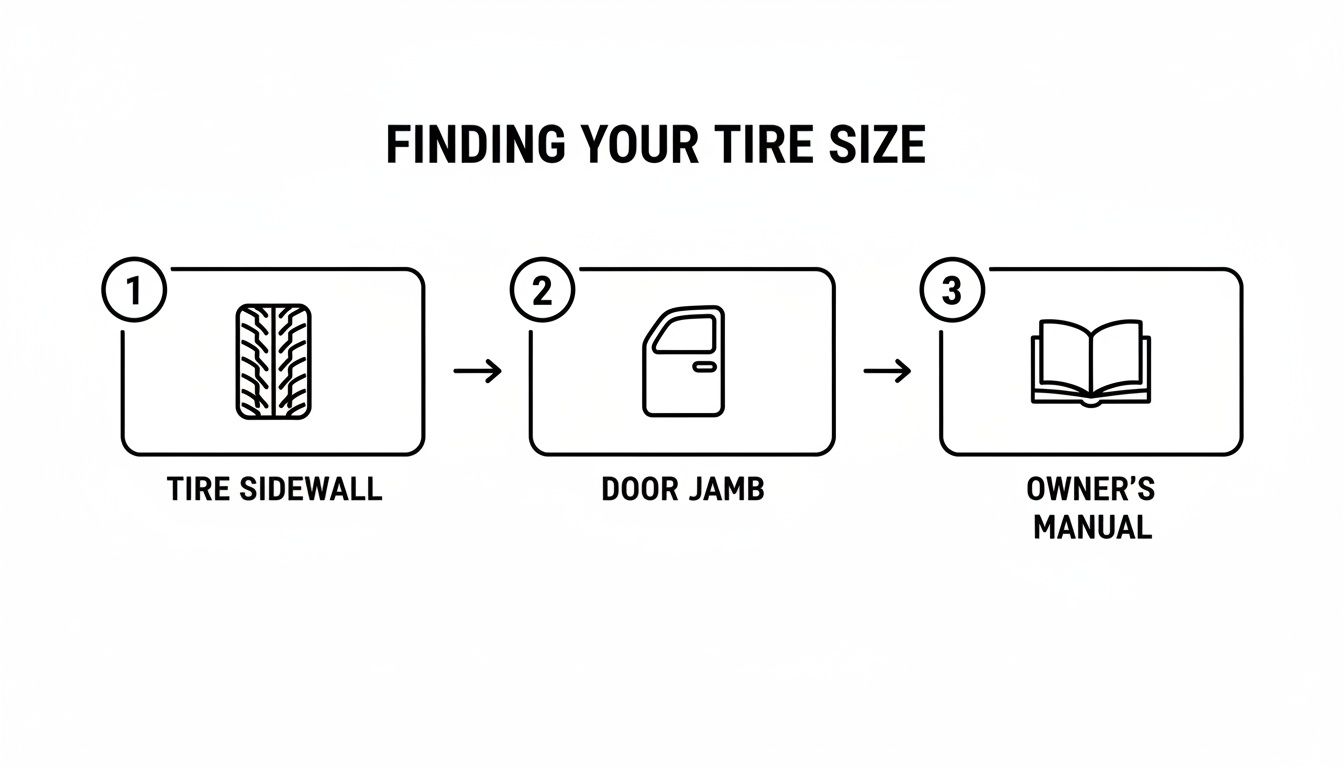
As you can see, your car gives you a few reliable options. If the numbers on the tire are smudged or hard to read, you can always fall back on the door placard or owner's manual.
Decoding the Numbers
One of the most reliable places to find your tire size is right on the tire itself. Every tire has a standardized code—like P215/65R15—that acts as its unique identifier. This code is more than just a model number; it's a blueprint for your tire's specifications.
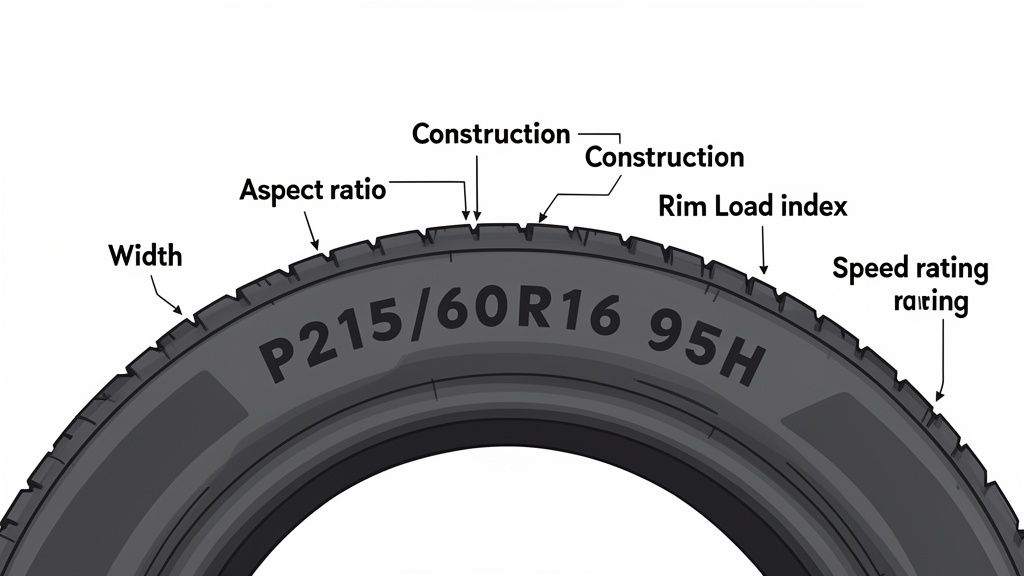
This sequence of letters and numbers tells you everything from the tire's type and width to its construction and rim diameter. It might look like a jumble at first, but each part has a specific meaning.
Let's break down what each part of that code means.
Decoding Your Tire's Sidewall Code
| Code | What It Means | Example |
|---|---|---|
| P | Tire Type: Indicates the vehicle class. "P" stands for Passenger. You might also see "LT" for Light Truck. | P215/65R15 95H |
| 215 | Tire Width: The width of the tire from sidewall to sidewall, measured in millimeters. | P215/65R15 95H |
| 65 | Aspect Ratio: The height of the tire's sidewall as a percentage of its width. | P215/65R15 95H |
| R | Construction: Tells you how the tire was built. "R" stands for Radial, which is the most common type today. | P215/65R15 95H |
| 15 | Rim Diameter: The diameter of the wheel (rim) that the tire is designed to fit, measured in inches. | P215/65R15 95H |
| 95H | Load Index & Speed Rating: The number (95) indicates the maximum weight the tire can support, while the letter (H) is its maximum speed rating. | P215/65R15 95H |
Understanding this code ensures you get a tire that's a perfect match for your vehicle's safety and performance needs.
Using mismatched tires is a serious safety risk. It can even throw off your fuel economy by as much as 5%. For most sedans on the road, the most popular rim sizes are between 16 and 18 inches, making up over 30% of the market.
A common mistake we see is drivers matching the main numbers but ignoring the load index and speed rating at the end. Those last few characters are just as vital for your vehicle's safety and handling.
Once you’ve got your tire size figured out, the next step is usually understanding the cost. If you're curious about what to budget, check out our guide on the average price for new tires.
Reading the Numbers on Your Tire's Sidewall
Ever glanced at the side of your tire and wondered what that jumble of numbers and letters is all about? It’s not just a factory code; it’s the most direct way to find your tire’s exact size and capabilities. Learning to read it is like learning your tire's own language.
That long string of characters tells you everything from the tire's width to its performance limits. One key number is the aspect ratio, which is the number you see right after the slash. This figure has a huge impact on your ride quality and handling. A lower number means a shorter, stiffer sidewall, which gives you a more responsive feel on the road but can throw off your speedometer if you stray too far from what the factory installed.
We often see drivers come in after upgrading their wheels. They pick a tire that fits the new, larger rim but has a different aspect ratio, not realizing it has completely changed how their car handles and made their speedometer inaccurate.
Decoding Load and Speed
After the basic dimensions, you’ll find the load index and speed rating. Honestly, these are the most important numbers for your safety. The load index is a two or three-digit number that tells you the maximum weight each tire can safely carry.
The speed rating is a letter that corresponds to the maximum speed the tire can handle before it's at risk of failing. It’s incredibly dangerous to ignore this, especially on performance vehicles. Putting a tire with a lower speed rating than what your car’s manufacturer recommends can lead to sloppy handling and a much higher chance of a blowout at highway speeds.
While the sidewall is a great place to look, it's not the only spot. Your owner's manual and the sticker on the driver’s side door jamb also have the original equipment manufacturer (OEM) specs. Sticking to the proper size can boost tire longevity by 20-30%, saving you hundreds yearly and reducing the risk of hydroplaning, which increases by 50% on worn, mismatched tires. As the all-weather tire segment grows, matching these specifications becomes even more important for year-round safety. You can find more data on the evolving automotive tire market at Fortune Business Insights.
Using Your Vehicle's Information Placard and Manual
What happens if your tires are covered in mud, or you just picked up a used car and have a sneaking suspicion the previous owner slapped on the wrong size? While checking the tire sidewall is a great start, it's not always the final word.
The absolute gold standard for finding your correct tire size comes directly from the people who built your car. Automakers provide this critical information in a couple of easy-to-find spots, ensuring you always have the original, factory-recommended specs at your fingertips.
Check the Driver's Side Door Jamb
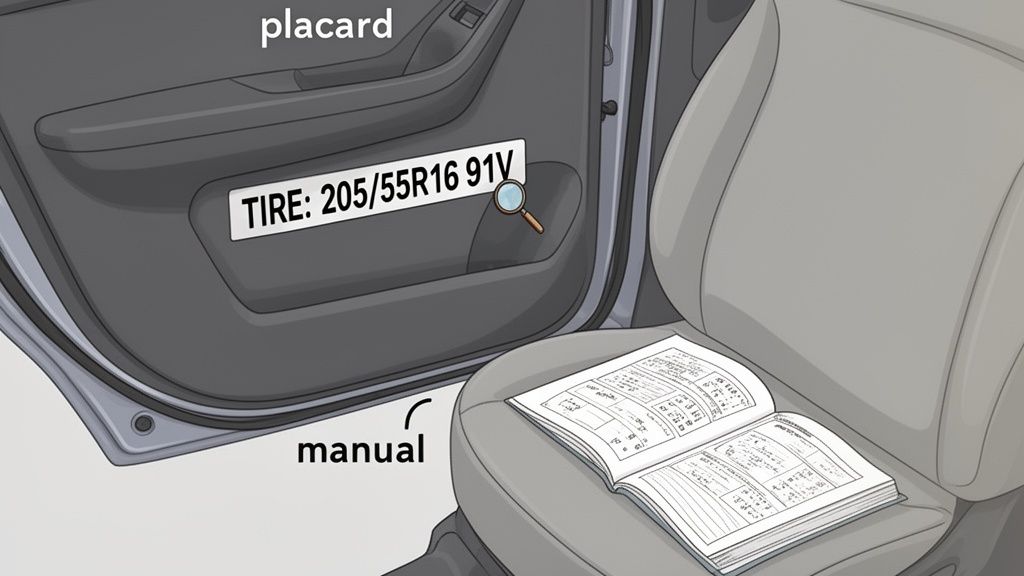
Go ahead and open your driver’s side door and take a look at the frame of the car. You’re looking for a small sticker, often called the vehicle information placard. This little label is packed with information, including the exact tire size recommended by the manufacturer and the proper inflation pressures.
This placard is your best friend when you need to be certain about tire size. Here’s why we always check it:
- Guaranteed Accuracy: It lists the Original Equipment Manufacturer (OEM) specs, straight from the source.
- Safety First: It includes the specific load index and speed rating your vehicle was engineered to handle safely.
- Always There: It’s permanently attached to the vehicle, unlike an owner’s manual that can easily get lost over the years.
This is especially important if you’re managing a fleet of vehicles and need to maintain factory specs for safety and liability. A mismatched tire isn't just a performance problem—it's a genuine safety risk.
Using the placard is the most foolproof method. It removes all the guesswork and ensures the tires you buy are a perfect match for your car's suspension, braking system, and even the speedometer calibration.
Consult the Owner's Manual
If the door placard is missing, damaged, or just too faded to read, your next stop should be the owner's manual. It’s usually tucked away in the glove compartment and has a dedicated section for wheels and tires.
Inside, you'll find the same OEM tire information. The manual might even offer extra details, like specs for alternative or optional sizes that were available for your trim level. For instance, some cars have different tire sizes for the front and rear axles—the manual will spell this out clearly, whereas a single tire’s sidewall won't.
When in doubt, always default to the manufacturer's guidance to guarantee the best performance and, more importantly, your safety on the road.
Finding Tire Size with Your VIN
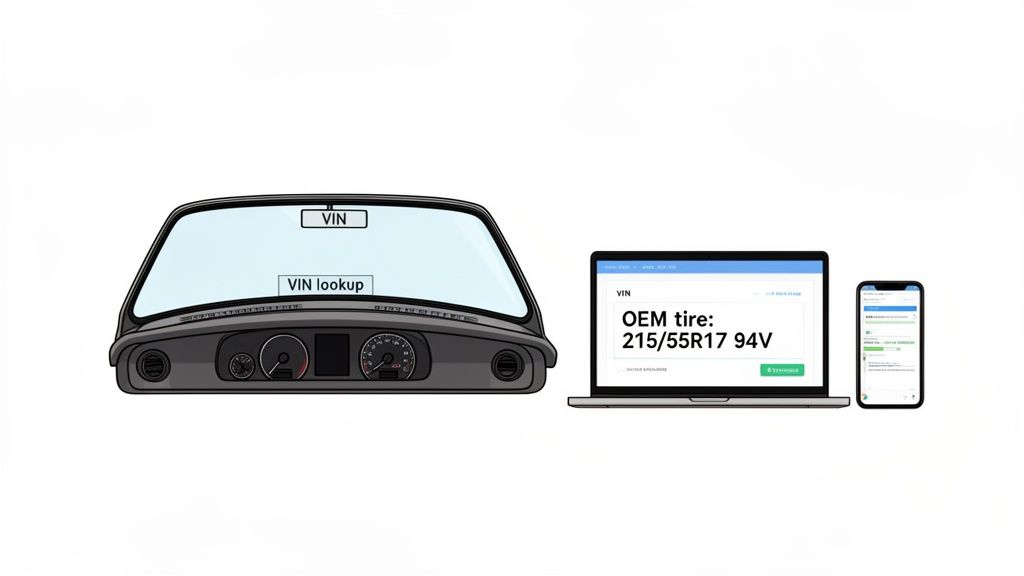
What if the owner's manual is long gone and the door sticker is scratched, faded, or just plain unreadable? Don't worry, you don't have to start guessing. There’s a foolproof digital method using your car's Vehicle Identification Number (VIN).
Think of your VIN as your vehicle’s unique fingerprint. This 17-character code holds all the original factory specs. You can usually find it in a few spots:
- On the driver's side of the dashboard, right where it meets the windshield.
- Printed on your vehicle registration or title.
- Often listed on your car insurance card.
Using Online VIN Decoders
Once you've jotted down the VIN, a quick search online will bring up several free VIN decoder tools. Just pop in the number, and the tool will pull up a detailed report of your vehicle's original specs, including the exact Original Equipment Manufacturer (OEM) tire size.
This is an absolute lifesaver, especially if you bought your car used. It lets you instantly check if the tires currently on the car are the right size or if a previous owner swapped them for something different. It’s a fast, accurate way to get the information straight from the source.
Getting the size right is more important than most people think. With replacement tires making up a massive 78% of the global market, mistakes are bound to happen. In fact, improper tire sizing is a contributing factor in about 13% of all blowouts. Using a VIN lookup can slash these errors by over 90%, ensuring you get a perfect match. You can see more on how the industry depends on these specs in this video analysis.
At professional shops like Kwik Kar, we use VIN lookups daily. It’s the most reliable way to guarantee that every replacement part, especially tires, is a perfect match for the specific make, model, and trim of your vehicle.
When to Get Professional Help with Your Tires
Knowing your way around a tire sidewall is a fantastic skill for any driver. But even the most hands-on car owner knows there are times when calling in a pro isn't just a convenience—it's critical for your safety.
Sure, a straightforward tire swap might feel manageable. However, certain situations pop up that need a technician's trained eye and specialized tools.
A common one we see is plus-sizing, which is when a driver wants to upgrade to a bigger set of wheels for a custom look. It seems simple enough, but getting it wrong can cause some serious headaches and safety issues. You need to pick a new tire that keeps the overall diameter correct, and the math has to be perfect.
Here’s what can go wrong:
- Tire Rub: A miscalculation can cause your new, larger tires to rub against the fender or suspension parts, especially during turns or over bumps.
- Electronic Glitches: Your speedometer and odometer readings can get thrown off, and it can even interfere with crucial safety systems like traction control or ABS.
- Poor Handling: The vehicle might not corner, brake, or respond the way its engineers designed it to, creating an unsafe driving experience.
An experienced technician can run the calculations needed to match a new tire to your bigger wheels without messing with your car's safety and performance.
When Wear Patterns Tell a Story
Sometimes, your tires are trying to send you a message about a bigger problem with your vehicle. If you see strange wear patterns—like the inside or outside shoulder wearing out much faster than the rest of the tread—it’s a major red flag. This isn't just a tire issue; it's a symptom that ASE-certified technicians are trained to diagnose.
Uneven wear often points directly to a bad wheel alignment or failing suspension parts. Simply replacing the tires without addressing the root cause means you'll just wear out your brand-new set prematurely.
A professional can find the real problem, whether it's poor alignment, worn shocks, or another mechanical issue. For example, a small bubble on a tire might seem like a minor blemish, but a pro knows it's a sign of internal damage and a serious blowout risk. You can read our guide to understand more about the dangers of a bubble on your tire.
Whether you’re a new driver or just trying to keep your car running right, trusting a professional shop like Kwik Kar gives you peace of mind that your vehicle is safe and ready for the road.
Common Questions About Finding Tire Size
Even with a guide in hand, it’s only natural for a few questions to pop up. We hear them all the time from customers trying to get the hang of finding their tire size. We’ve put together some answers to the most common ones we get, so you can feel confident you’re getting it right.
Can I Use a Different Size Tire on My Car?
This is a big one, especially from drivers wanting to change up their car’s performance or look. While you can sometimes use a different size, it's a very tricky process known as "plus-sizing" or "minus-sizing." This isn't just about finding a tire that fits the wheel; it involves precise calculations to make sure the new tire's overall diameter is identical to the original.
Get this wrong, and you can throw off your speedometer, mess with your anti-lock braking system (ABS), and even cause dangerous rubbing against the car’s body or suspension parts. It's always best to stick to the manufacturer's recommended size unless you’re working directly with a professional technician.
A common mistake we see is when someone buys a tire that fits their cool new wheels but has a different overall diameter. This one change can seriously impact your car's handling and throw its electronic safety systems for a loop.
Do Front and Rear Tires Always Have the Same Size?
For the vast majority of passenger cars, the answer is yes. All four tires are the same size, which makes tire rotations simple and helps all four tires wear down evenly. You can dive deeper into how good maintenance practices make a difference in our article on how long car tires should last.
However, you’ll find exceptions with some performance cars and certain SUVs. These vehicles often use a staggered fitment, which means the rear tires are wider than the front ones. This setup is specifically designed to boost traction and handling. If your car has a staggered setup, your owner’s manual or door placard will clearly list the different sizes needed for the front and rear.
What if I Can't Find the Tire Placard?
That vehicle information sticker in your door jamb is pretty durable, but over years of use, it can get scraped, damaged, or even removed. If yours is missing or you just can’t read it, don’t panic. You have a few other excellent ways to find the correct tire size:
- Check the Owner's Manual: The glove compartment is your next best bet. The manual is a treasure trove of your car's original factory specifications.
- Use Your VIN: As we mentioned earlier, your car's VIN is a powerful tool. Online decoders can instantly pull up your vehicle's factory specs.
- Consult a Professional: A quick call or visit to a trusted auto shop is a guaranteed way to get the right information, no guesswork required.
Getting the tire size right is absolutely crucial for your vehicle's safety and performance. If you're ever feeling unsure or just want a professional second opinion, the ASE-certified technicians at Kwik Kar Oil Change and Auto Care are always here to help. Stop by our shop in Richardson for expert advice and service you can count on. Learn more at https://www.kkrichardson.com.