If you’re active duty, a veteran, or a reservist, military car inspection requirements explained clearly can save you from fines, registration loss, or a failed return-state inspection. The rules governing vehicle inspections for military personnel are not simply a copy of civilian standards. They vary by state, overseas assignment, and whether you own a privately registered car or a surplus military vehicle. This guide cuts through the confusion, covering state waivers, overseas base inspection procedures, surplus vehicle compliance standards, and the practical steps you need to stay legal on every road you drive.
Table of Contents
- Key takeaways
- Military car inspection requirements explained: civilian vs. military rules
- Inspecting surplus military vehicles for street use
- Overseas military vehicle inspections and what they mean stateside
- Practical steps to stay compliant and avoid inspection failures
- Our take on what military personnel actually get wrong
- Get inspection-ready with Kwik Kar Oil Change & Auto Care
- FAQ
Key takeaways
| Point | Details |
|---|---|
| State waivers exist but require paperwork | Military members must proactively file forms like Missouri’s Form 768 before registration expires to qualify for an extension. |
| Overseas inspections follow base rules | Installations like USAG Bavaria run their own vehicle inspection stations that operate independently from state DMV processes. |
| Surplus vehicles face the toughest scrutiny | Missing DOT-compliant lights and improper tires are the top reasons surplus military vehicles fail civilian inspections. |
| PMCS is not the same as a civilian inspection | Military Preventive Maintenance Checks and Services focus on operational readiness, not the street-legal standards state inspectors check. |
| Early action prevents costly delays | Filing waivers late or skipping pre-inspection maintenance can result in lost registration and base access complications. |
Military car inspection requirements explained: civilian vs. military rules
Most service members discover the hard way that civilian inspection rules do not automatically transfer when you are stationed out of state or overseas. Each state sets its own safety and emissions standards, and military personnel often fall into a gray zone where their registration state’s rules still apply even when they physically cannot be there.
The good news is that many states recognize this conflict and offer formal waivers or extensions. Missouri grants safety inspection extensions to military members stationed out of state, provided you file a notarized General Affidavit using Form 768 before your registration expires. Miss that deadline and the extension disappears. Upon returning to Missouri, you have 10 days to get the inspection completed.
Maryland takes a slightly different approach. The state provides a two-year Uniformed Service waiver that stays valid as long as you remain stationed outside the state. It is renewable, which gives long-term out-of-state personnel a clear, low-friction path to maintaining compliance without the annual inspection scramble.
The critical difference between civilian and military processes is this: civilians walk into an inspection station on their schedule, while military members must generate paperwork, file on time, and track renewal windows regardless of where they are deployed. The table below shows how a few common states handle military inspection waivers.
| State | Waiver Type | Duration | Key Requirement |
|---|---|---|---|
| Missouri | Safety inspection extension | Until return | Notarized Form 768 filed before expiration |
| Maryland | Uniformed Service waiver | 2 years, renewable | Must remain stationed out of state |
| Texas | Registration renewal by mail | 1 year | Copy of military orders required |
| Montana | No state safety inspection | N/A | Registration only; no inspection required |
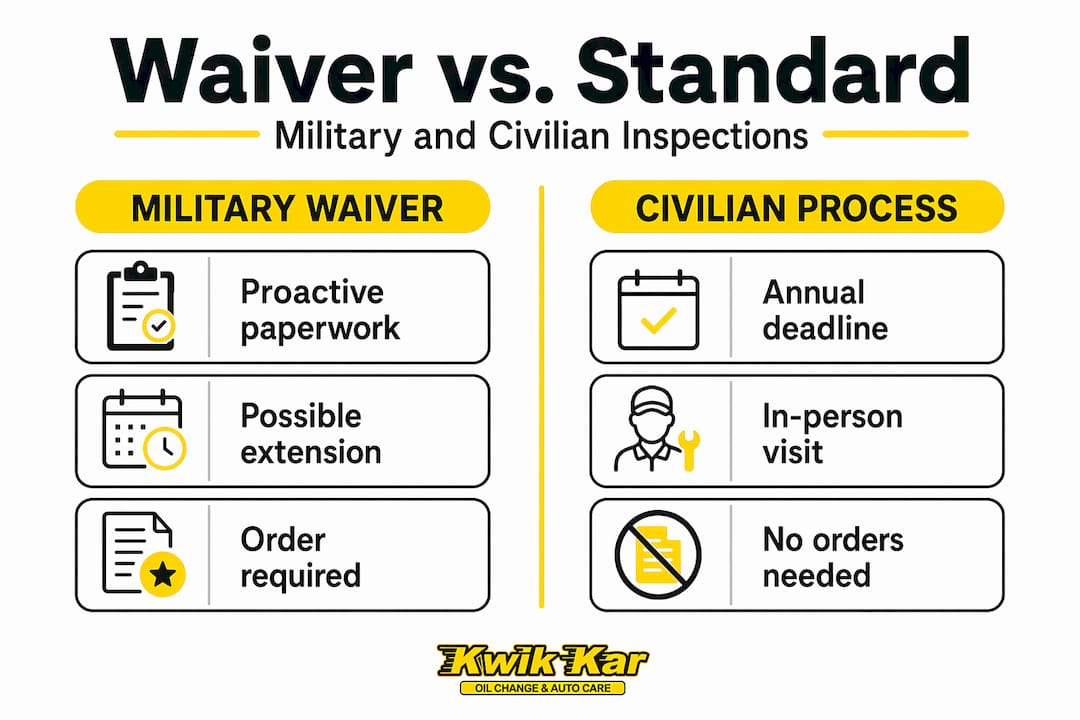
Pro Tip: File your waiver application the same week you receive PCS orders. Waiting until registration renewal notices arrive almost guarantees you will miss the filing window.
Inspecting surplus military vehicles for street use
Owning a surplus military vehicle is a point of pride for many veterans and collectors. Getting it road legal is a different matter entirely. Military surplus vehicles were designed for operational missions, not DOT compliance, and state inspectors treat them accordingly.
The standard civilian inspection checks items that were never a design priority for military equipment:
- DOT-compliant headlights, taillights, turn signals, and brake lights
- DOT-marked tires (military-spec tires manufactured after 1990 are often acceptable, but pre-1990 tires typically fail)
- Working speedometer calibrated to standard miles per hour
- Functional mirrors meeting state minimum size and placement standards
- Brake system performance meeting civilian stopping distance requirements
Missing or non-functional lighting and improper tires are the most common reasons surplus military vehicles fail their first civilian inspection. A lot of these vehicles come off surplus lots with cracked lenses, blackout-mode lighting only, or run-flat tires that do not carry a DOT stamp.
State standards vary dramatically. California and New York require rigorous safety inspections for surplus vehicles, while Montana requires no safety inspection for registration at all. This gap is why many surplus military vehicle owners strategically choose their registration state. It is not a loophole so much as a legal recognition that these vehicles occupy a unique category.
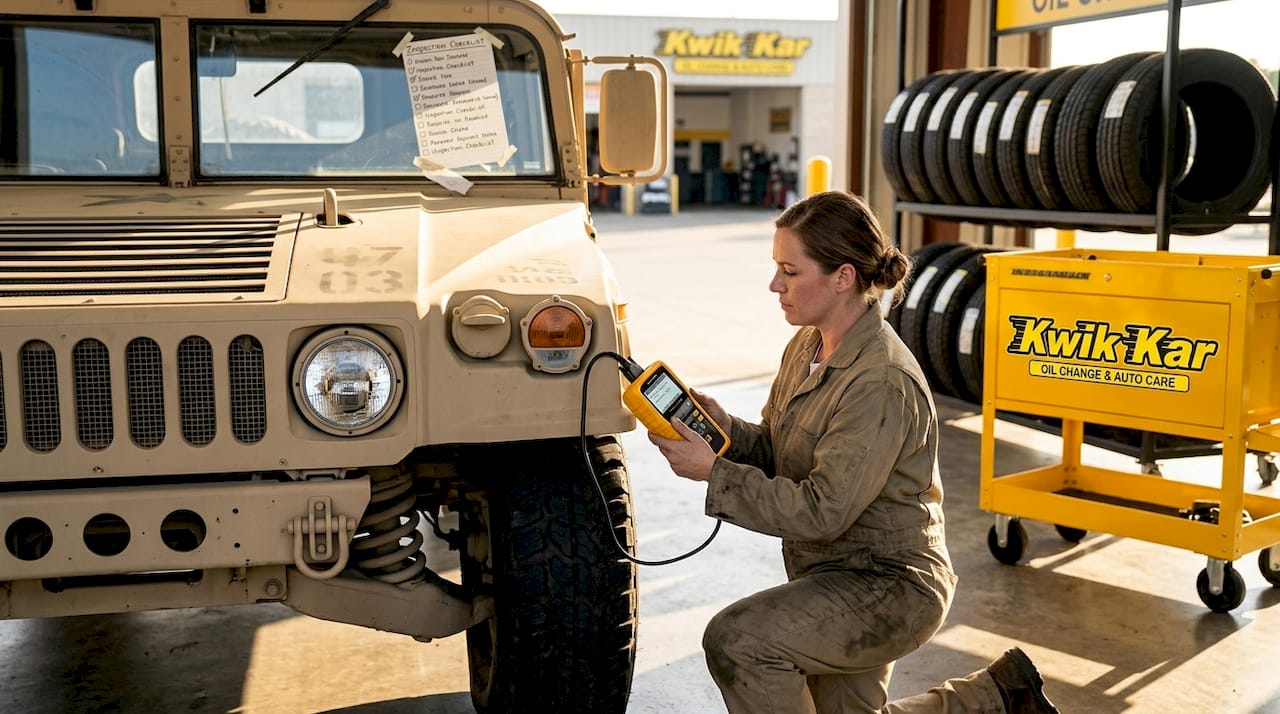
The distinction between military PMCS (Preventive Maintenance Checks and Services) and a civilian inspection is significant. Military PMCS uses DA Form 2404 and DA Form 5988E to document operational readiness, fault classification, and equipment condition. That system is mission-focused. A state inspector does not care whether your HMMWV can ford a 60-inch water obstacle. They care whether your brake lights work.
Pro Tip: Before bringing a surplus vehicle in for a civilian inspection, photograph every modification you have made and keep receipts for lighting upgrades, tire replacements, and mirror installations. That paper trail protects you if a pass or fail decision is disputed.
Overseas military vehicle inspections and what they mean stateside
Being stationed overseas adds a full layer of complexity to vehicle compliance that most stateside drivers never encounter. Military installations abroad maintain their own vehicle inspection stations governed by base operational policies and, in some cases, status of forces agreements with host nations.
At installations like USAG Bavaria, the 405th AFSB Vehicle Inspection Station handles registration eligibility directly. The process differs from anything a civilian DMV runs. Here is how the overseas inspection cycle typically works for a service member with a privately owned vehicle (POV):
- Register your vehicle at the installation’s vehicle registration office upon arrival, providing proof of insurance, valid stateside registration, and your military orders.
- Complete a local base inspection at the installation’s designated station. This inspection checks for compliance with both base safety standards and any host nation requirements.
- Obtain temporary plates if your stateside registration has lapsed or cannot be renewed while overseas. Permanent plates require full inspection clearance.
- Track renewal windows carefully. Failure to inspect on time can result in plates being surrendered before a PCS or ETS move, leaving you without a vehicle until stateside registration is restored.
- Plan your return by contacting your home state’s DMV before you redeploy. Many states require an inspection within a set window after your return date, and some will credit the overseas inspection period toward a waiver.
Veterans returning stateside after an overseas post often discover their registration has lapsed while their vehicle sat in storage or was shipped back. Coordinating with a military registration assistance service before redeployment can prevent gaps in coverage that trigger penalties at the port of entry or the DMV window.
Practical steps to stay compliant and avoid inspection failures
Staying ahead of military vehicle inspection requirements means treating compliance like a maintenance schedule rather than a one-time event. The vehicle inspection checklist approach works here because the most common failure points are almost always preventable with routine attention.
Documentation you should always have ready
Gather these before any inspection appointment or waiver filing:
- A copy of your current military orders showing duty station location
- Your home state vehicle registration and any prior waiver approvals
- Proof of current auto insurance meeting your home state’s minimums
- Receipts and photos documenting any safety modifications to a surplus vehicle
- DA forms or maintenance logs if an inspector requests evidence of recent service
Do’s and don’ts for military vehicle compliance
Do:
- File state waivers and extensions proactively, before deadlines, not after
- Check your routine car maintenance schedule against civilian inspection criteria, not just PMCS standards
- Verify DOT markings on tires before any inspection, especially on surplus vehicles
- Contact your home state DMV at least 30 days before your scheduled return to confirm current inspection requirements
Don’t:
- Assume that passing a military PMCS automatically means your vehicle will pass a civilian state inspection. Military readiness standards are mission-focused, not street-legal focused.
- Let your home state registration lapse while overseas without filing the appropriate waiver. Penalties accumulate even when you are not physically in the state.
- Bring a surplus vehicle to an inspection without upgrading lighting, mirrors, and tires first. Walk-in failures on these items waste time and inspection fees.
- Ignore emissions requirements. Some waivers cover safety inspections but not emissions, so confirm exactly which tests are waived by your home state.
Our take on what military personnel actually get wrong
I’ve worked with military vehicle owners long enough to know that the biggest mistakes don’t come from negligence. They come from confidence. Service members who have navigated complex deployment logistics often underestimate how poorly organized the civilian inspection system is by comparison. The military gives you a clear manual for every procedure. State DMVs give you a website that varies by county.
What I’ve learned from the vehicles that come through our shop is that PMCS-maintained vehicles are usually in genuinely good mechanical shape. The problem is the translation gap between operational readiness and street-legal compliance. A vehicle that can handle a field exercise may still be running tires that won’t pass a DOT visual check or headlights that weren’t designed for civilian road use.
The overseas reintegration situation is where I’ve seen the most avoidable problems. Personnel come back stateside expecting their vehicle to clear registration smoothly, not realizing their home state’s inspection clock never paused. Starting that conversation with your home state DMV three to four weeks before redeployment is not bureaucratic overkill. It is the single step that prevents a parking lot full of problems from greeting you when you land.
My honest advice: treat your personal vehicle’s civilian inspection compliance as a separate system from everything the military has taught you about maintenance. Both matter. They just measure different things.
— Kwik Kar
Get inspection-ready with Kwik Kar Oil Change & Auto Care
Whether you’re preparing for a Texas state inspection, catching up after a PCS move, or getting a surplus vehicle road-legal for the first time, Kwik Kar Oil Change & Auto Care in Richardson, TX has the expertise to get you across the finish line.
Our ASE-certified technicians know exactly where civilian inspections catch vehicles off guard: brakes, lighting, tires, and emissions. We offer transparent pricing, no-surprise diagnostics, and a military discount because the people who serve this country deserve a shop that respects their time and their budget. From brake repair to full vehicle diagnostics, our team handles the common failure points before they become failed inspections. Book your appointment at Kwik Kar’s auto repair services and arrive at your inspection with confidence.
FAQ
What waivers are available for military car inspections?
Many states offer inspection extensions or waivers for military members stationed out of state. Missouri requires a notarized Form 768 filed before registration expires, while Maryland provides a two-year renewable waiver for Uniformed Service members stationed outside the state.
Does passing a military PMCS mean my car will pass a civilian inspection?
No. Military PMCS evaluates operational readiness using DA Form 2404 and DA Form 5988E, which focus on mission capability rather than civilian street-legal standards. A civilian state inspection checks lighting, tires, brakes, and emissions compliance that PMCS does not prioritize.
How do vehicle inspections work for military members stationed overseas?
Overseas installations like USAG Bavaria operate their own inspection stations separate from state DMV processes. Vehicles must pass a local base inspection to obtain registration and plates, and failing to comply on time can result in plates being surrendered before a PCS or ETS move.
What are the most common reasons surplus military vehicles fail inspections?
Missing or non-functional DOT-compliant lighting and tires without DOT markings are the leading causes of inspection failure for surplus military vehicles. Upgrading these items before your inspection appointment prevents the most predictable and avoidable failures.
Do I need a civilian inspection when I return stateside from overseas?
Yes, in most cases. Your home state’s inspection timeline typically does not pause during an overseas assignment unless you have filed an active waiver. Contact your state DMV at least 30 days before your return date to confirm what inspection is required and how quickly it must be completed.