P0171 Code: 5 Minute Checks, Read Fuel Trims, When to Call a Pro
The P0171 code means your engine control module has detected too much air, or too little fuel, in the bank 1 cylinder bank’s air-fuel mixture. It is not an emergency in most cases, but it deserves attention within days, not months. Start with a five-minute visual check of the intake hoses and the mass airflow sensor before you assume the worst.
TL;DR:
- Vacuum leaks and unmetered intake air are the most common causes of P0171, often costing under $150 to fix.
- Dirty or faulty MAF sensors are frequent contributors, with cleaning often enough to resolve the code at minimal expense.
- Fuel delivery issues or a bad upstream O2 sensor can also trigger P0171, but these are usually less common and more costly to repair.
- DIY checks such as inspecting vacuum hoses and cleaning the MAF sensor can identify simple problems before costly repairs.
- Professional diagnostics, including smoke tests and live fuel-trim analysis, reliably pinpoint the root cause, saving money on unnecessary part replacements.
Table of Contents
- What the P0171 Code Actually Indicates
- Symptoms That Point to a Lean Condition
- The Most Common Causes, Ranked by Frequency
- The Diagnostic Flow a Technician Actually Follows
- DIY Checks and Low-Cost Fixes Worth Trying First
- When a Shop Visit Makes More Sense
- Why Clearing the Code Won’t Get You Through Inspection
- How Kwik Kar Oil Change & Auto Care Handles a P0171 Diagnosis
- Your Next Move Depends on the Symptoms
- What the Conventional Advice Gets Wrong About P0171
- Get an Accurate P0171 Diagnosis Without the Guesswork
- Sources
- FAQ
What the P0171 Code Actually Indicates
Bank 1 refers to the cylinder bank that houses the number one spark plug. On a straight four or six-cylinder engine, that means the whole engine; on a V6 or V8, it is one side of the block, while bank 2 is monitored separately. The upstream oxygen sensor on that bank reads the exhaust and reports back to the powertrain control module in real time. When the mixture runs leaner than the target, the PCM first nudges short-term fuel trim (STFT) to add fuel. If that correction has to stay high for too long, it gets written into long-term fuel trim (LTFT), which is the number that actually trips the code.
Most vehicles set P0171 once LTFT holds above a positive threshold for a sustained period, though the exact limit varies by manufacturer. A lean reading has only two real explanations worth chasing:
- Extra unmetered air is entering after the mass airflow (MAF) sensor, so the engine burns more air than the computer accounted for.
- Insufficient fuel is reaching the cylinders, so even a normal air charge burns lean.
Everything downstream of that logic is really about finding which of those two problems you have.
Symptoms That Point to a Lean Condition
A lean-running engine rarely hides quietly. The symptoms tend to show up in how the car idles and how it responds when you ask it to accelerate, and they typically worsen with more unmetered air or a bigger fuel shortfall.
- Rough, high, or surging idle, especially right after startup.
- Hesitation or a slight stumble when you press the accelerator.
- Noticeably worse fuel economy over a week or two of normal driving.
- A steady check engine light, sometimes joined by a rotten-egg smell if the catalytic converter is working overtime.
- A flashing check engine light, which signals active misfire and means you should stop driving rather than keep an eye on it.
If your light is flashing, treat that as the one exception to “keep driving carefully.” A steady light with mild symptoms can usually wait for a scheduled repair.
The Most Common Causes, Ranked by Frequency
Shops that see P0171 regularly work through causes in roughly this order, because the frequency data backs it up:
- Vacuum leaks and unmetered intake air. Cracked hoses, a loose intake boot, a bad gasket, or a stuck-open PCV valve let air into the engine after the MAF sensor measures it. This is the single most common cause, and it is usually the cheapest to fix.
- A dirty or failing MAF sensor. Dust, oil residue, or age can throw off the sensor’s airflow reading even when nothing mechanical is actually wrong. Over-oiled aftermarket air filters are a frequent, avoidable culprit here.
- Fuel delivery shortfalls. A clogged fuel filter, a weakening fuel pump, or a bad pressure regulator can all starve the engine of fuel it needs to keep the mixture in range.
- An upstream O2 sensor fault or an exhaust leak ahead of that sensor. Either one feeds the PCM a false lean signal even when the actual mixture is fine.
- Clogged fuel injectors or, less commonly, a failed fuel pressure regulator. These sit at the bottom of the list mostly because they are less common, not because they are minor once they happen.
The common causes documented for P0171 line up with this order almost exactly, which is why vacuum leaks and MAF contamination get checked first in nearly every shop.
The Diagnostic Flow a Technician Actually Follows
Guessing at parts is the most expensive way to fix a P0171 code. A technician-style approach reads the data first and replaces parts second, and it typically follows this sequence:
- Pull live fuel trims at idle and under load. If LTFT improves as RPM climbs, a vacuum leak is the likely culprit, since the fixed-size leak matters less relative to a bigger air charge. If LTFT stays elevated or gets worse under load, suspect fuel delivery or a MAF problem instead.
- Check for a matching P0174 code. When P0171 and its bank 2 counterpart appear together, the shared-cause principle points to one component both banks depend on, most often the MAF sensor, a large intake leak, or a fuel supply issue, rather than two unrelated bank-specific failures.
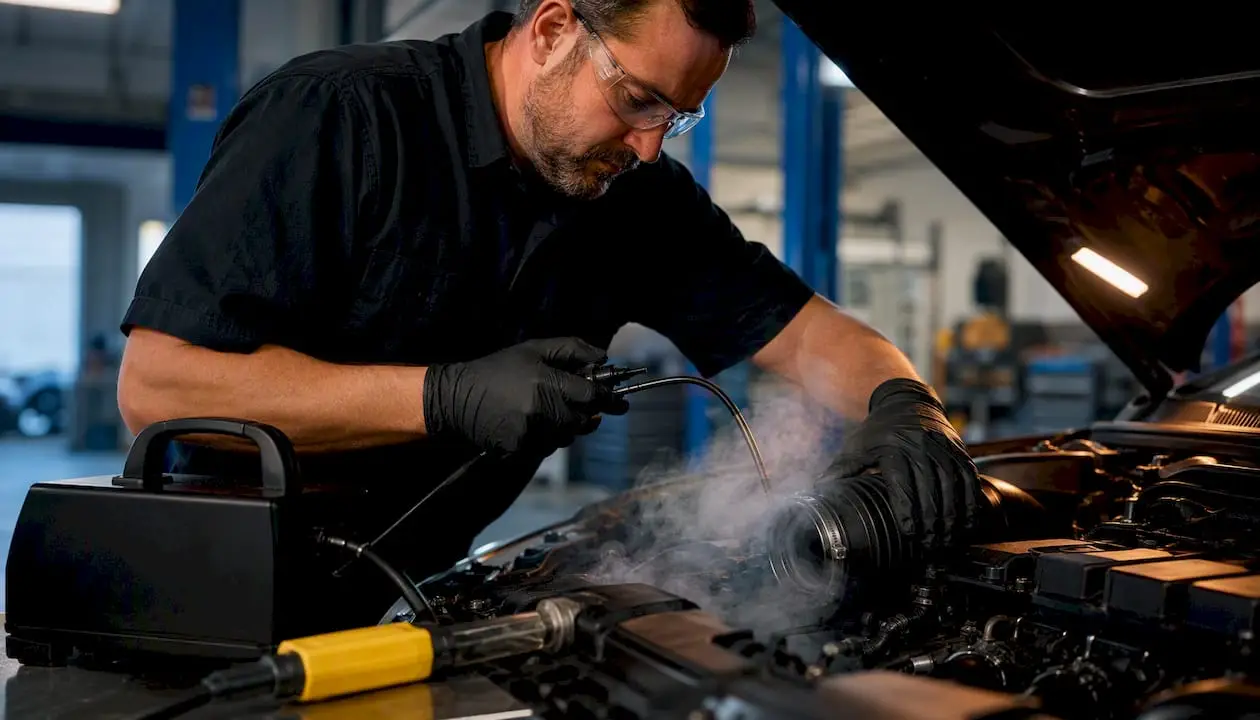
- Run a smoke test on the intake system. A smoke machine pushes visible vapor through the intake tract while the engine is off, and any leak point shows up immediately as smoke escaping a hose, gasket, or boot.
- Clean the MAF sensor and re-check the numbers. Pull the sensor, clean it with a dedicated MAF cleaner, reinstall it carefully, and compare the grams-per-second reading and fuel trims against factory specs before spending money on a replacement.
- Measure fuel pressure under load, not just at idle, since a weak pump or partially clogged filter can hold pressure fine at rest but fall short once demand increases.
- Confirm the O2 sensor waveform on a scope before condemning it. A sensor that looks slow or flat on a live graph is a legitimate replacement candidate; one that looks normal should be left alone.
- Test injectors last, once intake integrity and fuel pressure both check out clean.
This diagnostic progression, from live trims through injector testing, is the difference between one focused repair and three unnecessary ones.
Pro Tip: If your scan tool shows LTFT climbing at idle but settling back toward normal once you rev the engine to 2,500 RPM and hold it, that pattern is a strong signal of a vacuum leak rather than a fuel problem. Fuel-related lean codes tend to get worse, not better, as demand increases.
DIY Checks and Low-Cost Fixes Worth Trying First
Before you book a shop appointment, a handful of checks are safe, cheap, and genuinely useful for a competent DIYer.
- Visually inspect every vacuum hose, the intake boot, and its clamps for cracks, softness, or a loose connection. A flashlight and a slow walk around the intake tract catches most obvious leaks.
- Check the PCV valve. A valve stuck open acts exactly like a vacuum leak and costs under $20 to replace.
- Pull the MAF sensor and clean it with a MAF-specific cleaner, never brake cleaner or a shop rag, then let it air dry fully before reinstalling. Over-oiled aftermarket filters are a known cause of MAF contamination, so switch to a standard paper filter if you suspect that’s the culprit.
- Replace the cheap, likely parts first: a cracked hose, an aging PCV valve, or a dirty air filter, then clear the code and drive several cycles to see whether the trims settle back to normal.
Stop there if the light comes back. Fuel-pressure testing and injector diagnosis require tools and technique that go beyond a driveway repair, and getting a reading wrong can send you chasing the wrong part. If your engine bay looks grimy enough to hide a leak visually, a safe engine bay cleaning makes future hose and gasket inspections faster too.
When a Shop Visit Makes More Sense
If the cheap fixes don’t hold, professional diagnostics usually pay for themselves. A shop’s live-data scan and smoke test typically cost far less than the price of a wrongly guessed part, and they pinpoint the actual fault instead of a probable one.
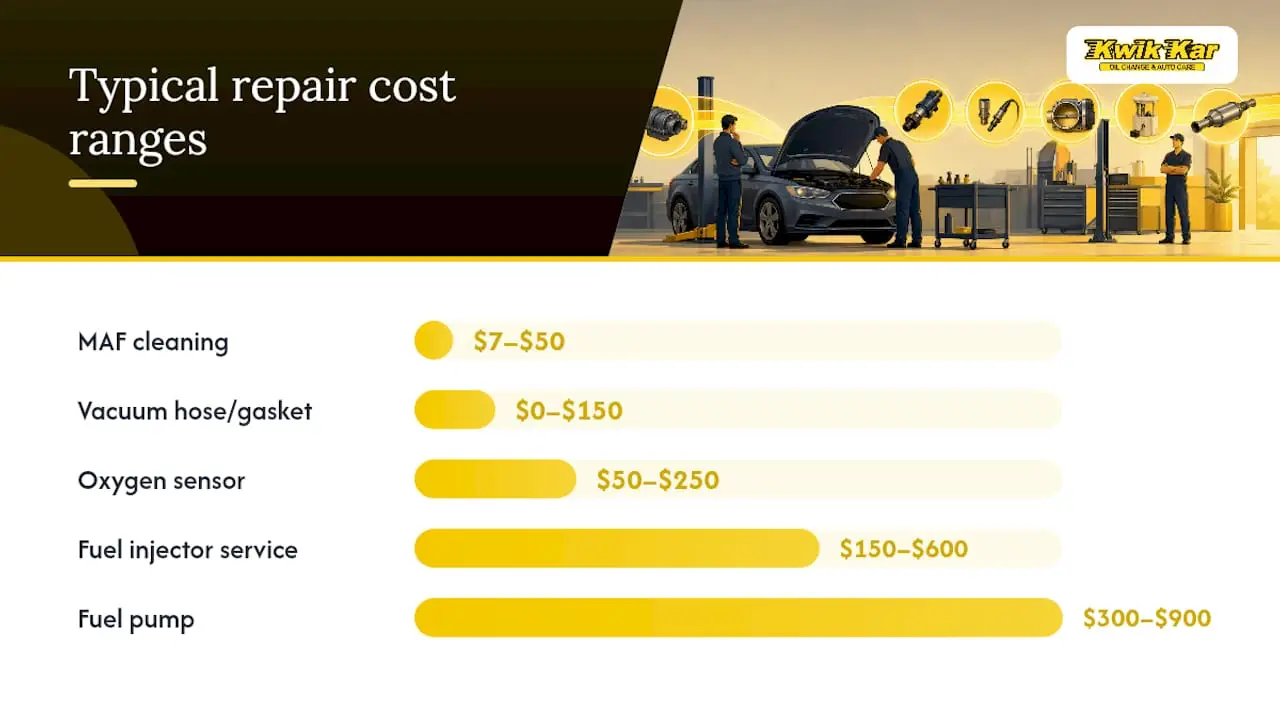
Rough repair cost ranges, based on typical shop pricing, look like this:
- Vacuum hose or intake gasket repair: $0 to $150
- MAF sensor cleaning: $7 to $50, or full replacement around $80 to $350
- Oxygen sensor replacement: $50 to $250
- Fuel pump replacement: $300 to $900
- Fuel injector service: $150 to $600
Bring your OBD-II scan printout, the fuel-trim numbers if you captured them, and a note of what you already tried. That alone can shave real diagnostic time off the visit. If a weak fuel pump or bad injector turns out to be the issue, fuel injector and pump repair and fuel injector testing are worth understanding before you approve the work.
Why Clearing the Code Won’t Get You Through Inspection
An active P0171 code causes an automatic failure on OBD-II emissions tests in the programs that use them. Erasing the code right before your test appointment does not help, because readiness monitors reset to “not ready” when the code clears, and they need completed drive cycles to report back as ready again.
The fix, in order: repair the actual root cause, then either drive the manufacturer-specified cycle or have a shop confirm readiness with a scan tool before you schedule the test. Skipping the verification step is the most common reason people fail an inspection twice for the same repair. A full emissions test prep guide walks through the drive-cycle requirements in more detail.
How Kwik Kar Oil Change & Auto Care Handles a P0171 Diagnosis
Kwik Kar Oil Change & Auto Care’s ASE-certified technicians work the diagnostic flow described above as a matter of routine, not as an upsell tactic. Live fuel-trim analysis, smoke testing, and fuel-pressure measurement under load come standard before any part gets recommended, which is the same dealership-level approach that gets you an accurate answer the first time instead of a parts-swapping bill. Transparent pricing means you see the diagnostic findings before approving repairs, and the shop’s recognition from CARFAX and RepairPal reflects a track record of getting these calls right. Military members and first responders receive dedicated discounts on the repair work itself. If your check engine light is on and you’re not sure whether it’s a $20 hose or a $900 fuel pump, that’s exactly the question a proper diagnostic session answers.
Your Next Move Depends on the Symptoms
Mild idle roughness or slightly worse fuel economy: try the MAF cleaning and hose inspection, clear the code, and drive a few cycles before deciding if it’s fixed. Persistent symptoms after that call for professional diagnostics. A flashing check engine light means stop driving and arrange a tow. Either way, bring your scan printout, the steps you already tried, and any fuel economy notes to speed up the visit.
What the Conventional Advice Gets Wrong About P0171
Most articles on this code treat it as a parts-replacement checklist: try a MAF sensor, then an O2 sensor, then a gasket kit, in whatever order feels intuitive. That approach gets expensive fast, and it is backwards from how anyone who actually fixes these for a living approaches the problem.
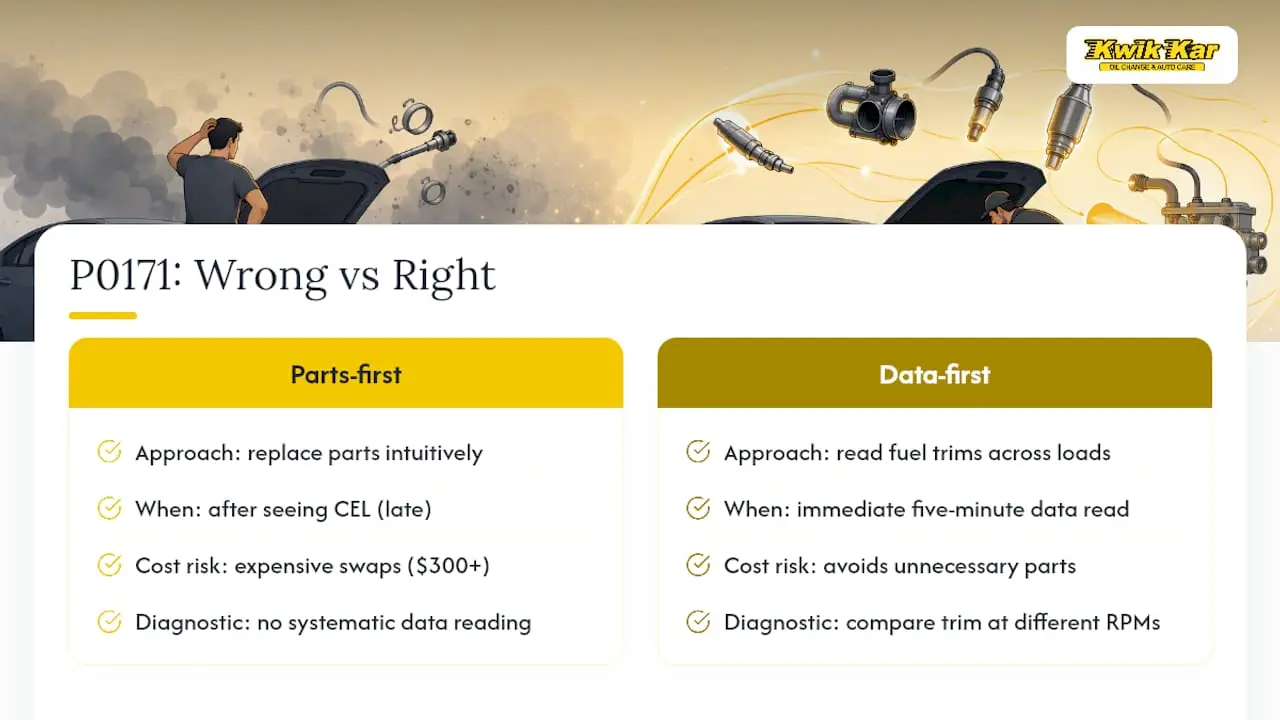
The real skill in diagnosing P0171 is reading fuel trim behavior across different engine loads before touching a single part. A leak that shrinks at higher RPM and one that doesn’t behave completely differently, and that single data point can save a $300 fuel pump swap on a car that just needed a nine-dollar PCV valve. Owners treat the check engine light as a verdict on how serious the problem is; it is really just a starting point for a five-minute data read.
What deserves more attention than it gets: the MAF sensor cleaning step. It’s often skipped because it feels too simple to be the fix, yet a contaminated sensor from an over-oiled filter mimics a genuine mechanical fault almost perfectly, and it costs nothing but a can of cleaner to rule out.
— Kwik Kar
Get an Accurate P0171 Diagnosis Without the Guesswork
Guessing at parts on a lean-code repair usually costs more than the diagnostic itself, since a $50 O2 sensor swap that doesn’t fix anything still leaves you paying a shop again later. Kwik Kar Oil Change & Auto Care runs live fuel-trim analysis, smoke testing, and fuel-pressure checks as the standard first step for any P0171 or P0174 complaint, so you get a specific answer instead of a trial-and-error repair order.

That approach applies whether the cause turns out to be a cracked intake hose, a fuel delivery issue, or something further down the list. The shop’s engine diagnostics service covers exactly this kind of live-data troubleshooting, backed by ASE-certified technicians and transparent pricing you can see before approving any work. If your check engine light has been on for more than a few days, book a diagnostic appointment at Kwik Kar Oil Change & Auto Care and get the fuel trims read properly before you spend money on a guess.
Sources
- OBD-II DTC: P0171 System Too Lean (Bank 1)
- P0171 Code: Causes, Symptoms, and How to Fix — Car Care Total
- P0171 diagnose and clear — iCarsoft Knowledge Hub
- Engine-codes
FAQ
How do I fix the P0171 engine code?
Start by reading live fuel trims and inspecting vacuum hoses and the PCV valve, then clean the MAF sensor and re-check the numbers before considering fuel-pressure testing or O2 sensor replacement.
Can you drive your car with a P0171 code?
You can usually drive short distances if the check engine light is steady and symptoms are mild, but a flashing light means stop driving, since sustained lean combustion can damage pistons, valves, and the catalytic converter over time.
What is the most common cause of the P0171 code?
Vacuum leaks from cracked hoses, loose intake boots, or a stuck PCV valve are the most frequent cause, followed closely by a dirty or contaminated MAF sensor.
How much does it cost to fix code P0171?
Costs vary widely by cause: a hose or gasket repair can run $0 to $150, MAF cleaning or replacement runs $7 to $350, an O2 sensor is typically $50 to $250, and a fuel pump replacement can reach $300 to $900.