$450–$900 per axle: Strut Replacement Cost for Richardson Drivers
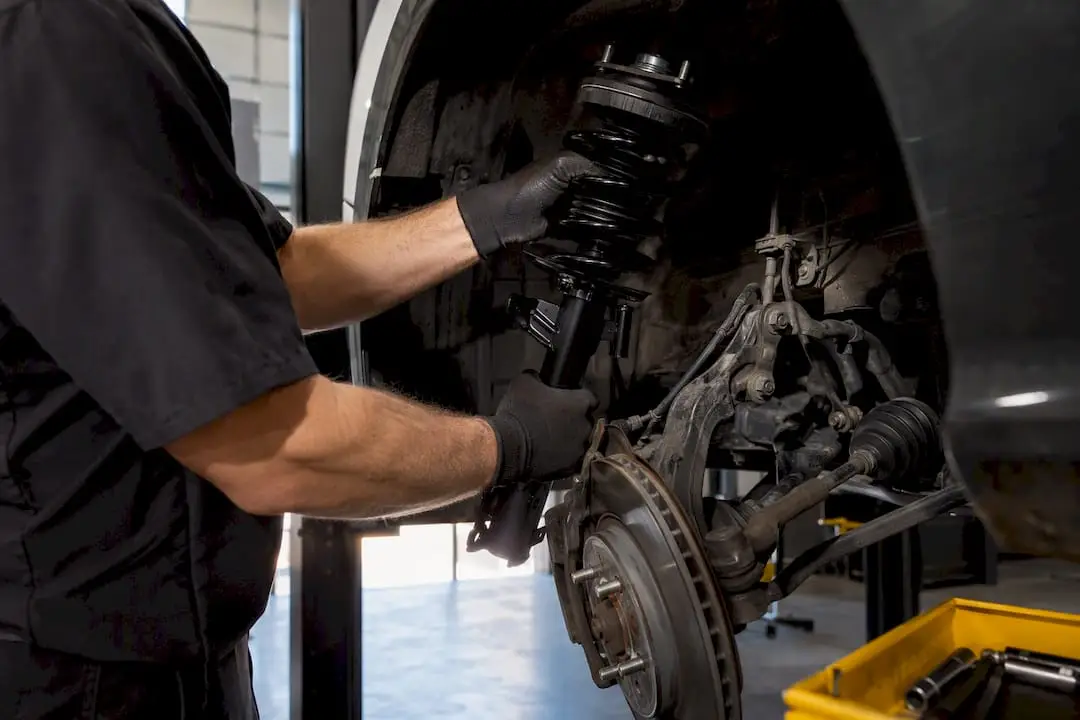
Expect to pay $450 to $900 per axle for strut or shock replacement at a professional shop, or $900 to $1,800 to replace all four corners on a standard vehicle, according to cost data from HonestMechanix. The three biggest swing factors are whether you need a full strut assembly or a simpler shock, how many labor hours the job takes, and whether a wheel alignment is bundled in. Heavy-duty trucks, luxury models, and vehicles with electronic or air suspension push well past those ranges.
TL;DR:
- Replacing a pair of front struts typically costs between $450 and $900, including parts, labor, and alignment, while full vehicle replacement ranges from $900 to $1,800.
- Heavy-duty trucks, luxury vehicles, and models with electronic or air suspension can significantly exceed these ranges due to more complex parts and calibration needs.
- Labor times are about 2 to 3 hours per front axle and 1 to 1.5 hours for rears, with wheel alignment almost always included to prevent uneven tire wear.
- The most expensive parts come from assemblies with air or electronic suspension components, which often require recalibration and specialized parts.
- Always get a detailed, itemized estimate covering OEM or aftermarket parts, labor, alignment, and warranty details before approving repairs.
Table of Contents
- Strut Replacement Cost Breakdown: Parts, Labor, and Alignment
- How Vehicle Type Changes Your Strut Replacement Price
- Shocks vs. Struts: Why One Costs More Than the Other
- Quick-Strut Assembly vs. Individual Strut Replacement
- Replacing Struts in Pairs and Why Alignment Isn’t Optional
- Signs, Inspection, and How Long Struts Actually Last
- DIY vs. Professional Strut Replacement: What It’s Really Worth
- How to Get an Accurate Strut Replacement Estimate
- What We See on the Shop Floor: A Local Perspective
- Book a Strut Inspection at Kwik Kar Richardson
- Where These Cost Figures Come From
- Sources
- FAQ
Strut Replacement Cost Breakdown: Parts, Labor, and Alignment
A strut replacement invoice usually has three line items, and understanding each one tells you whether a quote is fair or padded.
Parts make up the biggest variable. A basic shock absorber runs cheaper than a complete strut assembly, because a strut assembly bundles the strut, coil spring, and mount into one unit. Buying parts alone, expect a rough split like this:
- Shock absorbers (pair): often the lower end of the parts spectrum, since there’s no spring or mount to source.
- Strut assemblies (pair): pricier per corner because you’re buying three components instead of one.
- Mounts and bearings: frequently sold separately if your existing strut assembly doesn’t include them.
Labor is where regional shop rates matter most. Front strut work typically takes about 2 to 3 hours per axle, because the front suspension usually ties into the steering system and demands more disassembly. Rear shocks or struts tend to go faster, often 1 to 1.5 hours, since there’s less steering hardware in the way.
Wheel alignment almost always shows up on the same invoice as strut work, and for good reason: disturbing the suspension geometry changes how your tires meet the road. Shops that skip this step are cutting a corner that costs you tire wear later.
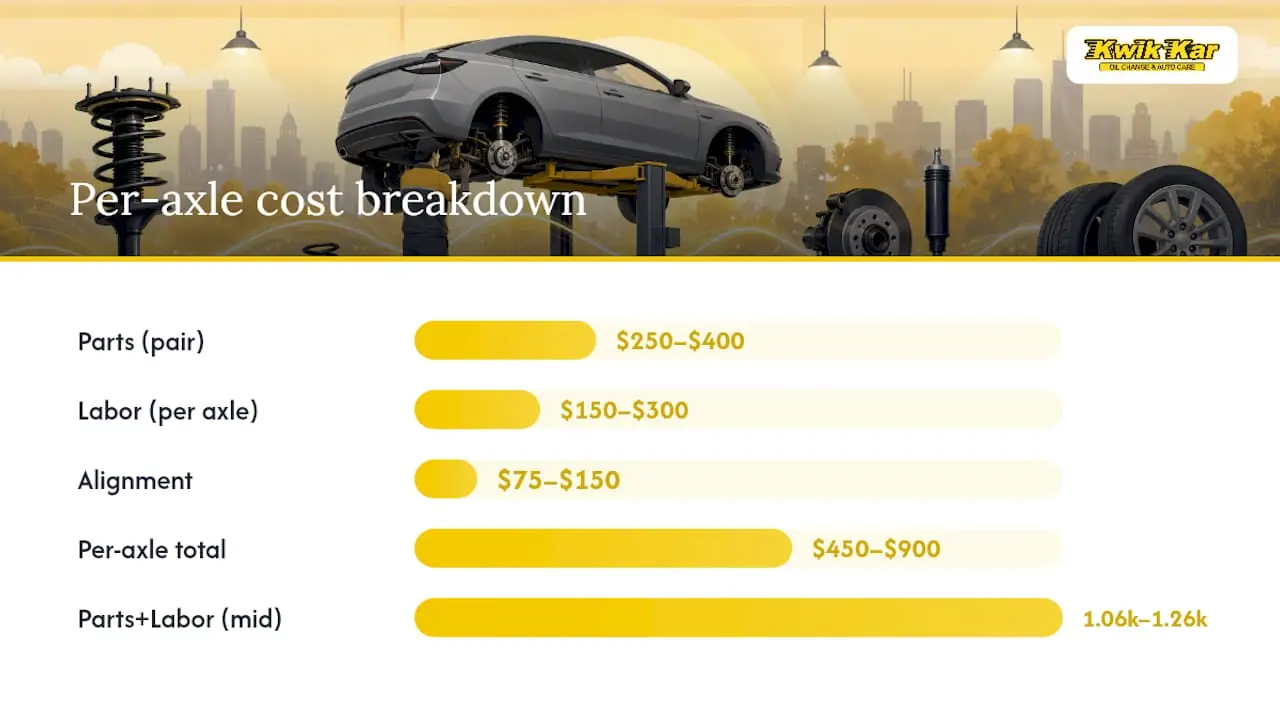
Here’s how those pieces stack into a realistic total. A front-axle strut assembly replacement might run $250 to $400 in parts, $150 to $300 in labor at 2 to 3 hours, and $75 to $150 for the alignment, landing you in that $450 to $900 per-axle window. Do both axles, and you’re looking at the $900 to $1,800 full-vehicle range that national estimators consistently report, with a common midpoint estimate around $1,057 to $1,260 for parts and labor combined.
How Vehicle Type Changes Your Strut Replacement Price
Your car’s class and suspension design move the price more than almost anything else.
- Economy and compact cars sit at the low end. Simpler suspension geometry and widely available aftermarket parts keep both parts and labor costs modest.
- Mid-size sedans and SUVs land in the middle of the range, often because SUVs carry heavier struts rated for more load, plus slightly longer labor times.
- Trucks frequently need heavier-duty strut assemblies built to handle towing or cargo weight, which raises the parts cost even before labor gets factored in.
- Luxury, performance, and electronic or air-suspension vehicles can push a single axle well above the standard range. Air struts and electronically controlled dampers cost significantly more than a conventional strut, and some require specialized calibration after installation.
A single rear axle on an air-suspension SUV can approach what a full four-corner job costs on an economy car, purely because of part complexity and the extra diagnostic or calibration labor. If your vehicle has adjustable ride-height or electronic damping, ask your shop directly whether the estimate includes recalibration, not just physical replacement.
Shocks vs. Struts: Why One Costs More Than the Other
Shocks and struts do a related job, but they’re not interchangeable, and that distinction drives a real price difference.
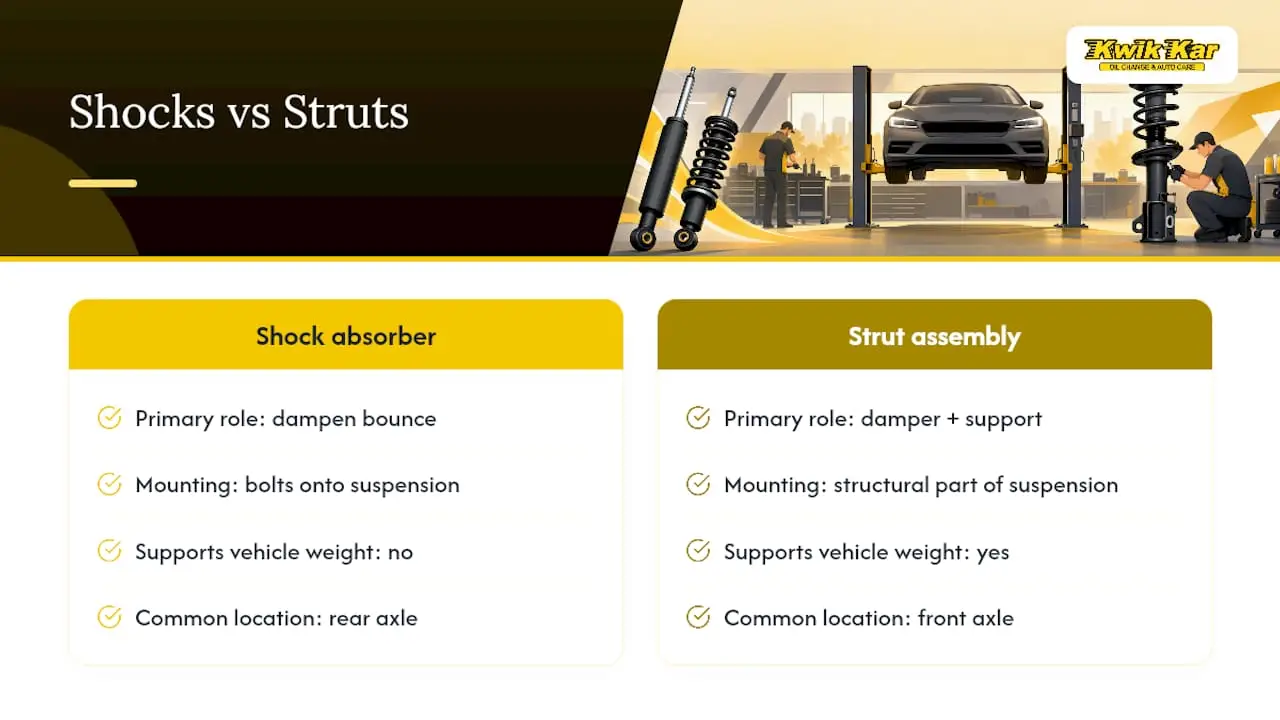
A shock absorber’s only role is to dampen bounce. It bolts onto a suspension system that already has a separate spring and mount holding the wheel in place, which is why many rear suspensions use shocks. A strut, by contrast, is a structural part of the suspension itself. It doesn’t just dampen movement, it also supports the vehicle’s weight and often integrates with the steering knuckle. That’s why struts are common on the front axle of most passenger cars.
Because a strut assembly bundles the damper, coil spring, and mount into one part, replacing it involves buying and installing more hardware than a shock swap. That’s the core reason strut replacement typically costs more than shock replacement, corner for corner.
A technician determines which one your vehicle actually needs during inspection, since guessing wrong means either an unnecessary expense or an incomplete repair. If your car uses shocks in the rear and struts in the front, don’t be surprised if your invoice shows two different part categories and two different price points.
Quick-Strut Assembly vs. Individual Strut Replacement
A “quick strut” is a pre-assembled unit: strut, spring, and mount, all compressed and ready to bolt in. The alternative is buying just the strut and having a technician transfer your existing spring and mount onto it, sometimes called a rebuild.
Quick-strut assemblies cost more upfront in parts, but they cut labor time significantly because the shop skips the spring-compression step entirely. Shop guidance generally favors quick struts for most passenger vehicle repairs, since the labor savings often offset the higher parts price, and there’s less risk of reusing a worn mount or bearing that should have been replaced anyway.
Rebuilding an individual strut can save money on vehicles where quick-strut assemblies are hard to source or unusually expensive, but it depends on your existing spring and mount being in good condition. If a shop recommends a rebuild to save cash, ask whether your current mount has been inspected, not just reused by default.
Replacing Struts in Pairs and Why Alignment Isn’t Optional
Shops routinely recommend replacing both struts on an axle at the same time, even if only one has failed. A worn strut on one side and a fresh one on the other creates uneven damping, which affects handling and accelerates tire wear on whichever side is compensating. Industry guidance consistently backs pair replacement as standard practice, not an upsell.
A wheel alignment after strut work isn’t optional either. New struts change ride height and suspension geometry slightly, and skipping alignment invites uneven tire wear within a few thousand miles. Expect your invoice to also list mounts, bearings if worn, and applicable sales tax on top of the strut, labor, and alignment charges.
Signs, Inspection, and How Long Struts Actually Last
Struts and shocks typically last a significant mileage range depending on driving conditions, though rough roads, heavy loads, and aggressive driving can shorten that lifespan considerably, according to industry lifespan data.
Watch for these signs that a strut or shock is failing:
- Excessive bouncing after hitting a bump, where the car keeps rocking instead of settling quickly.
- Visible fluid leaking from the strut body, which means the internal seal has failed.
- Uneven or cupped tire wear, especially scalloped patterns across the tread.
- Nose-diving under braking or a swaying, unstable feel in turns.
- Clunking or knocking noises over bumps, often signaling a worn mount or bushing.
During a physical inspection, a technician checks for leaking fluid, cracked mounts, and bounce testing at each corner. You can spot early warning signs yourself: push down on each corner of the car and watch how quickly it settles, or take a look at common signs of shock absorber damage if you notice a rougher ride than usual.
DIY vs. Professional Strut Replacement: What It’s Really Worth
A shop typically completes a full front-axle strut job in 2 to 3 hours, with rear work adding another hour or so, plus alignment time. A full four-corner replacement often fills most of a working day when you factor in the alignment appointment.
DIY strut replacement is technically possible, but it carries a real safety risk that many owners underestimate: coil springs on a conventional strut are compressed under enormous force, and a spring compressor tool used incorrectly can launch a spring with enough force to cause serious injury. That risk alone is why most independent guides steer casual DIYers toward quick-strut assemblies if they attempt the job at all, since those skip the compression step. Even then, you’re giving up a professional alignment, a labor warranty, and the assurance that mounts and bearings were properly inspected. For most drivers, the labor savings don’t outweigh the risk or the lost warranty coverage.
How to Get an Accurate Strut Replacement Estimate
A trustworthy strut replacement estimate should read like an itemized invoice, not a single lump number. Before you approve any repair, ask the shop for:
- A parts list specifying OEM vs. aftermarket components, since that choice affects both price and longevity.
- Estimated labor hours, not just a flat labor charge.
- Whether wheel alignment is included in the quote or billed separately.
- The warranty length on both parts and labor.
- A breakdown that separates parts, labor, alignment, and taxes so you can compare it against other quotes line by line.
Comparing headline totals across shops tells you almost nothing if one quote bundles alignment and another doesn’t. Line-item comparison is the only way to know you’re comparing the same job. Credentials matter here too: a shop staffed by ASE-certified technicians with transparent digital reporting gives you a paper trail if something needs revisiting under warranty, and it’s a meaningful signal that the diagnosis behind the estimate is sound.
Pro Tip: Always request a written estimate before work begins, and ask specifically whether the parts warranty covers labor if a strut fails early. A shop confident in its parts will say yes without hesitation.
What We See on the Shop Floor: A Local Perspective
We regularly see drivers wait months on a bouncing ride or a clunking noise, only to arrive with a worn mount or bearing that’s now damaged a healthy strut too, turning a single-part fix into a full assembly replacement. Our rule of thumb: if you notice uneven tire wear or a nose-dive under braking, get it inspected within a couple of weeks, not a couple of months. Suspension problems rarely stay isolated. We also offer discounts for military personnel and first responders, because trustworthy vehicle care shouldn’t be out of reach for the people who serve our community.
— Kwik Kar
Book a Strut Inspection at Kwik Kar Richardson
Kwik Kar Oil Change & Auto Care gives Richardson drivers something a lot of quotes skip: a written, line-item estimate before any wrench touches your car. When you book a suspension and strut inspection at our Richardson location, you’ll get a clear breakdown of parts (OEM vs. aftermarket options), labor hours, and whether alignment is included, so there’s no guessing what you’re actually paying for.

Our technicians are ASE-certified and recognized by RepairPal, which means your diagnosis follows the same standards a dealership would use, without the dealership price tag. We also offer discounts for military personnel and first responders on qualifying services. If your ride has started bouncing, pulling, or wearing tires unevenly, schedule a full auto repair inspection with us and get a written estimate you can actually compare against other shops, line by line.
Where These Cost Figures Come From
The ranges in this guide draw on HonestMechanix’s strut and shock cost breakdown, Vista Motion’s shock absorber replacement estimates, and RepairPal’s suspension repair estimator, which lets you run a make-and-model-specific quote. For a deeper look at suspension wear causes, Lizard’s Lunch covers the common culprits that shorten strut lifespan.
Sources
- How Much Does It Cost to Replace Struts and Shocks?
- Replacing Shock Absorbers: How Much Does It Cost?
- Suspension Shock or Strut Replacement Cost Estimate
FAQ
Can you still drive a car with bad struts?
You can technically drive with worn struts, but it’s not safe to do so for long, since bad struts increase stopping distance, reduce tire grip, and make emergency handling less predictable.
What are the signs of a bad strut?
Common signs include excessive bouncing, visible fluid leaks, uneven or cupped tire wear, nose-diving under braking, and clunking noises over bumps.
How long does it take a mechanic to replace a strut?
A shop typically needs 2 to 3 hours per axle for front struts and slightly less for rear shocks or struts, plus additional time for the required wheel alignment.
How long do struts last?
Struts and shocks generally last 50,000 to 100,000 miles, though rough roads, heavy loads, and aggressive driving habits can shorten that lifespan considerably.
How much does strut replacement cost per axle?
Expect $450 to $900 per axle at a professional shop, or $900 to $1,800 to replace all four corners on a standard vehicle, with higher costs for luxury or heavy-duty suspension systems.