TPMS Light Reset: How to Turn Off the Warning Safely
The tire pressure light goes out in most cars once you inflate every tire to the pressure on the driver’s doorjamb label and then drive for a few minutes. Some vehicles also have a reset button or a menu setting that has to be used after the tires are correct. If the light stays on or blinks, a sensor or the system itself likely needs attention, and resetting will not fix that.
This guide covers the steps that work, the ones that don’t, and how to tell the difference.
TL;DR
- Fix the cause first: check all four tires (and the spare, if your vehicle monitors it) with a gauge and inflate to the doorjamb placard pressure.
- Many vehicles clear the light after a short drive. Others need a reset button, a dash menu command, or a calibration step, so follow your owner’s manual.
- A light that blinks, then stays on, or that returns after the tires are correct points to a sensor or system fault.
- Never reset the light to hide a slow leak, a nail, or a damaged tire.
- If it won’t clear, call Kwik Kar Oil Change & Auto Care in Richardson at (972) 644-1851.
Table of Contents
- What the TPMS light is telling you
- Before you reset anything: check the tires
- Direct and indirect systems: why there is no single reset
- How to reset the TPMS light: step by step
- Why the light stays on after you add air
- Common mistakes worth avoiding
- Our perspective: treat the light as information
- When to bring it to a shop
- What about Texas inspections?
- Having us look at it
- FAQ
- Need help with a TPMS light?
- Sources
What the TPMS light is telling you
TPMS stands for tire pressure monitoring system. Federal law required it on new passenger vehicles after Congress passed the TREAD Act, which directed regulators to mandate a warning system that alerts the driver when a tire is significantly under-inflated. So nearly every car you are likely to drive in Richardson, Plano or Garland has one.
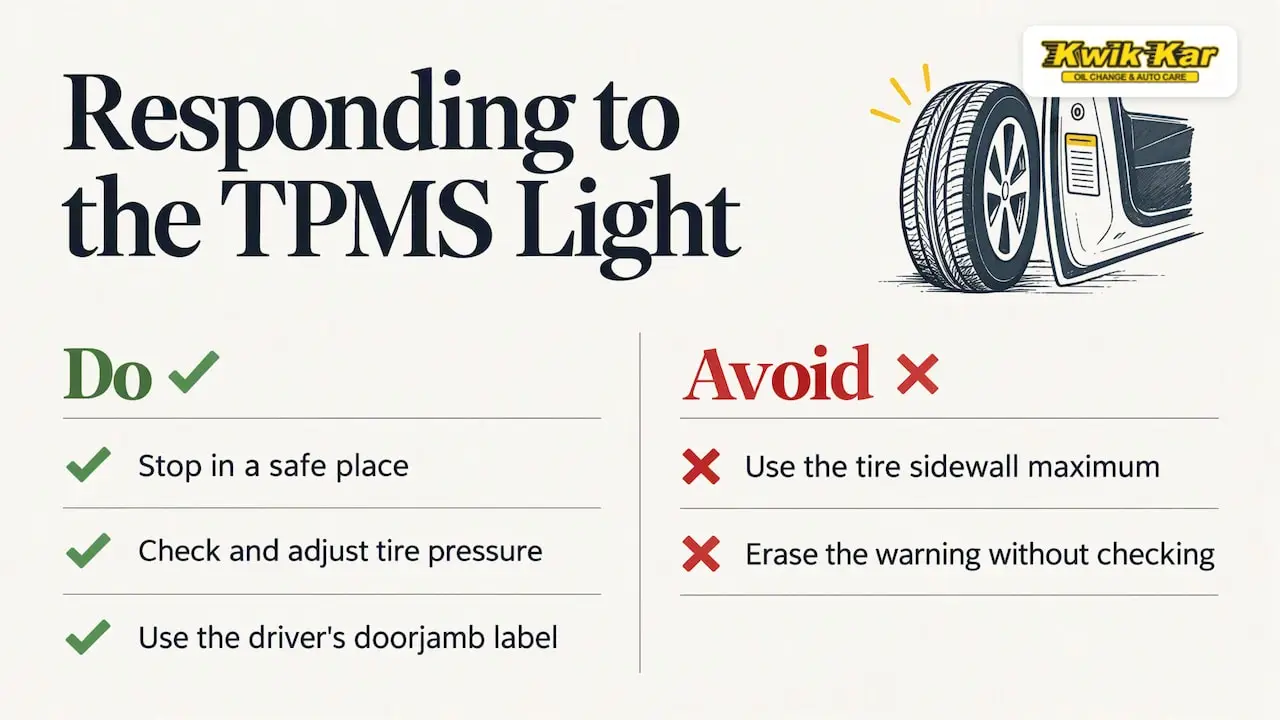
The light is a warning, not a fault code to be erased. It means the system believes at least one tire is well below its target pressure. Honda’s owner’s guide puts the response plainly: stop in a safe place, check the pressure, and adjust it to the level on the driver’s doorjamb label.
That label, not the number printed on the tire sidewall, is the pressure to use. The sidewall shows the maximum the tire can hold, which is a different thing.
Before you reset anything: check the tires
A reset only makes sense after the underlying pressure is right. Skipping this step is the most common reason the light comes back within a day.
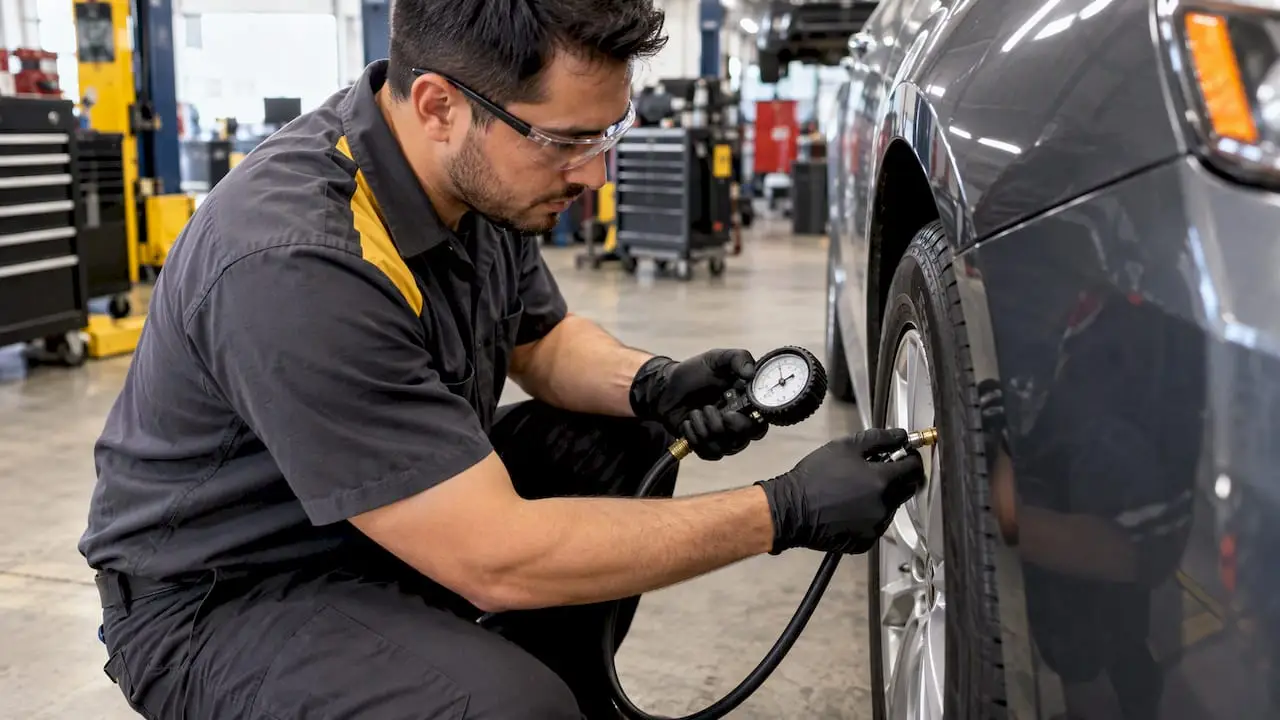
- Park on level ground and check the tires cold. Pressure rises as tires heat up, so a reading after a long freeway drive will be higher than the true cold value.
- Use a gauge, not your eyes. A tire can be several pounds low and still look normal.
- Inflate each tire to the doorjamb placard pressure. Check all four, not only the one you suspect.
- Look for the reason. Inspect the tread and sidewall for nails, screws, cuts or a bulge. If you see a bubble, read our guide to what to do about a bubble on a tire and don’t keep driving on it.
- Recheck in a day or two. If a tire loses several pounds again, you have a leak, and a reset will only silence the warning.
Our article on correct tire pressure walks through the gauge and inflation steps in more detail.
Why North Texas swings can trigger the light
Air contracts as it cools, so tire pressure drops when a warm afternoon is followed by a cold morning. A cold front rolling through Dallas County can be enough to trip the light on a tire that was only slightly low the day before. We cover this in why Texas weather impacts tire pressure and whether tire pressure drops in cold weather. If the light appears on the first chilly morning of the season, low pressure is the likely cause, and topping off the tires usually solves it.
Direct and indirect systems: why there is no single reset
The reset steps that rank on page one, such as holding a button until the light blinks three times, are real for some vehicles and absent on others. The reason is that there are two kinds of systems.
Direct TPMS uses a pressure sensor inside each wheel, usually attached to the valve stem. It reports actual pressure to the vehicle’s computer.
Indirect TPMS has no pressure sensors. Honda describes its version this way: the system monitors and compares the rolling radius and rotational characteristics of each wheel and tire using the wheel speed sensors that the ABS already relies on. A tire that is low rolls with a slightly smaller radius and spins faster, and the system notices.
Because an indirect system learns from how the car drives, it often needs to be told when the pressures are correct again. That is where a reset or calibration step comes in.
Tire Rack makes the same point: one answer will not suffice. Its example is a 2006 BMW M3 with an indirect system, where the driver sets the correct pressure, starts the engine and holds the reset button for up to eight seconds. It then notes that not all indirect systems work alike, and a Buick Rendezvous must be driven at specific speed ranges to relearn.
| System type | How it senses | What usually clears the light | Common trouble |
|---|---|---|---|
| Direct | A sensor in each wheel reads real pressure | Correct the pressure and drive briefly, sometimes with a relearn procedure | Dead sensor battery, damaged sensor, missing sensor after a wheel swap |
| Indirect | Compares wheel rotation speeds | Correct the pressure, then run the manufacturer’s reset or calibration | Skipped calibration, mismatched or uneven tires |
Your owner’s manual tells you which type you have. If it says the vehicle has no pressure sensors in the wheels, it is indirect.
How to reset the TPMS light: step by step
Use these steps as a general sequence and let your owner’s manual overrule any detail. Vehicles differ.
- Set every tire to the placard pressure. Do this first, with the tires cold.
- Turn the ignition on, engine off or running as your manual directs.
- Look for a reset method. Depending on the vehicle, it may be a physical button below the steering wheel or in the glove box, a setting in the instrument cluster or touchscreen menu, or no manual method at all.
- If there is a button, press and hold it until the light blinks, then release it, as your manual describes. Start the engine if directed.
- Drive. Many systems finish learning after several minutes of steady driving. Some need a specific speed range, which is why a short trip around the block may not be enough.
- Confirm the light is off. If it turned off and stays off through a few days of normal driving, the job is done.
Honda adds one detail worth knowing: any time you inflate, change, or rotate one or more tires, you need to recalibrate the system on that model. That is the instruction for that vehicle, not a universal rule, but it shows why a reset after a tire rotation is common. If you rotate your own tires or have them done on a schedule, our tire rotation guide explains the usual interval range.
Pro tip: If your vehicle has a display that shows individual tire pressures, use it as a cross-check. A tire showing noticeably lower than the others is your suspect, even if all four look fine by eye.
Why the light stays on after you add air
You filled the tires, drove for a while, and the light is still on. These are the usual explanations, from simple to more involved.
The system hasn’t relearned yet
Some systems update only after a certain amount of driving. Others never update until you run the calibration step. Check the manual for your model before assuming anything is broken.
One tire is still low
If you filled three tires and missed the fourth, the light stays on. Also check whether the spare is monitored on your vehicle. Some trucks and SUVs have a sensor in it.
You filled to the wrong number
Inflating to the sidewall maximum, or to a number from a different vehicle, can leave the system unhappy. Use the doorjamb label.
A sensor battery has died
Direct sensors run on small sealed batteries that cannot be replaced separately in most designs. When one fails, the system reports a fault. One shop-published guide puts sensor battery life at roughly 5 to 10 years, though that varies by vehicle, climate and driving, so treat it as a ballpark rather than a deadline.
A sensor was damaged or left out
A sensor can be damaged during a tire change, or a replacement wheel may not have one. Honda’s guidance for its Ridgeline warns to only use genuine TPMS-specified wheels since the wheels are equipped with the sensor. Aftermarket wheels need sensors transferred or replaced.
The system has a fault
On many vehicles, a blinking light that then turns solid indicates a malfunction in the system rather than low pressure. Exact behavior varies, so your manual is the authority. The same principle applies to other dash warnings: a flashing indicator generally signals something different from a steady one. For a general look at how orange warning lights are interpreted, this French-language guide to orange engine warning lights covers the idea of persistent versus flashing alerts, though TPMS specifics belong to your own manual.
Common mistakes worth avoiding
- Resetting without checking pressure. The light is doing its job. Silencing it hides the problem.
- Disconnecting the battery as a shortcut. It may not clear the light, and it can wipe other settings.
- Ignoring a repeating light. A tire that needs air every week has a leak. A slow leak can become a flat at highway speed.
- Using sealant or inflating over the placard to “fix” it. Overinflation reduces the contact patch and can hurt braking and ride.
- Assuming a reset means the tire is healthy. A tire can be worn, aged or damaged and still hold pressure. Our guide on when to get new tires lists the warning signs to look for.
Pressure also matters for your wallet. An EPA study on the effect of tire inflation pressure on fuel economy looked at how underinflated tires waste fuel, which is one more reason to keep the pressures right even when the light is off.
Our perspective: treat the light as information
At Kwik Kar Oil Change & Auto Care, we see the same pattern often. A driver resets the light, it returns, they reset it again, and a few weeks later they arrive with a tire that has a screw in it or a sensor that stopped talking months ago.
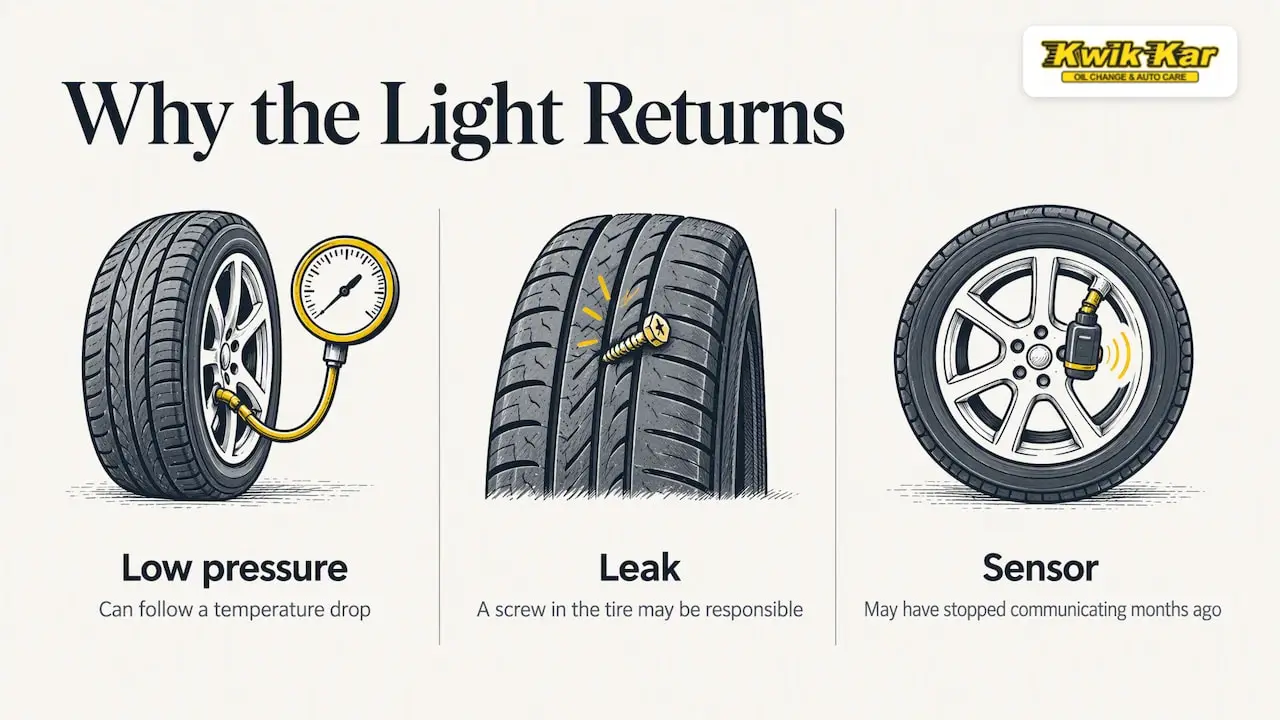
We think of the TPMS light as a second set of eyes. It watches four tires while you are busy driving to work or picking up the kids. Most of the time the answer is simple: low pressure after a temperature drop. Occasionally it is a leak or a sensor, and those are worth knowing about early.
Our approach is to find out which of the three situations you have before anyone suggests a repair. We would rather confirm that all you needed was air than sell you something you don’t need. Not every light means a repair, and not every repair is urgent. Where a repair is needed, we explain it in plain terms and show you what we found through our digital vehicle inspection.
— Kwik Kar
When to bring it to a shop
A DIY reset is reasonable when the light came on after a cold snap, you corrected the pressures, and it cleared. Book professional diagnosis if:
- The light blinks, then stays on, every time you start the car.
- It returns even though all tires are at the placard pressure.
- One tire needs air repeatedly.
- You recently changed wheels or tires and the light has been on since.
- You see a nail, a bulge, uneven wear or cracking.
- The vehicle pulls to one side, which can point to alignment or tire damage. See our note on alignment after new tires.
A shop can find a slow leak, check the tire and wheel, and read the system to identify which sensor isn’t responding. If a tire needs replacing, the same visit can cover it. Our tire sales and service team works on tires and wheels for drivers across Richardson, Plano, Garland, North Dallas and Addison.
If you’re not sure whether a dash light is a TPMS warning or something else, the check engine light guide explains why clearing lights without finding the cause is a poor idea in general.
What about Texas inspections?
People often connect dash warnings with inspection time, so a quick clarification. Texas ended most non-commercial passenger vehicle safety inspections in 2025. The change took effect January 1, 2025, and replaced the inspection with a $7.50 program replacement fee at registration. Emissions testing remains required for qualifying vehicles in applicable counties, including Dallas and Collin, where Richardson sits. Commercial safety inspections continue in Texas.
That means nobody will fail your car on a TPMS light, but tire condition still affects your safety and your fuel costs.
Having us look at it
If your TPMS light won’t go out, Kwik Kar Oil Change & Auto Care in Richardson can inspect the tires, check for leaks, and tell you what’s behind the warning. Our technicians are ASE-certified, and we share findings through digital inspection reports. Repairs that qualify may be covered by our 24-month/24,000-mile limited warranty, and the Lifetime Suspension Warranty applies only to qualifying suspension repairs. Coverage depends on the specific repair, so we confirm what applies before work begins.
Military members and first responders can ask about our discounts. Start at kkrichardson.com or call (972) 644-1851.
FAQ
How do I make the TPMS light go away?
Inflate all tires to the pressure on the driver’s doorjamb label, then drive for several minutes. If your vehicle has a reset button or menu command, use it after the pressures are correct. A light that remains on points to a leak or a sensor issue.
Can I reset the TPMS sensor myself?
Often yes, on vehicles with a reset button or a dash menu option, or ones that relearn while driving. Your owner’s manual gives the exact method. Replacing or programming a sensor is different and generally needs shop tools.
Why is my TPMS light on but my tires look fine?
A tire can be well below target without looking flat, and temperature drops can lower pressure overnight. A gauge will tell you. If all four read correctly and the light persists, a sensor or system fault is likely.
Do I need to reset the TPMS after rotating tires?
It depends on the vehicle. Some models, such as the Honda Civic covered in the manual we cited, call for recalibration after inflating, changing or rotating tires. Others reposition sensors automatically. Check your manual.
Is it safe to drive with the TPMS light on?
If the light is steady, stop soon, check the pressures and add air. Driving a long way on a very low tire can damage it and affect handling. If you see a flat or damaged tire, don’t continue driving.
Need help with a TPMS light?
If you’d like a second opinion on a stubborn tire pressure warning, you can schedule an appointment with Kwik Kar Richardson or call (972) 644-1851.
Sources
- Common TPMS Questions Answered, Tire Rack
- TPMS Final Regulatory Impact Analysis, NHTSA
- 2018 Honda Civic Sedan TPMS, Honda Owners
- 2020 Honda Civic Sedan TPMS, Honda Owners
- 2022 Honda Ridgeline TPMS, Honda Owners
- Effect of Tire Inflation Pressure on Vehicle Fuel Economy, EPA
- Texas vehicle inspections no longer required in 2025, FOX 4