
When to Get New Tires: Tread, Age, and Warning Signs
Replace tires at or below 2/32" of tread, no exceptions. Start shopping around 4/32" so you’re not caught making a rushed decision. Age matters just as much as tread: most manufacturers recommend retiring tires once they hit 10 years old, and any tire showing sidewall cracking, bulges, or exposed cord needs to come off the car immediately, regardless of how much tread remains.
- 2/32" — legal minimum, replace now
- 4/32" — start shopping, especially before wet or winter driving
- 6 to 10 years — typical age window where manufacturers recommend retirement
- Any visible cracking, bulging, or exposed cord — replace immediately, no matter the tread reading
Key Takeaways
Tire replacement decisions come down to three independent checks: tread depth at or below 2/32", age beyond manufacturer guidance, and any visible structural damage, with any single trigger being enough on its own.
| Point | Details |
|---|---|
| Tread threshold | Replace at 2/32"; start shopping around 4/32" for safer margin in wet or winter driving. |
| Age matters independently | Retire tires around 10 years old regardless of tread, and inspect closely after five years. |
| Damage overrides everything | Bulges, sidewall cuts, and exposed cord require immediate replacement, no tread calculation needed. |
| Uneven wear needs root-cause fixes | Alignment or pressure problems must be corrected first or the new tire wears the same way. |
| Professional verification closes the gap | Kwik Kar Oil Change & Auto Care confirms DOT/TIN age and internal condition that a home check can’t fully assess. |
Table of Contents
- When to Get New Tires: Reading Tread Depth Correctly
- How Old Is Your Tire? Reading the DOT/TIN Date Code
- Visible Damage That Means Immediate Replacement
- Uneven Wear, Pressure, and Alignment: What They Tell You
- Checking the Spare and Timing Your Purchase
- A 10-Minute Home Inspection You Can Do This Weekend
- Maintenance That Slows Wear and Delays Replacement
- When to Bring the Car to a Professional Shop
- What Most Tire Advice Gets Backward
- Get a Professional Tire Check Without the Guesswork
- Sources
- FAQ
When to Get New Tires: Reading Tread Depth Correctly
Tread depth is the single clearest signal you have, and you don’t need a shop visit to check it. The industry uses three common methods, and knowing all three matters because they answer slightly different questions.
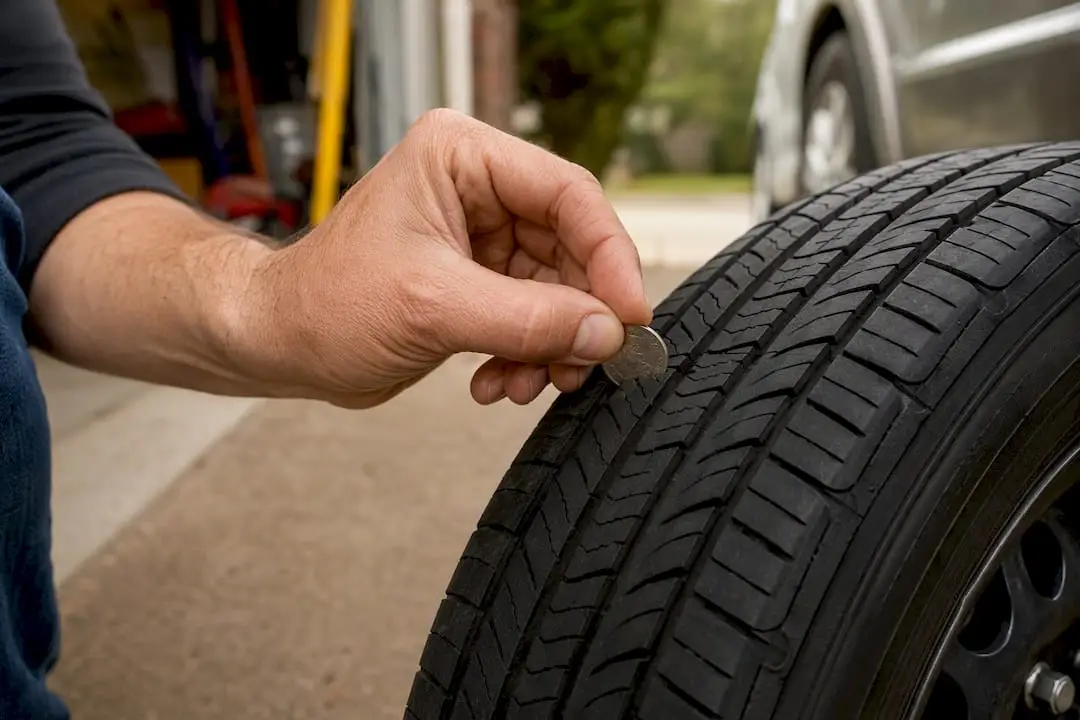
- The penny test. Insert a penny into the tread groove with Lincoln’s head facing you. If you can see the top of his head, you’re at or below 2/32", the NHTSA-defined minimum before a tire is considered unsafe.
- The quarter test. Same idea, but a quarter measures roughly 4/32". If Washington’s head is fully visible, Consumer Reports recommends you start shopping now rather than waiting.
- A tread-depth gauge. More precise than either coin trick and worth the few dollars it costs, since it gives you an exact number instead of a pass/fail guess.
Whichever method you use, check at least three points around the tire’s circumference and across the tread’s width, then use the smallest number you find. A single low reading on an otherwise healthy-looking tire is still the number that determines your safety margin.
The stakes of that number are higher than most drivers assume. Pirelli’s tread-depth guidance notes that stopping distance on wet pavement increases noticeably as tread wears from 4/32" down to 2/32", and hydroplaning resistance drops right along with it. That’s the gap between “start shopping” and “replace immediately.”
How Old Is Your Tire? Reading the DOT/TIN Date Code
Tread isn’t the whole story. A tire can look full and still be dangerously old, because rubber compounds degrade with heat, sunlight, and oxygen exposure even when the tire barely rolls.
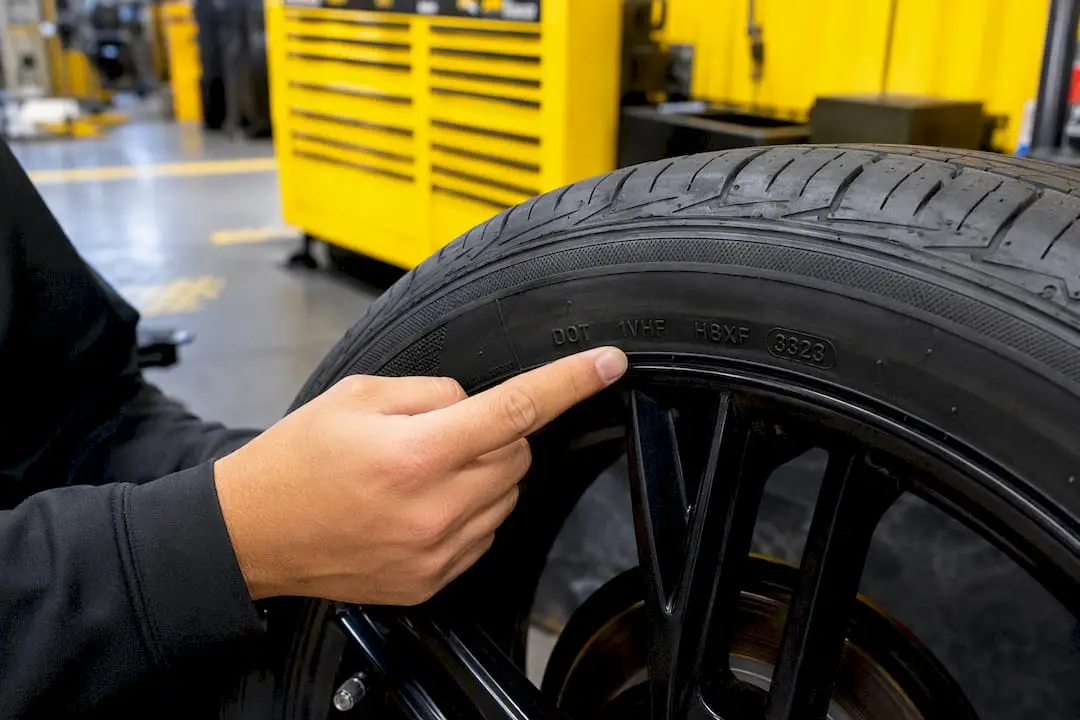
Every tire carries a DOT Tire Identification Number (TIN) stamped on the sidewall, and the last four digits are the ones that matter. They show the week and year of manufacture, so “0308” means the third week of 2008. This code is the most reliable way to determine a tire’s real age, far more trustworthy than guessing based on appearance.
- Locate the DOT code on the sidewall, sometimes on the inner face facing the wheel well.
- Read the final four digits as week, then year.
- Compare that date against manufacturer guidance, which typically calls for inspection after five years and retirement around 10 years, even for tires with plenty of visible tread.
- Hot climates and heavy highway use accelerate that timeline. A garage-kept car in a mild climate may push toward the upper end; a vehicle that sits outside in Texas summers should not.
- Don’t forget the spare. It ages on the same clock even though it never touches pavement, so check its date code and retire it on the same schedule.
Visible Damage That Means Immediate Replacement
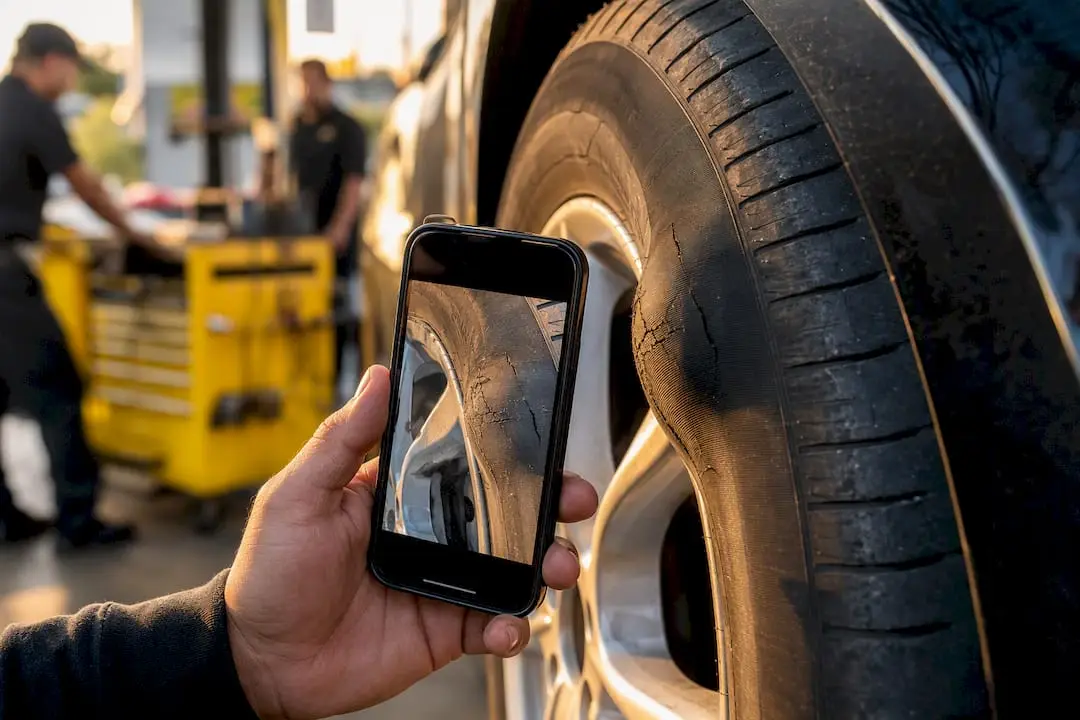
Tread and age aside, certain damage overrides every other calculation. If you see any of these, the tire comes off the car before you drive on it again:
- A bulge or bubble on the sidewall, which signals internal structural damage
- Cuts or punctures on the sidewall itself, rather than the tread
- Exposed steel belts or fabric cord showing through worn or damaged rubber
- Deep, web-like cracking across the tread or sidewall, a sign of dry rot
Punctures in the tread’s center are sometimes repairable if they’re small and the tire hasn’t run flat, but sidewall damage is never a repair candidate. When in doubt, a professional inspection settles it fast.
Pro Tip: Keep your phone handy during a home inspection. Photograph any bulge, crack, or cut you find so a technician can assess it quickly without you having to describe it from memory.
Uneven Wear, Pressure, and Alignment: What They Tell You
Wear patterns are diagnostic information, and reading them correctly can save you from replacing tires that were never the actual problem.
- Wear concentrated on the inner or outer edge usually points to misalignment, not a bad tire. Fixing the alignment before replacing the tire prevents the new one from wearing the same way.
- Wear centered in the middle of the tread typically means overinflation, while wear on both outer edges with a healthy center suggests underinflation. Either way, monthly cold-pressure checks against your vehicle’s placard value catch this early.
- Cupping or scalloped patches often trace back to worn suspension components rather than the tire itself.
Check your tire pressure with a gauge, not by eye, since underinflation quietly accelerates wear and heat buildup long before it’s visible. If uneven wear is confined to one tire, the root cause needs fixing first, or a brand-new tire will wear the same way within months. Depending on how far the wear has progressed, you may only need to replace a pair rather than all four, but a technician can confirm that with actual measurements rather than a guess.
Checking the Spare and Timing Your Purchase
Your spare deserves the same scrutiny as the tires actually touching the road, and most drivers never look at it until they need it.
- Check the spare’s pressure and DOT date monthly, alongside your regular tire check.
- Retire it on the same age schedule as your other tires, since rubber degrades whether or not it’s ever mounted.
- Begin shopping once your best tire hits around 4/32", not 2/32". That window gives you time to compare prices and book installation instead of scrambling for whatever’s in stock during an emergency.
- Look for shops that bundle mounting, balancing, and disposal into one visit, since piecing those services together separately usually costs more.
- If you’re prepping for winter driving, a broader seasonal readiness check covering battery, wipers, and fluids alongside tires catches problems before cold weather makes them worse.
A 10-Minute Home Inspection You Can Do This Weekend
You don’t need a lift or specialty tools to gather the facts that decide whether you need new tires now or can safely wait. Run through this five-step routine with the car cold, meaning it hasn’t been driven in at least three hours.
- Check cold tire pressure with a gauge and compare it to the placard inside your driver’s door, not the number on the tire’s sidewall.
- Scan each sidewall visually for bulges, cracks, or cuts, rotating the wheel by hand if needed to see the whole circumference.
- Run the penny and quarter tests at three points around each tire, noting the smallest reading you find.
- Locate and read the DOT/TIN code on each tire, including the spare.
- Take a short, slow drive and pay attention to any vibration through the steering wheel or a pull to one side, both of which point to wear or alignment issues.
Write down your smallest tread measurement for each tire and photograph anything questionable. That record turns a vague “my tires feel off” into specific information a technician can act on immediately.
Pro Tip: If you feel a vibration that changes with speed but not with braking, suspect tire wear or balance before you assume it’s brakes or suspension. Speed-dependent vibration is one of the most reliable signs.
Maintenance That Slows Wear and Delays Replacement
Good habits stretch the calendar on when you’ll actually need new tires, and none of them require special skills.
- Rotate tires every 5,000 to 7,500 miles so wear distributes evenly across all four instead of concentrating on the drive axle.
- Balance new tires at installation and again after any repair that involves removing the tire from the rim.
- Check pressure monthly when tires are cold, adjusting to the number on your door placard rather than the tire’s maximum-rated pressure.
- Get an alignment check any time you notice pulling, after suspension work, or as soon as uneven wear shows up during inspection.
Skipping these doesn’t just shorten tire life. It also masks the root cause of wear problems until a technician has to diagnose them from scratch.
When to Bring the Car to a Professional Shop
Some checks genuinely require a lift, a bead-breaker, and trained eyes, and that’s exactly where Kwik Kar Oil Change & Auto Care fits into this routine.
- Full DOT/TIN and internal condition verification from ASE-certified technicians who catch aging issues a home inspection might miss.
- Mounting, balancing, and alignment handled in one visit rather than three separate stops.
- Documented, transparent pricing you can review before any work begins, backed by recognition from CARFAX and RepairPal.
Bring your photos and recorded tread measurements from your home check. It cuts diagnostic time and gets you a straight answer on whether you need tire replacement now or can safely wait a season.
What Most Tire Advice Gets Backward
Most tire guides treat tread depth as the only number that matters, and that’s a mistake. Age and visible damage independently override tread depth, and we see this play out constantly: a tire with 6/32" remaining can still be unsafe if it’s nine years old and showing sidewall cracking, while a tire at 3/32" with a clean, recent manufacture date is a straightforward “replace soon” rather than an emergency.
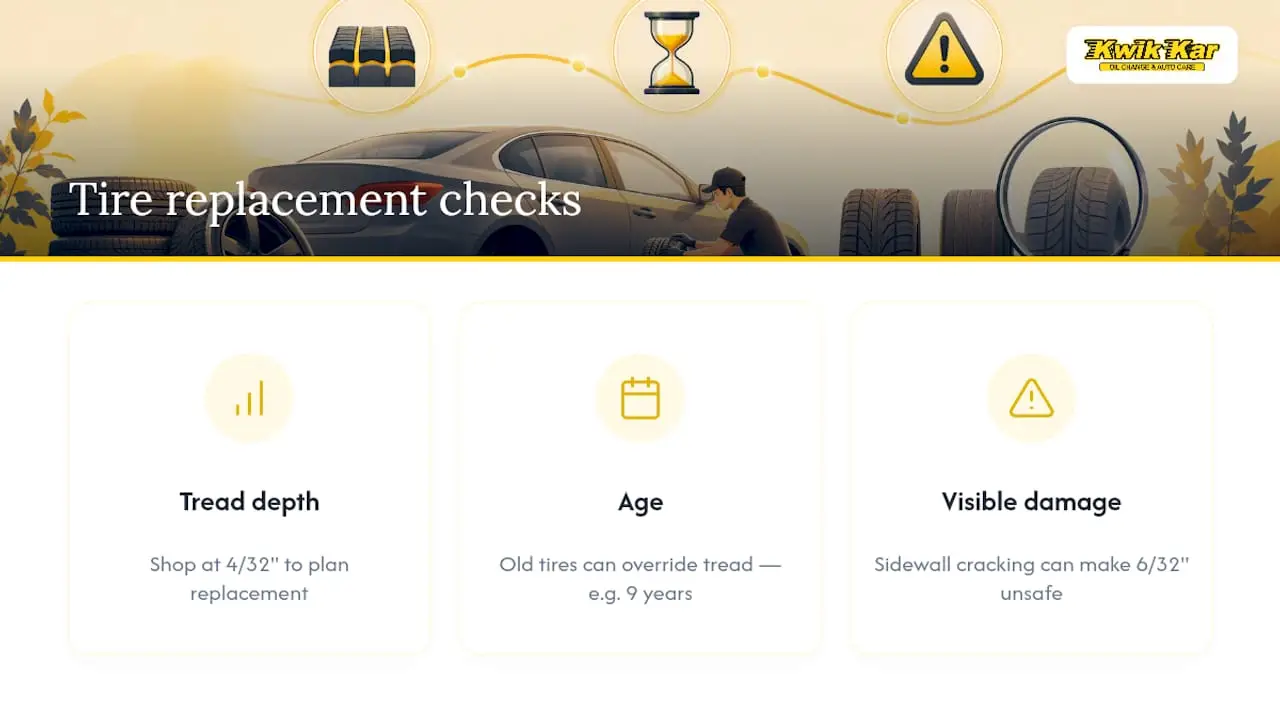
The bigger gap in conventional advice is timing. Waiting until 2/32" to start shopping treats tire replacement as a reactive decision instead of a planned one, and that’s exactly backward. Shopping at 4/32" gives you leverage: time to compare prices, book installation, and avoid the marked-up, whatever’s-in-stock scramble that comes with an emergency replacement.
Our honest read: tread depth, age, and visible condition are three separate checks, not one. Skipping any of them, or trusting tread alone, is how safe-looking tires end up causing preventable accidents.
Get a Professional Tire Check Without the Guesswork
A home inspection tells you a lot, but it can’t see internal belt separation or confirm exactly how much life is left in a tire that’s borderline on age. Kwik Kar Oil Change & Auto Care closes that gap with ASE-certified technicians who verify DOT/TIN age, inspect tread and structure, and give you documented, transparent pricing before any work starts, no dealership markup, no vague estimates.

If your home check turned up a borderline reading or you just want a second set of eyes before a road trip, book a tire inspection at Kwik Kar Oil Change & Auto Care. Military and first responder discounts apply, and the same visit can cover mounting, balancing, and alignment so you leave with everything handled at once.
Sources
- NHTSA TireWise — Tire safety
- How to Know When to Replace Your Tires – Consumer Reports
- Tire Replacement Guide – When & How to Replace Tires – Bridgestone
- How to Check Tire Tread Depth: The penny test | Pirelli
FAQ
How do you know when it’s time for new tires?
Check tread depth with a penny or quarter test, read the DOT/TIN code for age, and scan for cracks, bulges, or exposed cord. Any one of these hitting its threshold, 2/32" tread, roughly 10 years of age, or visible damage, means it’s time to replace.
How long should tires last on average?
Most tires last six to 10 years depending on manufacturer guidance, though driving conditions, climate, and maintenance habits like regular rotation and pressure checks can shorten or extend that window.
Is $200 expensive for a tire?
It depends heavily on your vehicle’s size, tire specifications, and whether the price includes mounting and balancing. Ask for transparent, itemized pricing so you know exactly what’s included before comparing quotes.
Should you replace tires at 4/32"?
You don’t have to replace immediately at 4/32", but that’s the point experts recommend you start shopping, since braking distance and wet-traction performance begin declining noticeably from there down to the 2/32" legal minimum.