90–100% vs 30–50%: Inspect Before a Flush or Drain and Fill
For most vehicles with over 100,000 miles or an unknown service history, a drain-and-fill is the safer starting point. Save a full transmission flush for fluid that’s heavily contaminated, or for cases where your manufacturer specifically calls for it. Check your owner’s manual first, then let a qualified technician inspect the fluid before you decide. A qualified technician can run that inspection and point you toward the right service instead of the more aggressive one.
TL;DR:
- A drain-and-fill is suitable for vehicles with over 100,000 miles or unknown service history because it is less invasive and offers an inspection opportunity.
- A transmission flush can replace nearly all fluid and is recommended only when fluid is heavily contaminated or burnt, but it risks dislodging debris in high-mileage or neglected transmissions.
- Manufacturer guidance and fluid condition are critical factors; some transmissions, especially certain CVT and dual-clutch types, explicitly prohibit flushing.
- A proper inspection by a qualified technician helps determine whether a flush or drain-and-fill is appropriate based on fluid color, smell, and service history.
- Routine transmission fluid service generally costs between $200 and $450, with the best approach being conservative first, then considering more aggressive service if needed.
Table of Contents
- Transmission Flush vs Drain and Fill: How Each Service Works
- Benefits and Risks of a Transmission Flush
- Benefits and Risks of a Drain and Fill
- How to Decide Between a Flush and a Drain and Fill
- Why ‘Never Flush’ Advice Exists, and When It’s Wrong
- What Transmission Service Costs and How Often You Need It
- How Kwik Kar Approaches Transmission Fluid Service
- Quick Checklist Before You Book a Transmission Service
- Our Take: Why We Default to Caution First
- Get Your Transmission Inspected
- Sources
- FAQ
Transmission Flush vs Drain and Fill: How Each Service Works
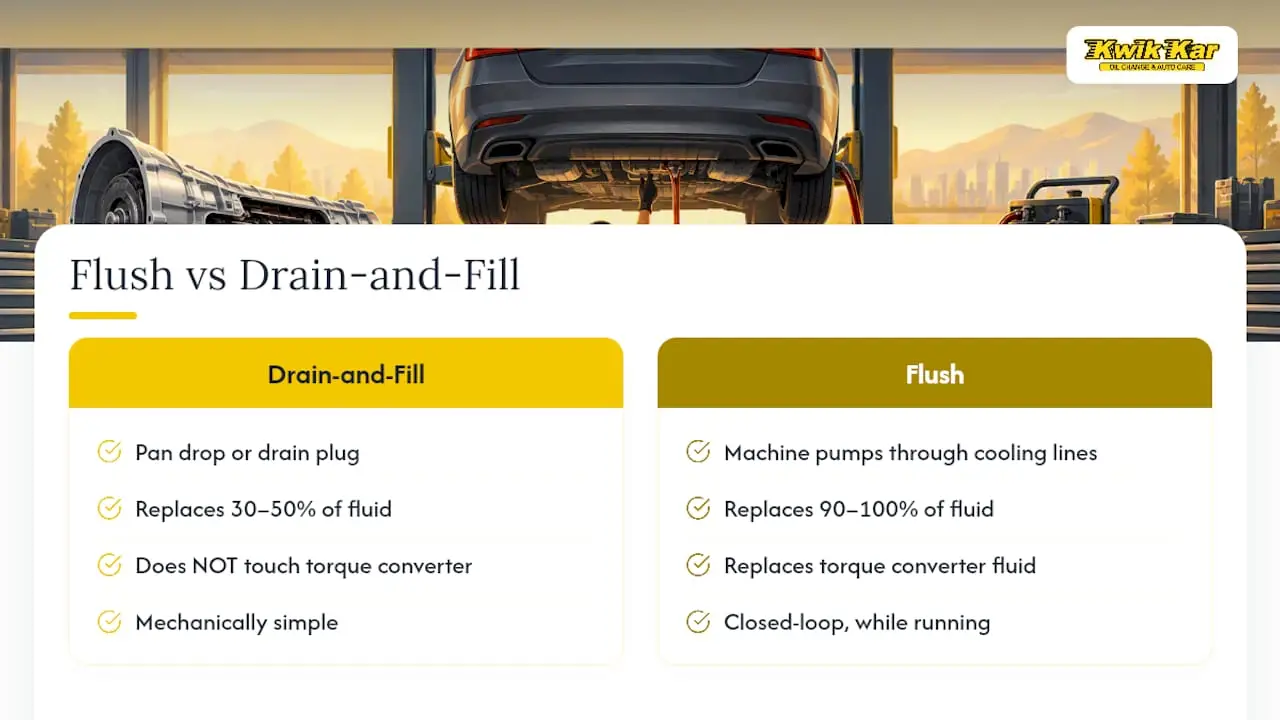
A drain-and-fill removes the fluid sitting in the transmission pan, usually by dropping the pan or opening a drain plug, then swaps the filter and gasket before refilling with fresh fluid. It’s a mechanically simple job, and it’s also incomplete by design. Because fluid stays trapped in the torque converter, the cooler lines, and parts of the valve body during a pan drop, a typical drain-and-fill replaces only about 30 to 50 percent of the total fluid, depending on the transmission’s design.
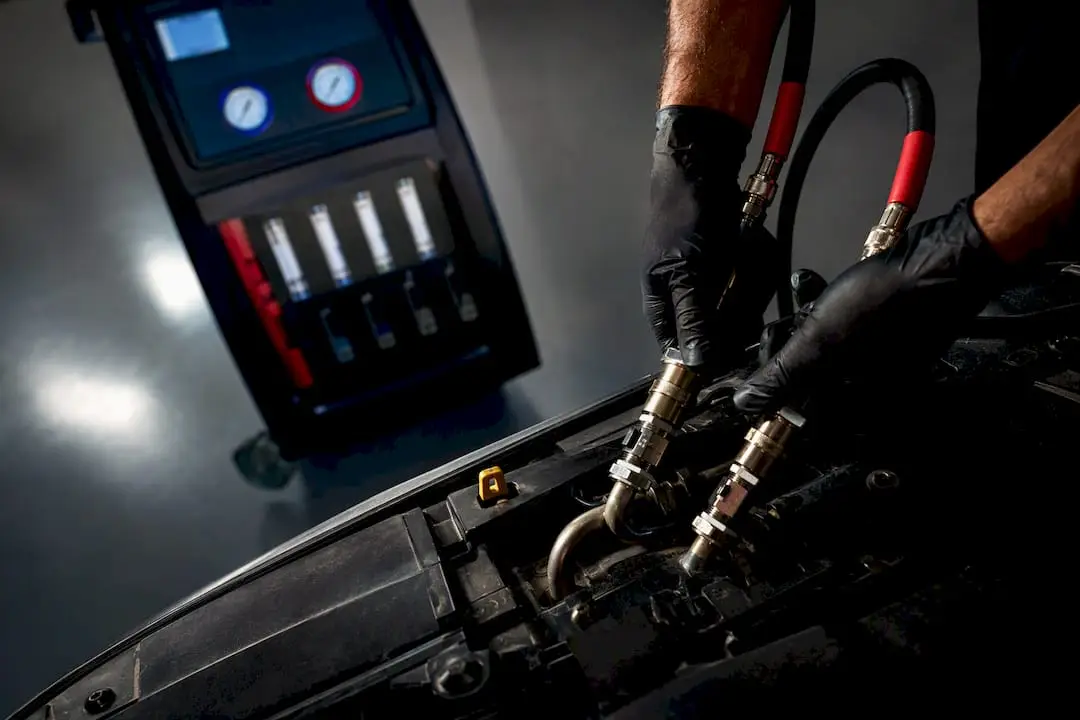
A transmission flush works differently. A machine connects to the cooling lines and pumps new fluid through the entire system, pushing old fluid out under pressure, including the torque converter, while the transmission keeps running. That closed-loop exchange is why a flush typically replaces 90 to 100 percent of the fluid in one visit, versus the partial swap you get from a pan drop.
The torque converter is the reason this gap exists at all. It’s a sealed, fluid-filled coupling that transfers power from the engine to the transmission, and it holds a meaningful share of the total fluid volume. A drain-and-fill never touches what’s inside it. A flush does, which is exactly why the two services aren’t interchangeable answers to the same question. One is a partial refresh. The other is closer to a full fluid replacement, and that difference drives almost every decision point that follows.
Benefits and Risks of a Transmission Flush
A flush earns its higher price when the fluid itself has become the problem. If your transmission fluid has turned dark brown or black, smells burnt, or you’re driving a vehicle with an unknown maintenance history, near-complete fluid replacement does something a partial drain can’t: it restores the additive package that controls friction, heat, and seal condition throughout the whole system, not just the pan.
The upside is real, but so is the risk. Power-flushing a high-mileage or neglected transmission can dislodge sludge and worn friction material that has settled into the pan and passages, and that debris can migrate into the valve body or solenoids, where it causes far more expensive problems than dirty fluid ever did.
Key considerations before choosing a flush:
- Best fit: fluid that’s visibly dark or smells burnt, heavy towing use, or fluid that’s clearly overdue for service.
- Main risk: loosened sludge or metal particles traveling into tight passages in older or worn units.
- Cost factor: flushes generally run higher than a pan drop because of machine time and full fluid volume.
- Manufacturer rule: some transmissions, including several CVT and dual-clutch designs, restrict or prohibit machine flushing outright.
If your fluid still looks reasonably clean and your maintenance history is solid, a flush is probably solving a problem you don’t have yet.
Benefits and Risks of a Drain and Fill
A drain-and-fill is the conservative default, and for good reason. It’s less invasive, it’s usually the lower-cost option, and it gives your technician a direct look at the pan, filter, and magnet for metal shavings. That visual inspection alone catches problems a flush machine would never reveal.
- Lower disturbance: partial fluid exchange doesn’t push high-pressure flow through passages that may already hold loose debris.
- Built-in inspection: dropping the pan lets a technician see filter condition and check for metal contamination directly.
- Routine fit: ideal for scheduled maintenance on a transmission with a known, well-documented service history.
- Lower cost: less machine time and simpler procedure than a full flush.
The tradeoff is fluid quality. Since roughly half the old fluid can remain in the torque converter and cooler lines after one drain-and-fill, heavily degraded fluid may need two or three successive services, spaced out over time, to approach what a single flush accomplishes. Some technicians treat three consecutive pan drops as a reasonable substitute for a flush when a customer wants a more gradual, lower-risk path to cleaner fluid.
How to Decide Between a Flush and a Drain and Fill
You don’t need to guess at this. Work through it in order, and the right answer usually becomes obvious by step three.
- Read your owner’s manual first. Manufacturer guidance is the final word, and it can override general advice entirely. Toyota’s own service instructions, for example, walk through a pan-drop procedure with specific fill levels, and some CVT and dual-clutch transmissions explicitly forbid a machine flush in favor of a manufacturer-specified process.
- Look at the fluid itself. Fresh automatic transmission fluid is usually red or pink and smells mild. Dark brown, black, or burnt-smelling fluid points toward heavier contamination, and that shifts the decision toward a flush, assuming your transmission and mileage allow it.
- Factor in mileage and history. A vehicle over 100,000 miles with no documented fluid changes is a candidate for a cautious drain-and-fill first, not an aggressive flush. Technicians frequently recommend this conservative path for unknown-history vehicles, reserving flushing for used vehicles once the fluid condition has been assessed.
- Weigh how the vehicle is used. Frequent towing, stop-and-go city driving, or hauling heavy loads accelerates fluid breakdown, which can justify a more thorough service sooner than the standard interval.
- Let a technician run diagnostics if anything looks off. Slipping, delayed engagement, or unusual noise deserves a pressure check and fluid inspection before you commit to either service.
Pro Tip: If your transmission is high mileage and history is a question mark, ask your technician about a magnetic in-line filter on the return line. It catches fine metallic particles that a standard fluid service might miss, giving you an extra layer of protection after service.
Why ‘Never Flush’ Advice Exists, and When It’s Wrong
You’ve probably heard the blanket warning: never flush an older transmission. It’s not wrong, exactly. It’s incomplete. The advice comes from real cases where flushing a high-mileage, neglected transmission dislodged years of accumulated sludge and sent it straight into the valve body, turning a fluid service into a transmission rebuild.
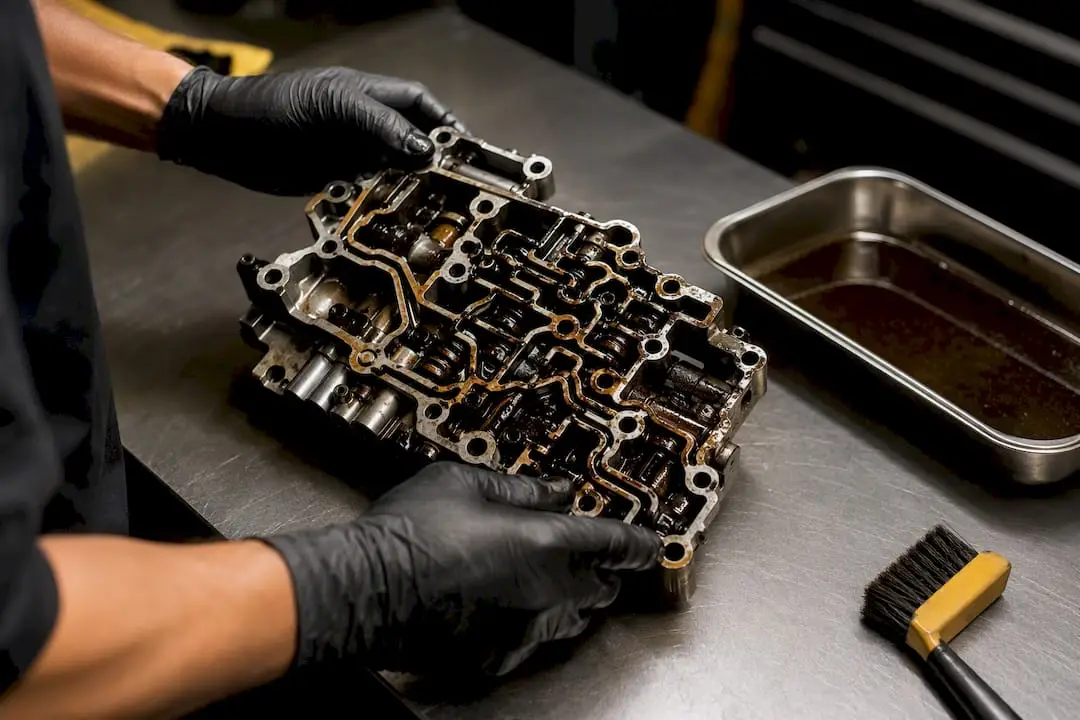
That risk is genuine, but it’s a mileage-and-condition problem, not a universal rule against flushing. A five-year-old vehicle with clean, well-maintained fluid faces almost none of that risk. Manufacturer restrictions add another layer some drivers overlook entirely. Certain CVT and dual-clutch transmissions aren’t just unsuited to flushing; the manufacturer’s service documentation rules it out for that specific design, which is a mechanical fact, not a general caution.
Execution matters just as much as the decision itself. Using the wrong fluid specification, connecting the flush machine improperly, or rushing the procedure can cause damage that has nothing to do with the transmission’s age or mileage. Flip the coin, though, and the counterpoint holds too: fluid that’s badly degraded and left untreated causes its own damage over time, through overheating, varnish buildup, and accelerated wear. A well-timed flush on a transmission that can safely handle it often prevents exactly the expensive repair that skipping service invites.
What Transmission Service Costs and How Often You Need It
A standard fluid service, whether it’s a drain-and-fill or a flush, typically runs between roughly $200 and $450, while a full transmission replacement can run into several thousand dollars. That gap alone explains why routine fluid service is one of the cheapest forms of insurance your car offers.
What moves the price within that range:
- Fluid type and specification (synthetic blends generally cost more than conventional fluid)
- Whether a filter and gasket are replaced along with the fluid
- Transmission fluid capacity, which varies significantly by vehicle
- Technician labor time, especially for flush procedures requiring machine setup
- Diagnostic charges if fluid condition or symptoms warrant a pressure check first
Many technicians follow a practical rule of thumb: fluid and filter service roughly every 24,000 to 36,000 miles for many automatic transmissions, shortened for vehicles used for towing or heavy city driving.
“Filled for life” is a phrase worth some skepticism. Some manufacturers use it to describe transmissions that don’t need scheduled fluid changes under normal conditions, but normal conditions assume light use and a controlled climate. Texas summers and daily commuter traffic don’t always qualify. Rather than scheduling service purely by the calendar or the odometer, base timing on what an inspection actually shows. A transmission with clean fluid at 40,000 miles may not need service yet. One with dark fluid at 25,000 miles might need it now.
How Kwik Kar Approaches Transmission Fluid Service
Every transmission visit starts with a look, not a guess. That means pulling a fluid sample, checking its color and smell, inspecting the pan and filter when accessible, and reviewing whatever service history you can provide before recommending a drain-and-fill, a flush, or further diagnostics.
ASE-certified technicians handle that evaluation, which matters because the right call depends on reading fluid condition and transmission type correctly, not defaulting to whichever service sounds more thorough. The shop is recognized by both CARFAX and RepairPal, and every visit comes with transparent, itemized pricing so you know what you’re paying for and why. Military and first responder discounts apply to eligible customers.
Findings get documented and shared with you directly, so you can see exactly what the inspection turned up before agreeing to any service.
Quick Checklist Before You Book a Transmission Service
Use this at the counter or on the phone when you’re weighing a transmission flush vs drain and fill for your specific vehicle.
| If this describes your situation… | Then consider… |
|---|---|
| Fluid looks dark or smells burnt, and diagnostics confirm no major damage | A flush, once a technician has ruled out heavy sludge risk |
| Mileage over 100,000 with unknown service history | Starting with a conservative drain-and-fill |
| Owner’s manual prohibits flushing for your transmission type | Manufacturer-specified drain-and-fill only, never a flush |
| Clean fluid, known service history, routine mileage interval | Standard drain-and-fill on schedule |
Before you commit, ask the shop a few direct questions: What does the owner’s manual recommend for this specific transmission? Can I see the fluid sample or a photo of it? Does the service come with any warranty coverage? A shop that welcomes those questions is one you can trust with the answer.
Our Take: Why We Default to Caution First
We’d rather under-recommend than over-recommend when it comes to transmission service. That’s not indecision. It’s a reflection of what actually causes transmission failures in the field: not too little service, but the wrong service applied to a transmission that couldn’t handle it.
An older transmission with questionable history gets a conservative drain-and-fill from us first, followed by a real conversation about what the fluid and filter showed. If that inspection points toward a flush, being heavy contamination, manufacturer guidance, or a clean service record with high mileage, we’ll say so plainly. What we won’t do is push a flush on a transmission where the risk outweighs the benefit just because it’s a bigger ticket. Inspection first, recommendation second. That’s the whole approach.
If you’re unsure which side of that line your vehicle falls on, that’s exactly what an inspection is for. Bring it in and let’s find out together.
— Kwik Kar
Get Your Transmission Inspected
You don’t have to diagnose your own transmission fluid over a phone call with a stranger. A qualified local shop can give you an actual inspection, check fluid color, filter condition, and service history, before recommending anything, so you’re never paying for a flush your transmission didn’t need or skipping a service it did.

Every visit is handled by ASE-certified technicians with transparent, itemized pricing and a digital report you can actually read. Whether your vehicle needs a routine transmission fluid change, a full diagnostic workup, or transmission repair and clutch service, the recommendation comes from what the fluid and pan actually show, not a flat-rate script. Military and first responder discounts apply for eligible customers, and Kwik Kar Oil Change & Auto Care’s work is backed by CARFAX and RepairPal recognition.
Curious what a flush might run for your specific vehicle? Check current transmission flush cost estimates or browse the full service menu before you call. When you’re ready, schedule a transmission inspection at Kwik Kar Oil Change & Auto Care and get a straight answer instead of a guess.
Sources
- Maintain your car’s transmission and avoid costly repairs – Consumer Reports
- Transmission flushes: When they help and when they hurt your car – HowToGeek
- Transmission Fluid Flush vs Change: Which Service Is Right For Your Vehicle? – Mister Transmission
- Change transmission fluid – Toyota Car Tips
FAQ
Why Is a Transmission Flush Not Always Recommended?
A flush isn’t recommended for every vehicle because high pressure fluid exchange can dislodge sludge and worn debris in a high-mileage or neglected transmission, pushing that material into the valve body or solenoids. Some manufacturers also prohibit flushing outright for certain CVT and dual-clutch designs, making the owner’s manual the deciding factor.
Is 100,000 Miles Too Late to Change Transmission Fluid?
No, but it changes which service makes sense. At that mileage with unknown history, a conservative drain-and-fill is usually the safer starting point rather than an aggressive flush, and a technician can assess fluid condition before recommending anything further.
How Much Does a Full Transmission Flush Cost?
Professional fluid service, including a flush, typically runs between about $200 and $450, depending on fluid type, transmission capacity, and labor time. Kwik Kar Oil Change & Auto Care provides transparent, itemized pricing after inspecting your vehicle, so you know the exact cost before any work begins.
Can You Feel a Difference After a Transmission Flush?
Many drivers notice smoother shifting and quieter operation after a flush, especially if the old fluid was degraded or contaminated. If fluid was already in reasonably good condition, the difference is often subtle since there was less improvement available to make.
What’s the Real Difference Between a Flush and a Drain and Fill?
A drain-and-fill replaces roughly 30 to 50 percent of the fluid using the pan drop, while a flush uses a machine to exchange nearly all of it, including fluid in the torque converter and cooler lines. The right choice depends on your fluid’s condition, your vehicle’s mileage and history, and what your owner’s manual permits.