If you're searching where can i get my car aligned, there's a good chance your car already answered that question for you. It may drift left on a straight road. The steering wheel may sit crooked even when you're tracking forward. Or you may have looked at your front tires and noticed one edge wearing faster than the other.
Most drivers put up with that longer than they should. They adapt. They hold the wheel a little tighter, correct a little more often, and tell themselves they'll deal with it at the next oil change. I see that all the time with daily commuters around Richardson, especially on vehicles that rack up miles and deal with potholes, curbs, and rough pavement.
A wheel alignment isn't just about making the car feel nicer. It affects how the vehicle tracks, how the tires wear, and how hard the suspension has to work. If the angles are off, the car is fighting itself every mile. That means less stability, more tire scrub, and in newer vehicles, potential problems with driver-assist systems that depend on the car being set up correctly.
The good news is that you have several solid options. The better news is that you can tell the difference between a shop that's equipped to do the job right and one that's mostly selling alignments as an add-on.
Is Your Car Trying to Tell You Something?
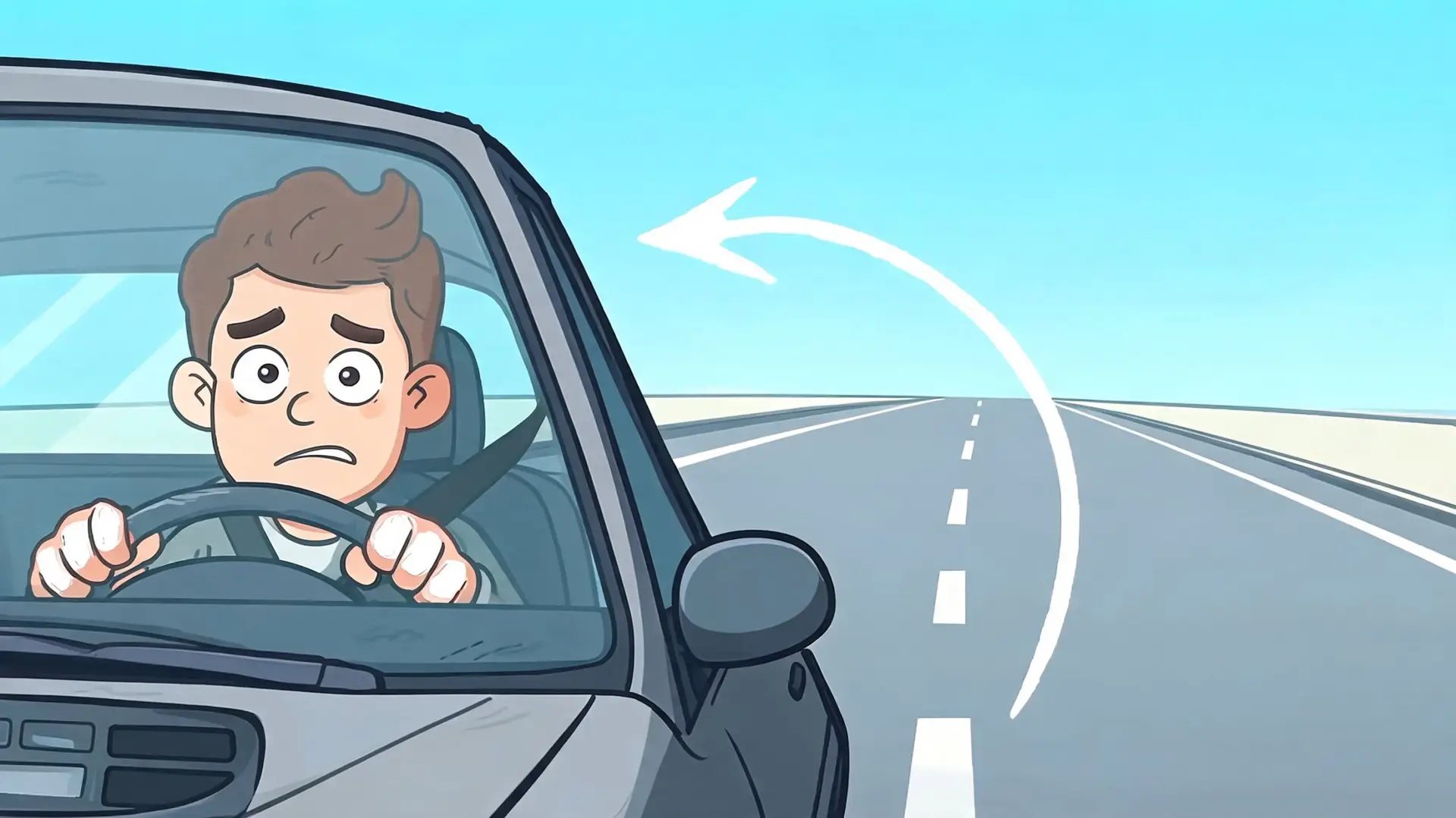
You merge onto the highway, let go of the wheel for a second, and the car starts walking toward the next lane. Not sharply. Just enough that you keep correcting it. By the time you reach your exit, your hands are doing more work than they should.
That's one of the most common alignment complaints. Another is when the steering wheel is off-center even though the vehicle is moving straight. Drivers often assume it's a tire issue, a road crown issue, or just normal wear. Sometimes it is. Often, it isn't.
A misaligned car behaves a lot like walking in shoes with the soles worn unevenly. You can still move forward, but your body keeps compensating. Your car does the same thing. The suspension and tires stop sharing the load evenly, and the result shows up in the steering, the tread, and sometimes your fuel use.
Why this isn't a minor annoyance
Alignment service has become a large part of regular vehicle care because the need is real, not because shops invented it. The global wheel alignment services market was valued at USD 27.29 billion in 2025 and is projected to reach USD 37.04 billion by 2034, while North America held a 40.01% market share according to Fortune Business Insights' wheel alignment market report. That kind of demand comes from one thing: a lot of vehicles need this service to stay safe and drive correctly.
A car that's out of alignment rarely fixes itself. It usually wears tires until the owner is forced to deal with it.
What drivers usually notice first
Some symptoms show up behind the wheel. Others show up when you inspect the tires.
- Constant correction on straight roads means the vehicle may not be tracking squarely.
- A crooked steering wheel often points to angles that aren't centered correctly.
- Edge wear on the tire tread is one of the clearest visual warnings.
- A change after a pothole or curb hit is often the event that knocks things out.
If your car has started doing any of that, the next question isn't whether to ignore it. It's where to take it so the diagnosis is accurate and the alignment is done properly.
Key Signs Your Car Needs an Alignment
Most alignment problems start with feel. The vehicle doesn't feel settled anymore. It may wander, pull, or react in a way that makes the steering feel busy instead of calm.
What you can feel from the driver's seat
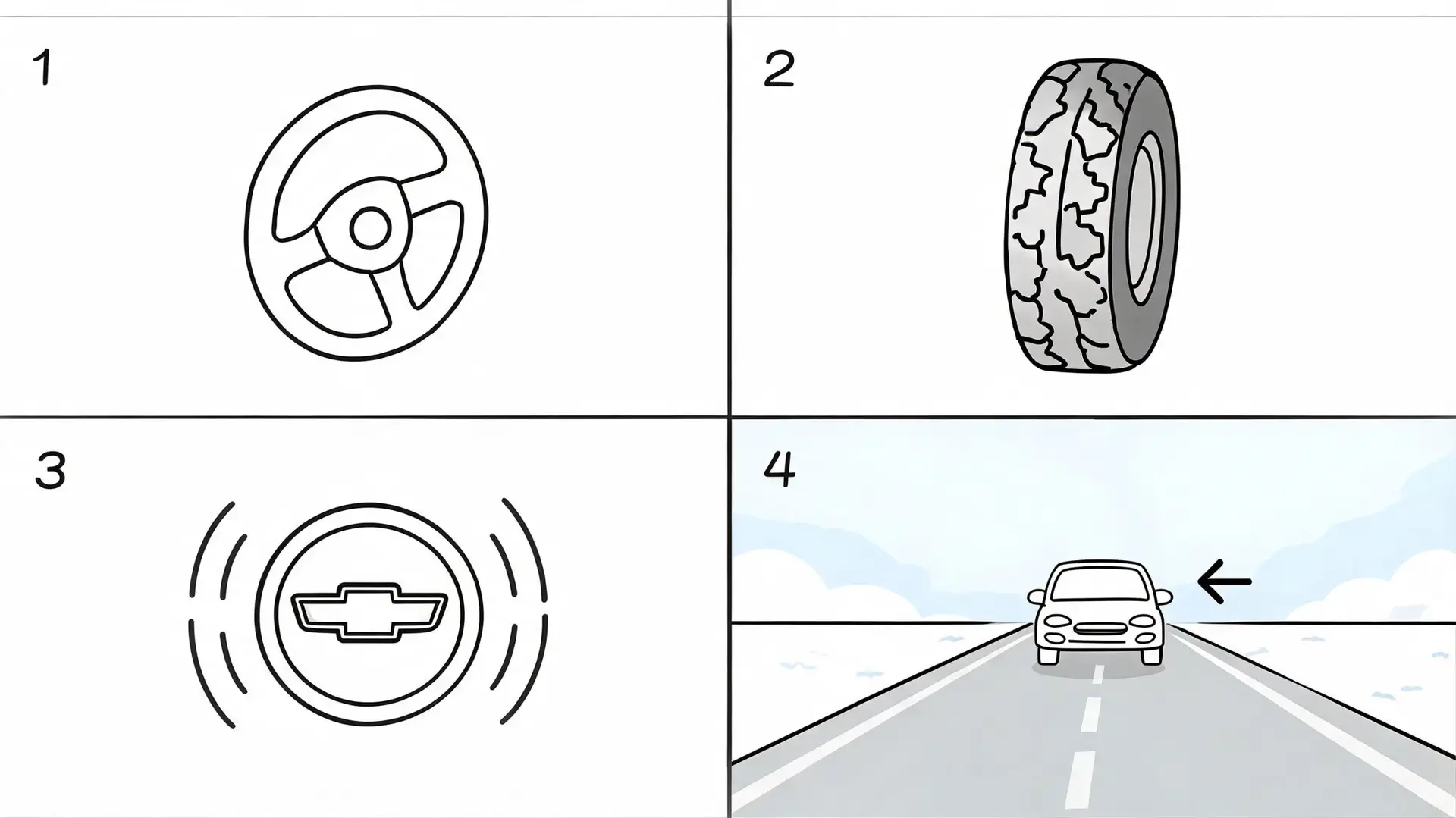
A healthy car tracks straight with minimal correction. If yours feels like a shopping cart with one bad wheel, pay attention to these signs:
- Pulling left or right even after checking tire pressure.
- Steering wheel not centered when the car is going straight.
- Loose or unsettled highway feel where you keep making tiny corrections.
- Tire squeal in turns when nothing else seems wrong.
Those symptoms don't always mean alignment alone. Worn suspension parts, damaged tires, or incorrect tire pressure can mimic the same complaint. That's why a good shop checks basics before touching the adjustment points. If your tire pressure is off, fix that first. If you need a quick refresher on the basics, this guide on how to pump a car tyre is a useful place to start.
What you can see on the tires
Tires tell the truth. They show what the vehicle has been doing on the road.
Look for:
- Inner-edge wear that suggests the tire isn't sitting flat on the road.
- Outer-edge wear that points to the same problem from the other direction.
- Feathering across the tread where the blocks feel sharp one way and smooth the other.
- One tire wearing differently than its match on the other side.
If you're buying new tires without fixing the underlying alignment problem, you're putting fresh rubber on the same bad geometry.
Later in the diagnosis, it helps to see the process in action.
When you actually need an alignment
I don't recommend alignments by habit alone. Some shops push them as if every car needs one on a fixed schedule. That's not how real-world maintenance works.
A car usually needs an alignment after one of these triggers:
- You hit a pothole hard enough to feel it through the suspension
- You bumped a curb
- You replaced steering or suspension parts
- You installed new tires and want to protect them
- The car shows one of the warning signs above
Why newer cars changed the conversation
On late-model vehicles, alignment is no longer just a tire and steering issue. It's also a technology issue. As of 2025, NHTSA guidelines mandate dynamic alignments for 70% of new US vehicles with lane-keeping assist, and static alignments alone fail in 40% of those cases, according to this vehicle alignment overview from Jiffy Lube.
Practical rule: If your vehicle has lane-keeping assist or similar ADAS features, ask the shop whether they can handle alignment work that supports proper recalibration. If they can't answer clearly, keep looking.
That's where many drivers get caught. The car may leave with the steering wheel straighter, but the system side of the job wasn't fully addressed.
Comparing Your Car Alignment Options
If you're asking where can i get my car aligned, your choices usually come down to three types of providers: the dealership, an independent repair shop, or a national chain that's built around tires and quick service. None is automatically right for every driver.
The better approach is to match the shop to the vehicle, the problem, and your priorities.
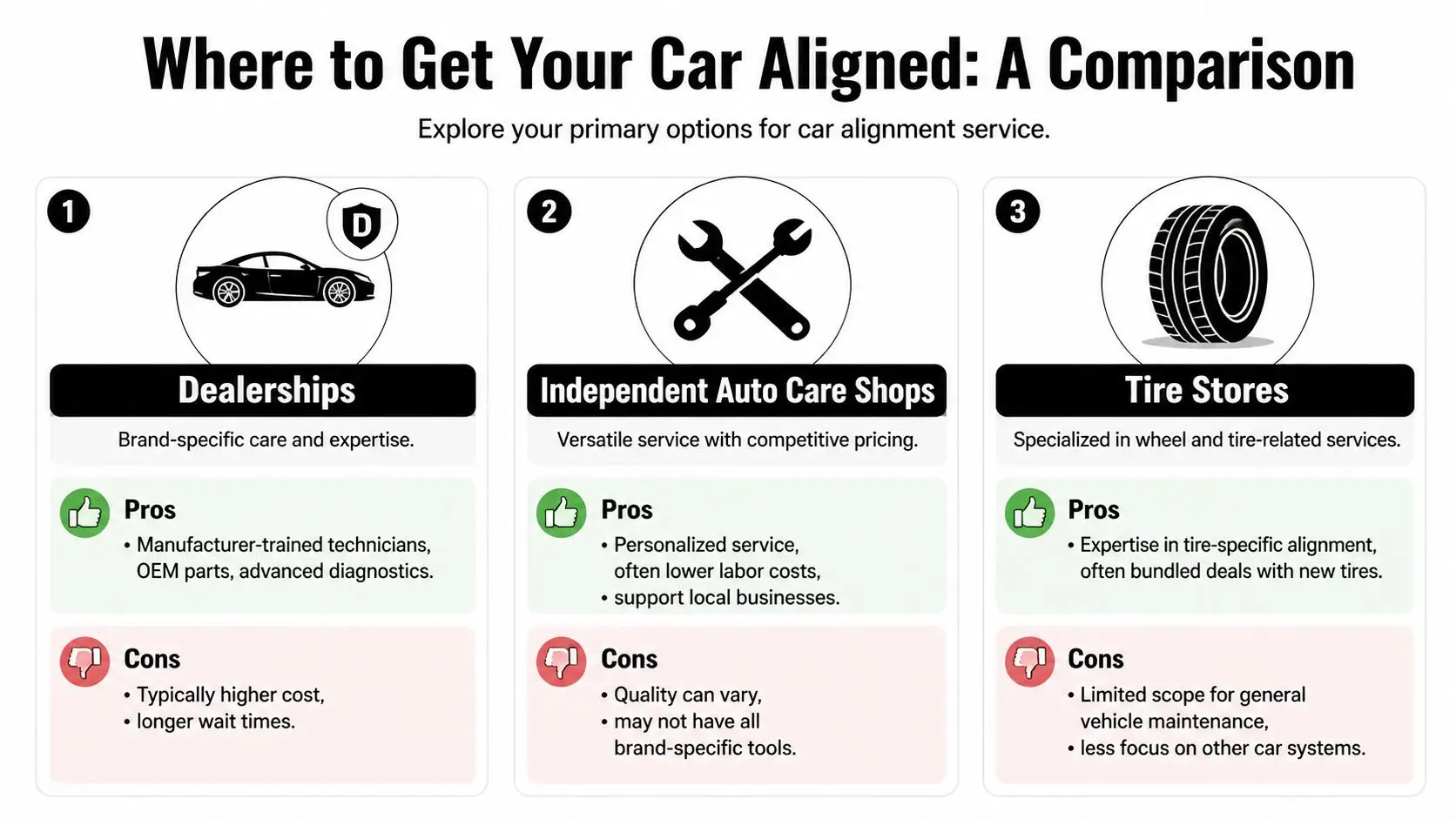
Side-by-side view
| Provider Type | Typical Cost | Pros | Cons |
|---|---|---|---|
| Dealership | Usually higher | Brand-specific procedures, access to manufacturer information, familiar with model-specific issues | Higher pricing, less personal service in some cases, may recommend dealer-only paths when aftermarket solutions would work |
| Independent Auto Care Shop | Varies by shop and vehicle | Personalized service, often more direct communication, can be strong value if equipment and training are current | Quality varies a lot, some shops have excellent equipment and some don't |
| Tire Store or National Chain | Often marketed as convenient | Easy to find, alignment often offered with tire service, fast scheduling at many locations | High-volume workflow, quality depends on the specific location, may focus narrowly on tires rather than the whole steering and suspension picture |
The real trade-off isn’t dealer versus independent. It’s whether the shop has the right people, the right equipment, and the discipline to inspect the car before adjusting anything.
Dealerships
Dealerships make sense when your vehicle is newer, highly model-specific, or tied closely to factory procedures. If you drive a late-model vehicle with advanced electronic systems, a dealership may already be set up around that brand’s workflow.
That said, dealerships aren’t always the most practical place for an alignment. You’re often paying for a broader overhead structure, and the service lane can feel less consultative if you’re trying to solve a straightforward wear or steering issue.
Independent shops
A strong independent shop is often the sweet spot. You can get an experienced technician, a better conversation about what’s wrong, and a more useful inspection of tires, steering, and suspension as one system.
You need to be selective. Some independent shops invest in current alignment equipment, VIN-based specification tools, and trained technicians. Others still treat alignment like a simple toe set and send the car out. If you’re comparing options, this article on Firestone lifetime alignment coupon considerations is useful because it frames the decision around long-term value instead of just the initial pitch.
Chains and tire-focused stores
National chains and tire stores can be convenient, especially if you’re already there for tires. Many can do solid work. The issue isn’t the brand name. It’s the volume model.
In a busy tire environment, the alignment may be treated as the last step in a tire sale instead of a full diagnostic check. That’s fine when the vehicle only needs a straightforward adjustment. It works poorly when the actual problem is a worn bushing, bent component, or an off-center thrust angle from the rear.
What usually works best
For an older commuter, a family SUV, or a work vehicle, I lean toward the shop that does three things well:
- Inspects before adjusting
- Explains what is adjustable and what is worn
- Provides a printout or clear explanation of results
One local option in that category is Kwik Kar Oil Change and Auto Care, which offers wheel alignment service with ASE-certified technicians and modern alignment equipment. That’s not the only place you can go. It is the type of setup worth looking for.
What Happens During a Wheel Alignment
Many drivers picture an alignment as a technician making a few quick turns on some bolts and sending the car back out. On a modern machine, the process is much more exact than that.
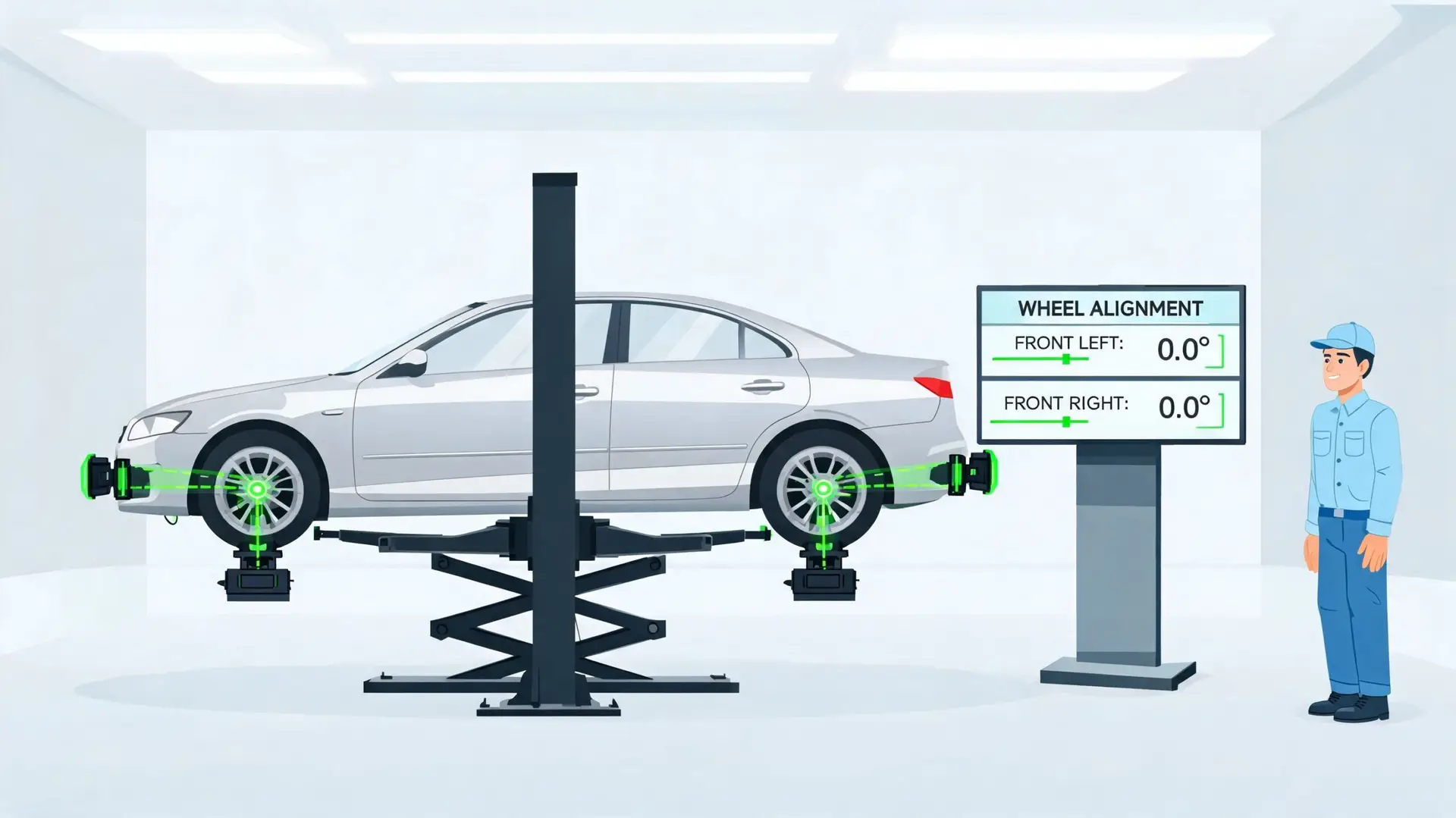
The car gets inspected first
Before a good technician adjusts anything, the car needs a basic steering and suspension check. Tire pressure matters. Tire condition matters. Worn tie rods, bad bushings, loose ball joints, or damaged control arm components can make any alignment temporary or impossible.
If a shop skips that step, the numbers on the screen may look better than the car will feel on the road.
Then the machine measures the angles
Think of alignment like tuning an instrument. The car can only drive smoothly if the angles are set in harmony with each other.
The three main alignment angles are:
- Camber, the inward or outward tilt of the wheel
- Caster, the angle of the steering axis
- Toe, the direction the tires point relative to each other
Modern alignment systems measure those angles with serious precision. Technicians use computerized machines to measure camber, caster, and toe with precision up to 0.1 degrees, and a toe misalignment of just 1/32 inch can reduce tire life by over 50%, according to SPC Alignment’s AlignGuide information.
Small numbers matter in alignment work. A setting that looks barely off on paper can wear a tire fast in the real world.
Adjustments are made to the vehicle’s available points
Not every angle is adjustable on every vehicle. That’s another thing drivers aren’t always told clearly.
A technician may adjust toe easily on one car, while camber or caster may require a specific kit, a shim, or replacement hardware on another. Some vehicles also need ride height and suspension condition considered before the final settings mean anything. If you want to see what a dedicated service visit for that looks like, Kwik Kar’s wheel alignment service page shows the kind of service scope you should expect from a provider.
You should leave with proof
A proper alignment visit usually ends with one of two things: a printout showing before-and-after readings, or a clear explanation of what was adjusted and what couldn’t be adjusted because of worn or damaged parts.
Ask for that. You’re paying for measured work, not guesswork.
Two-Wheel Versus Four-Wheel Alignments Explained
Often, confusion arises because drivers hear “front-end alignment” and assume all alignments are basically the same. They aren’t.
A two-wheel alignment typically focuses on the front wheels. That can be appropriate on older vehicles with a solid rear axle where rear adjustment isn’t part of the design. On those vehicles, the front settings do most of the work.
A four-wheel alignment checks both front and rear angles, including the rear thrust angle. That matters because the rear wheels influence how the entire vehicle tracks down the road, not just how the steering wheel feels in your hands.
Why four-wheel matters on modern vehicles
Four-wheel alignments are critical for over 80% of modern sedans and SUVs with independent rear suspensions, and that service corrects the rear thrust angle to prevent dog-tracking, which can cause fishtailing and double the rate of rear tire wear, according to Big Chief Tire’s wheel alignment service overview.
If you’ve ever followed a vehicle that seems to travel slightly sideways, that’s dog-tracking. The body looks like it’s pointed one way while the vehicle’s path is slightly different. The driver may not notice it at first, but the tires do.
What works and what doesn’t
What works is matching the alignment type to the suspension design.
What doesn’t work is selling a front-only adjustment on a vehicle whose rear geometry affects straight-line tracking and tire wear. That’s one reason cheap alignment offers can be misleading. If the car needs a four-wheel setup and gets a partial job, the problem may improve without being completely solved.
For most modern sedans, SUVs, and many trucks, ask one direct question: Are you checking and setting the rear thrust angle, or only adjusting the front? The answer will tell you a lot.
A Checklist for Choosing a Quality Alignment Provider
The hardest part of alignment service isn’t finding a shop that offers it. It’s finding one that can do it accurately and explain the result truthfully.
That’s where many drivers get burned. A 2023 AAA survey found that 62% of drivers unknowingly use uncertified shops for alignments, and RepairPal data links those shops to a 25% higher rate of repeat visits for the same issue, according to Firestone’s alignment information page.
What to verify before you book
Use this checklist before you hand over the keys:
- Check technician credentials. Ask whether the technician performing the work holds ASE certification, and ask whether the shop can show that clearly.
- Confirm outside accreditation. RepairPal and NAPA AutoCare affiliations don’t replace skill, but they are useful trust signals when paired with real inspection practices.
- Ask what machine and spec system they use. You want current computerized equipment and VIN-specific specifications, not generic settings.
- Find out whether they inspect suspension parts first. Alignment on worn components wastes your time and money.
- Ask for the result in writing. A before-and-after printout, or a clear explanation, should be standard.
Read reviews the right way
Don’t just scan star ratings. Look for comments about alignment specifically.
You want to see whether customers mention straight tracking, honest explanations, and whether the issue stayed fixed. That’s the same logic smart car owners use when comparing other vehicle services. For example, if you’re evaluating cosmetic care separately, a guide to Central PA mobile detailing costs helps show how useful price context and service transparency can be. The principle carries over. Clear scope matters.
Certification isn’t decoration. It’s one of the few signals a driver can check before the work starts.
One more question that filters out weak shops
Ask this: Can you handle newer vehicles that may need alignment work tied to driver-assist system performance?
A strong shop won’t dance around that question. They’ll explain what they can do, what they can’t, and whether another facility is needed for part of the process. That honesty is worth more than a low advertised price.
If you’re trying to build a long-term service relationship instead of gambling on whoever has an opening today, this guide on how to find a trustworthy mechanic is a practical next read.
Why Richardson Drivers Trust Kwik Kar for Alignments
Richardson drivers usually want the same thing from an alignment shop. They want the car to drive straight, the tires to wear normally, and the explanation to make sense.
Kwik Kar Oil Change and Auto Care fits the checklist that matters. The shop is backed by CARFAX, RepairPal, and NAPA AutoCare, and the work is handled by ASE-certified technicians using current equipment. That matters for commuters putting serious miles on their vehicles, families trying to stay ahead of tire and suspension problems, and fleet owners who can’t afford repeat visits for the same concern.
The other reason local drivers value that setup is simple. They can get transparent estimates and straightforward service without the dealership-only experience. For military personnel, first responders, and healthcare workers, the available discounts also make routine vehicle care easier to manage.
If your vehicle pulls, your steering wheel sits off-center, or you’ve had a hard impact with a pothole or curb, the right next step is a real inspection, not a guess.
Frequently Asked Questions About Car Alignments
How long does a wheel alignment usually take
It depends on the vehicle and what the technician finds during the inspection. A straightforward alignment takes less time than a vehicle with seized adjustment points, worn steering parts, or suspension damage. If the shop has to stop and show you failed components before aligning it, that’s a good sign they’re doing the job correctly.
Is alignment included when I buy new tires
Sometimes it’s offered as an add-on, and sometimes it’s packaged into a tire sale. Don’t assume it’s automatic. More important, don’t assume a quick alignment check means the job was completed properly. Ask whether the shop measured all relevant angles and whether they inspected the steering and suspension first.
Can a small curb hit knock the alignment out
Yes, it can. Not every bump will do it, but even a hit that seems minor can shift angles enough to affect tire wear or steering feel. If the steering changed afterward, don’t ignore it.
If the car drives straight, can it still be out of alignment
Yes. Some cars don’t pull much but still wear tires unevenly. Tire wear often tells the story before the steering wheel does.
Do I always need a dealership for an alignment
No. A dealership can be a good choice for some vehicles, but the better question is whether the shop has qualified technicians, modern equipment, and the ability to inspect the full steering and suspension system before making adjustments.
If your car is pulling, your steering wheel is off-center, or you want a second opinion before replacing tires, Kwik Kar Oil Change and Auto Care offers certified, transparent service for Richardson drivers who want the job checked carefully and explained clearly.