You park after a normal drive through Richardson, step out, and catch a sharp gasoline odor near the tailpipe. That usually gets people’s attention fast. It should.
When exhaust smells like gas, your car is telling you fuel isn’t being burned the way it should. Sometimes the issue is relatively straightforward, like an airflow or sensor problem. Other times, it points to a condition that can affect drivability, emissions, fuel economy, and in some cases your family’s safety.
A lot of drivers make the same mistake at this point. They either ignore it because the car still runs, or they jump straight to replacing parts without a real diagnosis. Neither works well. The better approach is simple: protect yourself first, do a few safe checks, then let a technician confirm the cause before a small issue turns into a much bigger repair.
That Unmistakable Smell A Sign You Should Never Ignore
It usually happens at the end of a trip. The engine’s hot, the car is idling or just shut off, and suddenly that raw-fuel smell is obvious. Some drivers notice it only outside the vehicle. Others catch it near the rear bumper or even around the cabin after parking.
That smell isn’t a personality trait of an older car. It’s a warning. Modern engines are designed to meter fuel very precisely, so if gasoline is making it through the exhaust with a strong odor, something in that system is out of balance.
What the smell is really telling you
In plain terms, the engine is often running too rich. That means it has too much fuel or not enough air for clean combustion. Instead of burning completely, some fuel leaves the engine unburned and goes out through the exhaust.
Imagine a grill flooded with lighter fluid. It may still ignite, but it won’t burn cleanly.
A gas smell from the exhaust is usually a combustion problem first, not just an odor problem.
I’ve seen drivers focus only on the smell and miss the clues that matter more. A rough idle, a check engine light, dark exhaust, or a drop in fuel economy often show up alongside it. Even if those symptoms aren’t obvious yet, the odor by itself is enough reason to act.
Why waiting usually makes it worse
Rich-running engines don’t just waste fuel. They can foul spark plugs, stress the catalytic converter, and make diagnosis more expensive later because one failed component starts affecting others. The car may still be drivable for the moment, but that doesn’t mean it’s safe to ignore.
If you’re commuting daily, carrying kids, or driving an older high-mileage vehicle, this is one of those problems that deserves a real decision, not a guess. Start with safety.
Your First Move Critical Safety Actions
If the smell is strong, treat it like a real hazard until proven otherwise. Gasoline exhaust odors can expose you to toxic unburned hydrocarbons and carbon monoxide, and gasoline engine exhaust contains over 50 known carcinogens, including benzene, according to California Proposition 65 information on gasoline engine exhaust. The same source notes that vehicles with rich mixtures can emit 2-5 times more CO, and fuel leaks account for 5% of vehicle fires.
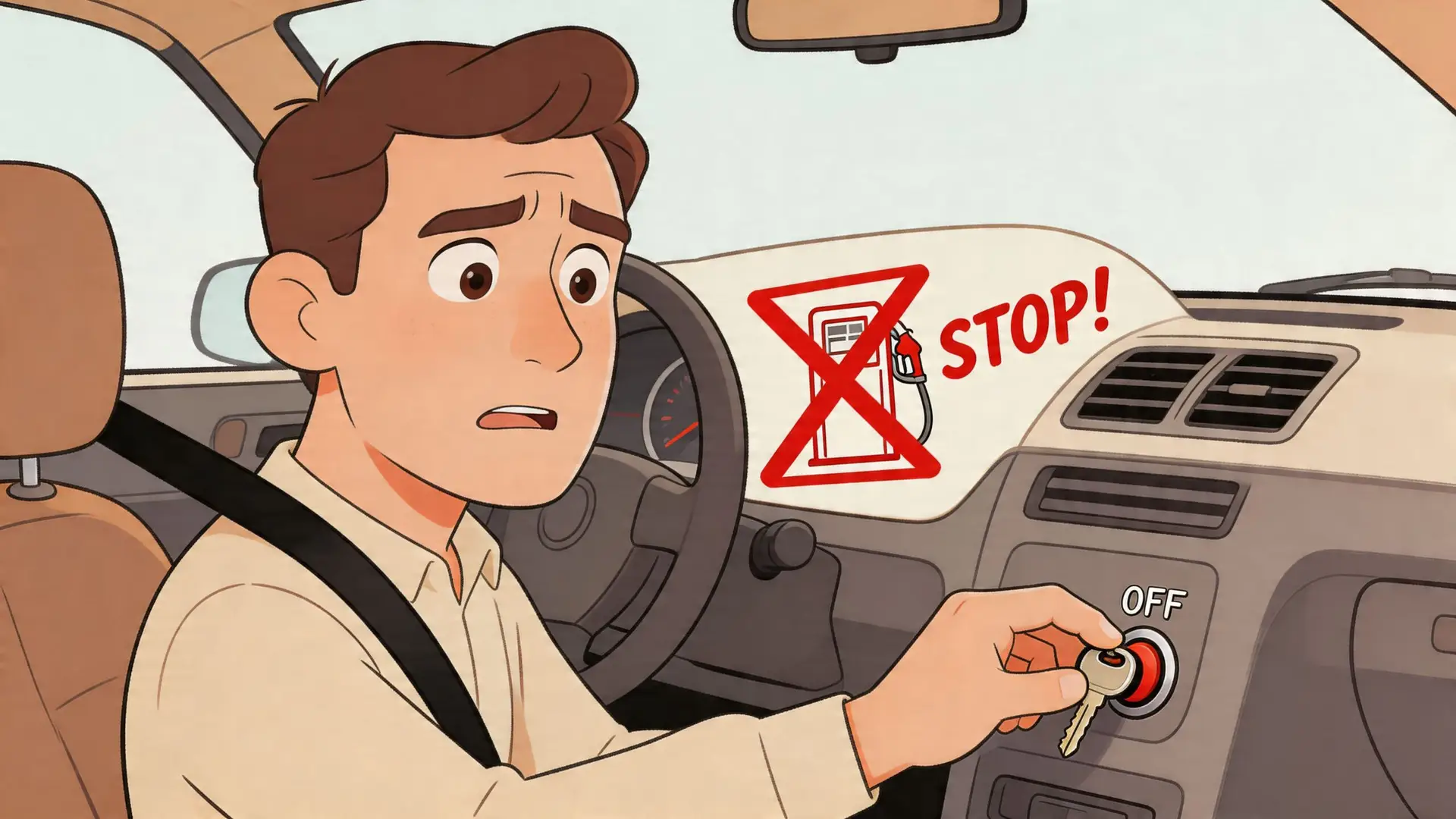
What to do right away
Park outdoors
Move the vehicle to an open area if you can do it safely. Don’t leave it in a closed garage where fumes can collect near water heaters, pilot lights, or other ignition sources.
Shut the engine off
Don’t keep restarting it to “see if it clears up.” Repeated starts can dump more fuel into an already rich condition.
Keep flames and sparks away
No smoking, no lighters, and no poking around with improvised electrical tools.
Step back if the smell is intense
If the odor is strong enough to make you feel lightheaded or uncomfortable, get away from the car and arrange a tow rather than driving it.
When you should stop driving immediately
Some situations move this from “needs attention” to “don’t drive it.”
- Visible liquid fuel under the car or in the engine bay
- Smoke along with the fuel smell
- Misfiring, stumbling, or stalling
- Fuel smell inside the cabin, especially with passengers on board
Practical rule: If you smell gas and also see a leak or feel the engine running badly, shut it down and don’t gamble on making it home.
What not to do
A few common reactions make the situation worse.
- Don’t ignore it because the car still starts. Rich-running cars often keep running long after the problem begins.
- Don’t pour random fuel additives into the tank as a first response. Additives don’t fix a bad sensor, a leaking injector, or a fuel pressure problem.
- Don’t assume it’s “just old car smell.” Exhaust that smells like gas has a cause. The job is to find it before heat and raw fuel damage other parts.
Why Your Car's Exhaust Smells Like Gas
You smell fuel at the tailpipe because gasoline is making it through the engine without burning completely. In the shop, that usually points to one of two paths. The engine is being commanded to run too rich, or fuel is getting into a cylinder when it should not.
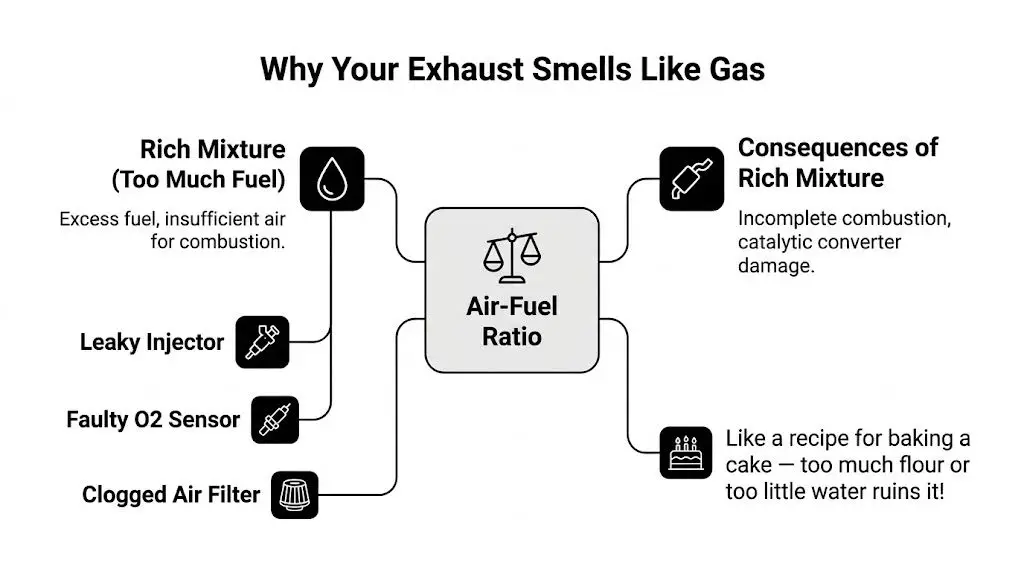
A healthy gas engine tries to stay near the proper air-fuel balance for clean combustion. When that mix shifts too far toward fuel, the burn is incomplete and raw hydrocarbons leave through the exhaust. That is the odor you notice standing behind the car at idle, after startup, or when you pull into the garage at the end of a Richardson commute.
Two failure patterns cause most fuel-smell complaints
The first is a control problem. The engine computer adds more fuel than needed because one of its inputs is wrong.
The second is a mechanical leak. Fuel slips past an injector or another component even when the computer is not asking for it.
That difference matters. A sensor problem and a leaking injector can create the same smell, but they do not get fixed the same way.
The parts that commonly cause it
A few components show up over and over in rich-running diagnoses:
O2 sensors
Oxygen sensors report how much oxygen is left in the exhaust so the computer can trim fuel delivery. When a sensor gets lazy or fails, the computer may keep enriching the mixture. If you want a closer look at that failure pattern, read these bad O2 sensor symptoms.MAF sensor
The mass airflow sensor measures incoming air. If it reads low because it is dirty or failing, the fuel calculation can end up too heavy.Air intake restriction
A clogged air filter or intake restriction can cut available air enough to make the mixture richer than it should be.Leaking fuel injectors
An injector that drips after shutdown or overfuels at idle can leave a strong gas smell and sometimes cause a hard start the next morning.Fuel pressure problems
Excess fuel pressure can push more fuel through the injectors than the system intended.Ignition misfires
If the spark is weak or inconsistent, the engine may have the right amount of fuel but still fail to burn it fully.
If you also notice black smoke from the exhaust, that usually supports an over-fueling condition instead of a minor odor with no performance change.
Why this problem can get expensive
Raw fuel in the exhaust does more than smell bad. It can foul spark plugs, wash oil off cylinder walls, and overheat the catalytic converter. Catalytic converters are expensive, and on many late-model vehicles the bill climbs fast once excess fuel starts damaging the exhaust system.
Families and daily commuters should take that seriously. A car that still drives can still be doing damage on every trip to work, school pickup, or a run down Central Expressway.
What a technician is trying to determine
At Kwik Kar, the first question is simple. Is the engine running rich by command, or is fuel leaking past a part that should be sealed?
That is why a real diagnosis matters more than swapping random parts. We look at scan data, fuel trims, sensor readings, misfire history, and signs of injector leakage. Those clues tell us whether the fix is a sensor, an air metering problem, a fuel delivery fault, or an ignition issue causing unburned fuel to exit the tailpipe.
A gas smell from the exhaust is one symptom. The repair depends on which system is causing it.
DIY Checks You Can Perform Safely
There are a few things you can check yourself without taking risks or tearing into the car. The goal isn’t to diagnose every possibility in your driveway. It’s to gather useful clues and decide whether the car should be driven, scanned, or towed.
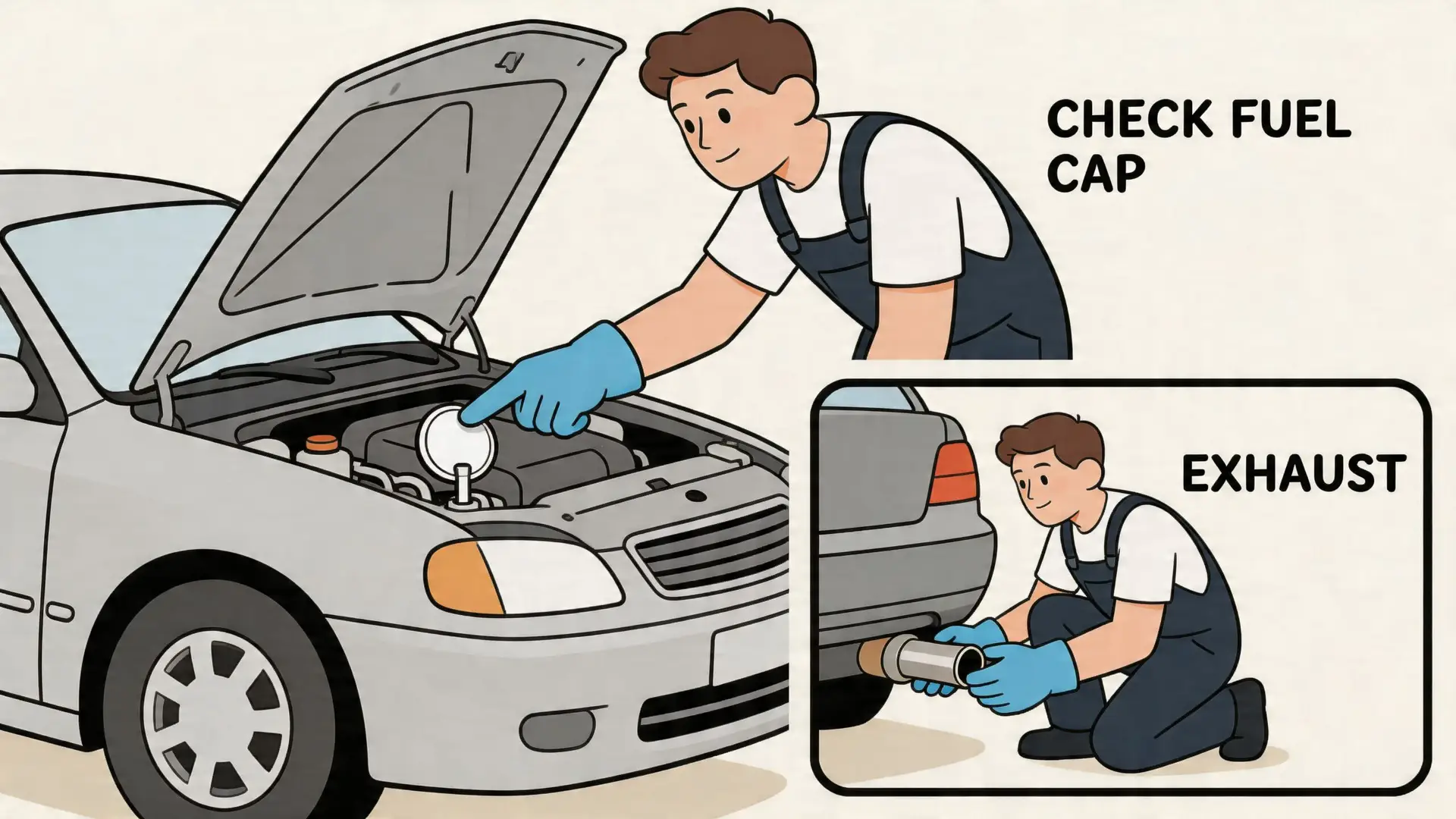
Start with what you can see and smell
Do these checks with the car parked outside.
Look at the tailpipe area
If you see dark soot or obvious black residue, that supports a rich-running diagnosis.Check under the vehicle
Look for wet spots or drips. If anything looks or smells like raw fuel, stop there and don’t restart the engine.Notice when the odor is strongest
Only at startup, only after parking, or all the time? That timing helps narrow the problem when a technician tests it.Pay attention to the idle
A shaky idle, hesitation, or stumbling can point toward an active mixture problem rather than a one-off odor event.
Check the simple item people overlook
Make sure the gas cap is fully tightened and seated correctly. A loose cap doesn’t usually explain a tailpipe rich condition by itself, but it’s quick to verify and worth ruling out before you move on.
If you’ve been thinking about cleaning the fuel system yourself, be careful about what that can and can’t accomplish. This article on DIY fuel injector cleaning is useful because it separates maintenance from actual fault repair.
Use an OBD-II scanner the right way
A basic scan tool is the most helpful DIY step because it gives you direction. According to Sun Automotive on gas-smelling exhaust and rich codes, a rich fuel mixture often triggers P0172 or P0175. Those codes point to a system-too-rich condition and often tie back to failing O2 sensors, which are common after 60,000-100,000 miles. The same source notes a failing O2 sensor may prompt 10-20% excess fuel injection.
What to do
Plug the scanner into the OBD-II port
It’s usually under the dashboard on the driver’s side.Read stored and pending codes
Don’t clear them right away. Stored information matters.Write the codes down exactly
P0172 and P0175 matter here, but any accompanying codes help too.Check freeze-frame data if your scanner shows it
That snapshot can reveal whether the issue happened at idle, under load, or during warm-up.
What those codes do and don’t tell you
A code is a clue, not a verdict.
- P0172 or P0175 means the system is rich.
- It doesn’t automatically mean “replace the O2 sensor.”
- It may also point toward a MAF issue, injector issue, or fuel pressure problem.
Bring the exact codes with you. Good diagnostics starts faster when the technician knows what the car saw and when it saw it.
DIY line you shouldn’t cross
You can inspect. You can scan. You can document symptoms.
You shouldn’t open the fuel system, test injector spray patterns in your driveway, or keep driving a car that smells strongly of gas just because the scanner gave you a code. That’s where professional testing becomes the safer and cheaper move.
Common Repairs and Estimated Costs
The repair bill usually comes down to one question. Are we dealing with a simple input problem, or has raw fuel been entering the exhaust long enough to damage other parts?
That difference matters. A restricted air filter or lazy sensor is often a smaller job. A leaking injector, high fuel pressure condition, or converter damaged by rich running costs more because diagnosis takes longer and the repair can involve multiple components.
Estimated Costs for Gas Smell Repairs
| Common Cause | Typical Repair | Estimated Cost (Parts & Labor) |
|---|---|---|
| Faulty O2 sensor | Replace failed sensor and verify fuel trim response | $200 to $450 |
| Contaminated or failed MAF sensor | Clean sensor if possible or replace it, then retest | $150 to $400 |
| Clogged air filter | Replace air filter and inspect for related drivability issues | $25 to $90 |
| Leaking fuel injector | Test injector balance, replace faulty injector or seals as needed | $250 to $900 |
| Bad fuel pressure regulator | Pressure test the system and replace regulator if out of spec | $200 to $650 |
| Catalytic converter affected by prolonged rich running | Confirm converter damage and replace if needed | $900 to $2,500+ |
These are realistic shop ranges, not guarantees. Richardson drivers with turbocharged engines, direct injection, or limited-access engine bays often land toward the higher end because labor time increases fast.
Why estimates sometimes change after diagnosis starts
Fuel-smell complaints often have a root cause and a consequence. For example, the original problem may be a leaking injector, but by the time the car gets tested, the spark plugs are fuel-fouled and the converter has taken a beating. That changes the estimate because the full repair changed.
If you want a plain-English explanation of why that happens, this article on unexpected changes in repair estimates gives good context.
A practical way to make the decision
If the smell is brief on a cold start and there are no other symptoms, schedule diagnosis soon and avoid putting it off for weeks.
If the smell is strong, keeps returning, or comes with rough running, hard starts, or fuel smell near the cabin, stop driving it except to get it repaired. For families commuting around Richardson, that is the safer call.
Diagnosis first usually saves money. Guessing does not. Replacing an O2 sensor because a code points in that direction can waste money if the actual fault is fuel pressure or an injector leaking after shutdown.
If injectors are part of the conversation, this breakdown of fuel injector cost to fix helps explain why injector repairs can range from a seal replacement to a more involved service.
The lower-cost path is usually accurate testing first, one targeted repair, and a final verification that the fuel smell is gone.
When to Trust the Pros at Kwik Kar
A fuel smell from the exhaust can move out of the DIY category fast. If the odor is strong, keeps coming back, or shows up inside the cabin, get the car checked before you keep commuting in it.
For Richardson families, commuters, and anyone who spends long stretches in traffic, that decision matters. A rich-running engine can turn one fix into several if you keep driving it, and any smell that reaches the cabin raises the stakes.
Signs you’re past the DIY stage
Bring it in if any of these apply:
- The smell stays around after the basic checks you can do safely
- You have P0172 or P0175, especially with rough idle, hesitation, or hard starts
- The smell gets into the cabin
- You regularly drive children, passengers, or coworkers
- The vehicle is older or high-mileage, and the symptom is getting stronger
What a shop can confirm that a scanner can’t
A code reader gives you a starting point. It does not confirm the failed part.
In the shop, we look at live fuel trim data, sensor response, fuel pressure, injector behavior, and cold-start patterns. That matters because the same rich-condition code can come from very different faults. I have seen one car need a leaking injector, another need a skewed MAF diagnosis, and another turn out to have fuel pressure that stayed too high after shutdown. Guessing at parts usually costs more than testing.
A proper diagnosis also checks for what the original problem may have damaged, including spark plugs and the catalytic converter.
Why this matters in Richardson
Richardson drivers put real time on their vehicles. School pickup lines, stop-and-go commuting, and hot weather all make a fuel-smell problem harder to ignore and more expensive to postpone.
If this is the family car, the daily work commuter, or the vehicle you depend on every morning, treat the smell as a repair decision, not a wait-and-see issue. At Kwik Kar, the goal is simple. Confirm the cause, fix the right part, and make sure the odor is gone before the problem grows into a bigger repair bill.
Frequently Asked Questions About Gas Smells
Is it safe to drive if my exhaust smells like gas
Sometimes the car will still drive, but that doesn’t make it safe. If the smell is mild and there are no drivability symptoms, you may be able to move it a short distance for service. If the odor is strong, you see fuel, or the engine is misfiring, shut it off and tow it.
Can bad or old gasoline cause this smell
It can contribute to poor running, but it usually isn’t the main reason exhaust smells like gas. Most of the time, the smell points to a mixture-control problem, a sensor issue, or fuel getting through the system unburned.
Will the smell go away on its own
Usually, no. Rich-running conditions don’t tend to self-correct. Even if the smell seems to disappear for a day or two, the underlying problem can return and may damage other components while you wait.
If your exhaust smells like gas, don’t guess and don’t keep driving until the problem gets expensive. The ASE-certified team at Kwik Kar Oil Change and Auto Care helps Richardson drivers diagnose fuel, sensor, and drivability issues with the kind of testing that finds the cause instead of swapping parts. If your car has a fuel odor, rough idle, or rich-mixture codes, schedule a professional inspection and get a clear plan before a minor warning turns into a major repair.