Rough Idle Diagnosis: Causes, Tests and When to Get Help
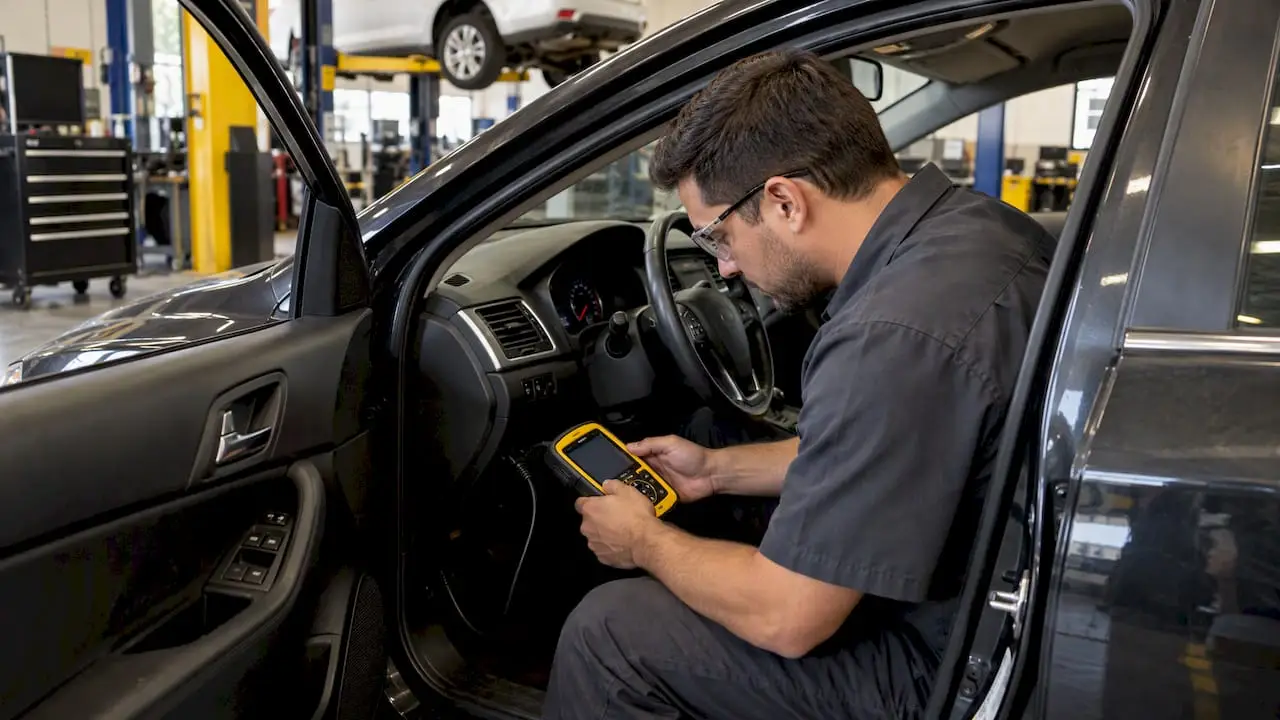
A rough idle is a symptom, not a diagnosis. The shaking, stumbling or uneven RPM you feel at a stop usually traces back to one of three things: air getting into the engine that the computer did not measure, a cylinder that is not firing cleanly, or a fuel or sensor problem that throws the mixture off. The fastest way to find which one is to note when the roughness happens, read the stored codes, inspect the obvious items, and then test one system at a time.
This guide walks through that process the way a technician approaches it. It is written for drivers in Richardson, Plano, Garland, Addison and North Dallas who want to understand what is going on before they book a repair.
TL;DR
- A rough idle points to air, fuel or ignition trouble. Vacuum leaks, worn spark plugs, weak ignition coils, dirty injectors and a dirty throttle body are the most common culprits.
- Note when it happens: cold, warm, at a stop in gear, or with the A/C on. That detail narrows the list quickly.
- A code is evidence, not a verdict. Proper diagnosis confirms the cause before parts are replaced.
- A flashing check-engine light needs prompt attention. Do not keep driving normally with it.
- Kwik Kar Oil Change & Auto Care in Richardson can diagnose it at (972) 644-1851.
Table of Contents
- What a rough idle feels and sounds like
- The most common causes of a rough idle
- Narrow it down: when does the roughness happen?
- The diagnostic process, step by step
- What you can safely check before you book
- Don’t throw parts at it
- When to stop driving and get it checked
- Rough idle, inspections and emissions in Texas
- Our perspective: diagnosis first, parts second
- Rough idle diagnosis in Richardson, TX
- FAQ
- Sources
What a rough idle feels and sounds like
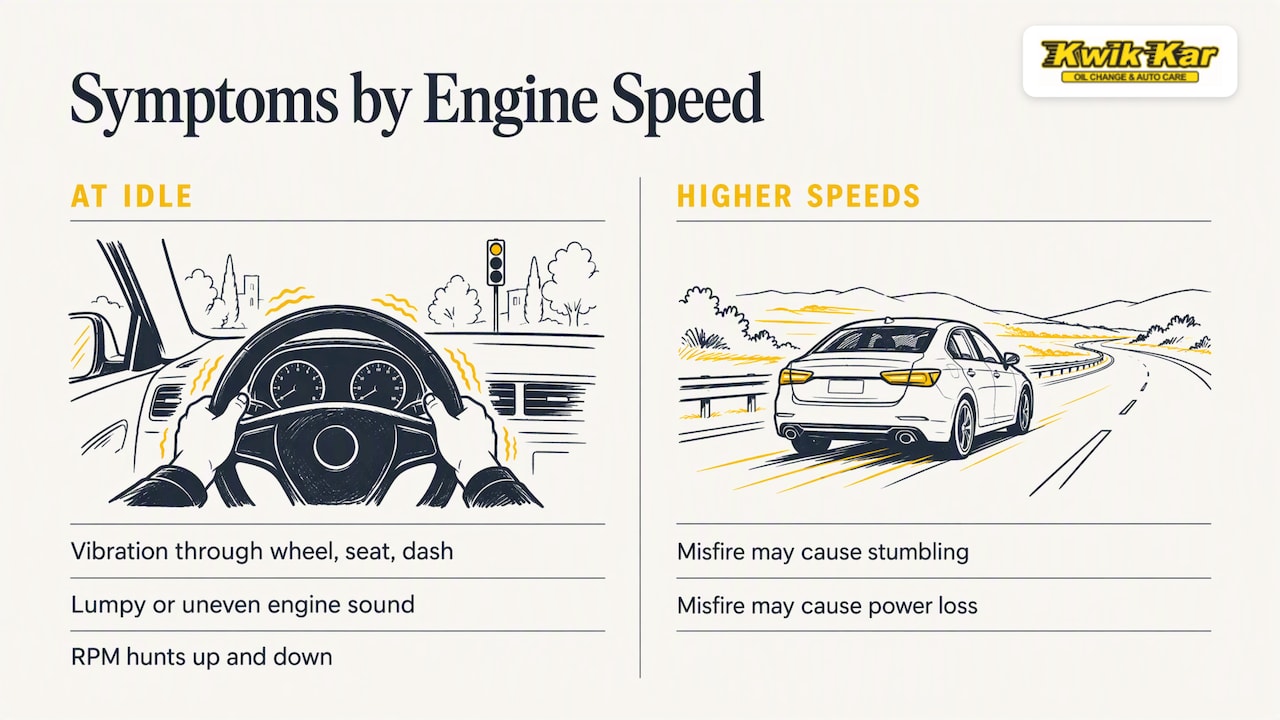
Most drivers describe it as a vibration through the steering wheel, seat or dash while stopped. The engine may sound lumpy or uneven, with RPM that hunts up and down. Sometimes it feels like a stumble, as if one cylinder skipped a beat.
General Motors describes the complaint in one of its technical service bulletins as a lopey, lumpy or low idle that some owners notice most when the engine is fully warm or idling in Drive at a stop. That bulletin covers certain 2019 to 2021 Chevrolet Silverado and GMC Sierra trucks, so treat it as an example of the symptom, not a universal diagnosis.
A misfire often shows up as shaking at idle. At higher engine speeds the same fault can turn into stumbling or a loss of power, according to AA1Car’s misfire guide.
The most common causes of a rough idle
Several systems have to work together for an engine to idle smoothly. When one slips, the idle is usually the first place you feel it. The main suspects, drawn from a broad repair guide to rough idle and from AA1Car’s misfire article, are:
- Vacuum leaks. A cracked hose, loose intake connection or leaking gasket lets unmetered air in.
- Ignition faults. Worn spark plugs, bad plug wires or weak coils cause cylinders to misfire.
- Dirty or clogged fuel injectors, or low fuel pressure, which leave the mixture uneven.
- Throttle-body problems. Carbon buildup, or a faulty idle-air-control (IAC) valve or MAP sensor.
- Emissions plumbing. A stuck-open EGR valve or leaking PCV plumbing.
- Mechanical issues. Leaking intake valves, low compression or, less often, balance-shaft failure.
Worn engine or transmission mounts can also make a healthy engine feel rough, because they let normal vibration reach the cabin. GM’s own diagnostic guidance for unresolved rough idle includes checking engine-mount vibration alongside codes, voltage and fuel readings.
Why vacuum leaks show up at idle
At idle the throttle is almost closed, so only a small amount of air enters the engine. A leak that adds a little extra air is a large share of the total, which leans out the mixture. As you open the throttle, the same leak becomes a smaller fraction and the roughness often fades. AA1Car explains this effect, and it is why a smooth engine at 2,500 RPM and a shaky one at a red light can be the same problem.
What the throttle body does
The throttle body regulates airflow into the engine. On many vehicles the IAC valve lets the computer fine-tune idle speed by bleeding small amounts of air into the intake. Haynes notes that dirt buildup can gum up the throttle-body butterfly and cause a rough idle. Not every vehicle has a separate IAC valve, so the exact part depends on your make and model.
Narrow it down: when does the roughness happen?
Your observations are the first diagnostic tool. Before you call a shop, spend a few days noticing the pattern. Car Fault Lab suggests paying attention to whether the roughness appears cold, after warm-up, with the A/C running, or only when the transmission is in gear.
| Pattern you notice | What it can point to |
|---|---|
| Rough only when cold | Fuel delivery, worn plugs, a sticking idle-control system |
| Rough only when warm | Stuck-open EGR valve, EVAP purge valve, heat-sensitive ignition parts, vacuum leak that opens with heat |
| Rough at a stop in Drive, smooth in Park | Engine or transmission mounts, idle-speed control, load-related issues |
| Rough with A/C on | Weak idle compensation, dirty throttle body, accessory load on a tired engine |
| Rough with a flashing check-engine light | Active misfire that needs prompt attention |
| Intermittent, no pattern | Loose connectors, grounds, or a failing sensor that acts up occasionally |
This table is a starting point, not a verdict. Different engines behave differently, and several causes can overlap.
Rough idle when warm
A warm-only rough idle can come from a stuck-open EGR valve, an EVAP purge valve that flows too much fuel vapor, a vacuum leak that opens as parts expand with heat, ignition components that fail when hot, or a dirty or sticking idle-air system, according to a symptom guide on warm-engine roughness. In Texas summers, heat soak in the engine bay makes these heat-related faults easier to notice, especially in stop-and-go traffic on Central Expressway or George Bush Turnpike.
Rough idle at a stop
If the vehicle shakes at lights but drives smoothly, suspect the things that matter most at low RPM: unmetered air, fuel mixture, idle control and mounts. If it also stalls or nearly stalls, mention that when you book. A car that idles low and cuts off needs a professional look sooner rather than later.
The diagnostic process, step by step
Good diagnosis follows an order. ASE’s study guide for advanced engine performance describes it as verifying the customer concern, deciding whether it is a malfunction or normal operation, inspecting components, finding service information and choosing procedures based on the vehicle’s data. In practice, it looks like this.
- Verify the complaint. The technician reproduces the rough idle, ideally under the same conditions you describe (warm, in gear, A/C on).
- Retrieve codes and freeze-frame data. Stored and pending codes are read before anything is cleared. Freeze-frame data records conditions when the fault was set. A code is evidence of a detected condition, not automatic proof that a named part has failed.
- Inspect before measuring. Hoses, wiring, connectors, grounds, fluids and the air filter get a visual and physical check. This prevents chasing odd data caused by something obvious, such as a cracked hose or a bad ground, as this ASE-focused training lesson points out.
- Review live data. System voltage, oxygen-sensor behavior, fuel trims, fuel pressure and engine load are compared with what they should be. GM’s bulletin on unresolved rough idle lists these same checkpoints.
- Test one system at a time. Air, fuel and ignition each get their own branch of testing, so one fix does not hide another problem.
- Repeat the original conditions. After the repair, the technician reruns the conditions that triggered the symptom to confirm it is gone.
Step 1: Air and vacuum
The technician inspects intake and PCV plumbing and may use an approved smoke test to find unmetered-air leaks, a method described in a rough-idle workflow guide. Fuel trims help here too. On a Ford with lean codes P0171 or P0174, a vacuum leak can produce positive fuel trims at idle that move closer to normal at 2,500 rpm.
Step 2: Ignition
Spark plugs, coils and wires are compared for signs of cylinder-specific trouble. MOTOR Magazine’s rough-idle troubleshooting column recommends starting with fuel and ignition systems, and notes that a secondary-ignition oscilloscope can show the overall health of the ignition system.
Step 3: Fuel
Fuel pressure is measured safely and compared with the specification for the vehicle. Dirty injectors, a weak pump or a clogged filter can all show up here. Fuel-system service is only recommended when testing points to it.
Step 4: Mechanical condition
If air, fuel and ignition all check out, compression, leak-down or valve-timing tests may be needed. These are less common, but they matter when an engine has high mileage or a history of overheating.
What you can safely check before you book
You do not need to turn wrenches to help the diagnosis. A few simple observations save time:
- Write down when the roughness happens and whether the check-engine light is steady or flashing.
- Look at the air filter and the air-intake tube for cracks, loose clamps or disconnected hoses.
- Note any recent work, a recent fill-up at a new station, or a recent battery replacement.
- If the engine bay is caked with grime, a gentle approach to cleaning the engine bay safely makes leaks, cracked hoses and loose connectors easier to spot. Keep water away from electrical connectors and the alternator.
Do not clear codes before the shop reads them, since that erases the freeze-frame data a technician would use. And if you smell fuel, see smoke, or the engine is overheating, skip the DIY checks and call for help.
Don’t throw parts at it
The most expensive way to fix a rough idle is to guess. Replacing plugs, then coils, then a sensor can cost more than a single proper diagnostic, and the problem may remain if the real cause is a vacuum leak or a failing mount. Our guide to avoiding surprise engine diagnostic costs lists the questions worth asking any shop before work begins. For a general overview of how to work through unfamiliar symptoms, see our quick car trouble diagnosis steps.
Two related reads may help if your dashboard is lit up: what the check-engine light means for Richardson drivers and bad O2 sensor symptoms, since a failing oxygen sensor can skew the mixture and cause uneven running.
When to stop driving and get it checked
A mild, steady roughness is worth scheduling soon, but it is rarely an emergency. Some signs are different:
- A flashing check-engine light. The Car Care Council says a flashing light indicates a problem occurring right now and needs immediate attention. Our page on what to do when the check-engine light flashes covers the next steps.
- Stalling, or loss of power in traffic. An engine that dies at an intersection is a safety concern.
- Overheating, fuel smell or smoke. Pull over safely and call for assistance.
In April 2026, car-care month guidance from AAA, NAPA and industry partners listed rough idling alongside hard starts, stalling and low power as problems to address rather than ignore. Not every rough idle is urgent, but none improves by being ignored for months.
Rough idle, inspections and emissions in Texas
Rough idle can affect emissions, so it is worth knowing where Texas stands. Texas ended most non-commercial passenger vehicle safety inspections on January 1, 2025, under House Bill 3297, according to the Texas Department of Public Safety. Commercial vehicle safety inspections continue. Emissions testing remains required for qualifying vehicles in applicable counties, and DPS notes that emissions tests are different from safety inspections.
If your vehicle must pass an emissions test, an unresolved misfire or a lit check-engine light can be a problem at the testing station. Our article on why a check-engine light fails inspection explains what to do before you go.
Our perspective: diagnosis first, parts second
At Kwik Kar Oil Change & Auto Care in Richardson, we see rough idle come in with the same story: the owner has already heard three different guesses. Our approach is to slow down. Our ASE-certified technicians start by confirming the complaint, reading the codes and checking the basics, then testing the system the evidence points to.
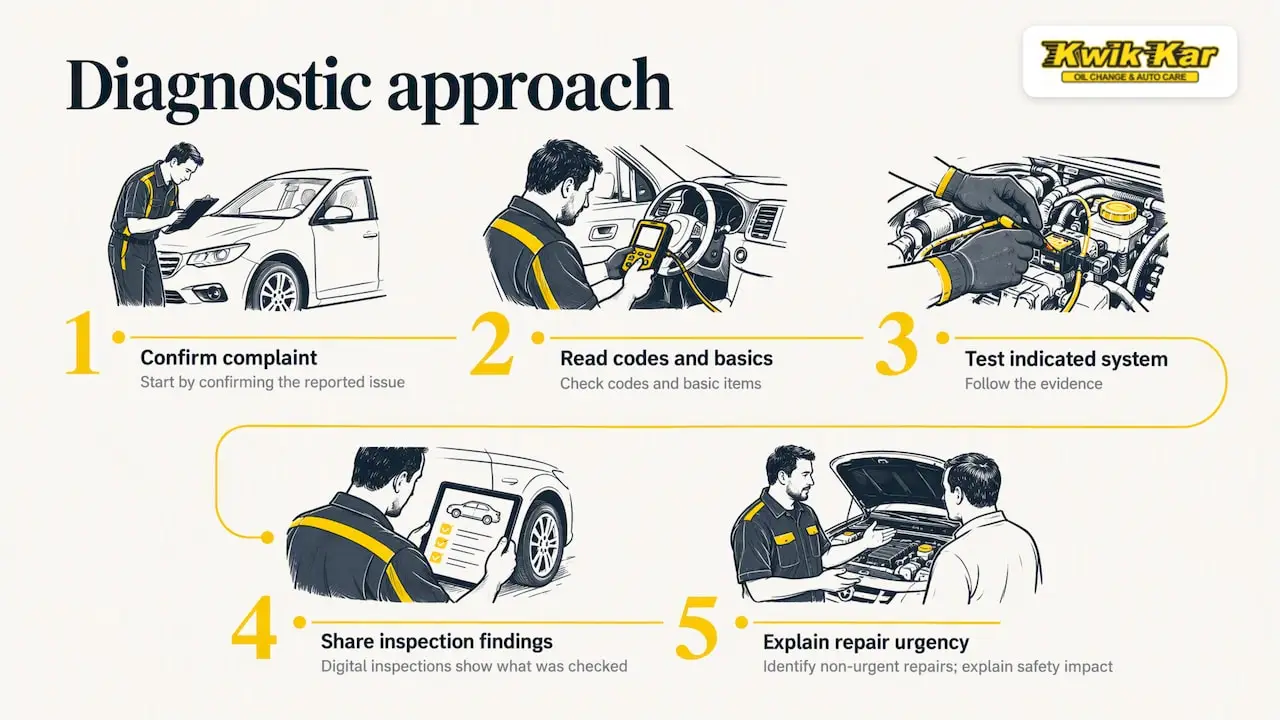
We also share what we find. Digital vehicle inspections let you see the condition of what we looked at, so a recommendation is something you can review, not just take on faith. If a repair is not urgent, we will say so. If it affects safety, we will explain why in proportion.
Some fixes are simple, like a loose hose or a set of worn plugs. Others take more testing. Either way, we would rather prove the cause than sell a guess.
— Kwik Kar
Rough idle diagnosis in Richardson, TX
If your engine shakes at stops, hesitates, or has a check-engine light on, we can diagnose it at Kwik Kar Oil Change & Auto Care in Richardson. Our engine diagnostics and repair services cover code reading, inspection and testing, and if the cause is wear-related we can handle tune-up and engine performance work or engine repair when it is needed.
Our limited warranty of 24 months or 24,000 miles applies only to qualifying repairs, and it does not cover every service or inspection. Ask us what applies to your specific repair. Call (972) 644-1851 or schedule an appointment online when it suits you. We serve drivers across Richardson, Plano, Garland, Addison and North Dallas.
FAQ
What are the most common causes of a rough idle?
Vacuum leaks, worn spark plugs, weak ignition coils, dirty fuel injectors and a dirty throttle body are the usual suspects. Sensor faults, a stuck EGR valve and worn engine mounts also show up often. Testing is the only reliable way to tell which one applies to your vehicle.
Can I keep driving with a rough idle?
A mild roughness is usually fine for a short time while you schedule a diagnosis. Stop driving normally if the check-engine light is flashing, the engine stalls, or you notice overheating, smoke or a fuel smell. When in doubt, call a shop before continuing.
Why does my car idle rough only when it is warm?
Heat-related causes include a stuck-open EGR valve, an EVAP purge valve passing too much vapor, ignition parts that fail when hot, or a vacuum leak that opens as components expand. A technician can reproduce the condition with the engine at operating temperature and check codes and fuel trims.
Will a rough idle fail an emissions test?
It can, especially if it comes with a misfire or an active check-engine light. Emissions testing remains required for qualifying vehicles in applicable Texas counties, so it is best to have the cause diagnosed and repaired first.
Sources
- Texas DPS: Vehicle Safety Inspection Program Changes Now in Effect
- GM technical bulletin on rough idle diagnosis (NHTSA, 2013)
- GM technical bulletin on warm rough idle, 2019 to 2021 Silverado and Sierra (NHTSA, 2021)
- ASE Advanced Engine Performance Specialist (L1) study guide
- ASE: AAA, NAPA and partners celebrate Car Care Month
- Car Care Council: Cone Zone season and your vehicle
- MOTOR Magazine: Trouble Shooter, Rough-Idling Engine
- AA1Car: Random misfires
- AA1Car: How to diagnose and repair engine misfires
- AA1Car: Ford P0171 and P0174 lean codes
- Haynes: Car throttle body explained
- 2CarPros: Diagnosing and repairing engine rough idle
- MasterTechPrep: Diagnose emissions or driveability problems
- OBD2SCAN: Rough idle diagnostic workflow
- Car Fault Lab: How to diagnose rough idle
- OBDGuides: Rough idle only when warm