Water Pump Failure Symptoms: What to Look and Listen For
The most common signs of a failing water pump are coolant leaking at the front of the engine, an engine that runs hot, a squeal or whine that follows engine speed, and rust or crusty buildup on the pump itself. AutoZone lists the same core signs. If you see steam, a gauge climbing into the red, or coolant dripping steadily, stop driving and call for help. Overheating can damage an engine quickly.
This guide explains each symptom, how to tell a harmless trace of moisture from a real leak, what else can mimic a bad pump, and what to do next. We wrote it for drivers across Richardson, Plano, Garland, North Dallas and Addison, where summer heat puts extra demand on every cooling system.
TL;DR
- Watch for coolant at the front of the engine, overheating, squealing or whining noises, and rust or crusty residue around the pump.
- A small, dry trace at the weep hole can be normal. Liquid coolant dripping from it is not.
- Overheating alone does not prove the pump is bad. A stuck thermostat, a blocked radiator or a dead cooling fan causes the same symptom.
- Do not keep driving with a hot engine or a pump you suspect has failed. A short stretch can turn a repair into an engine problem.
- Kwik Kar Oil Change & Auto Care in Richardson can diagnose the cooling system at (972) 644-1851.
Table of Contents
- What the water pump does
- The main water pump failure symptoms
- Normal weep-hole moisture or a failing pump?
- How to check a water pump without removing it
- What else can look like a bad water pump
- Can you drive with a bad water pump?
- Do water pumps fail suddenly?
- Why water pumps fail
- What happens when you bring the car in
- Cooling system service in Richardson
- FAQ
- Book a cooling system check
- Sources
What the water pump does
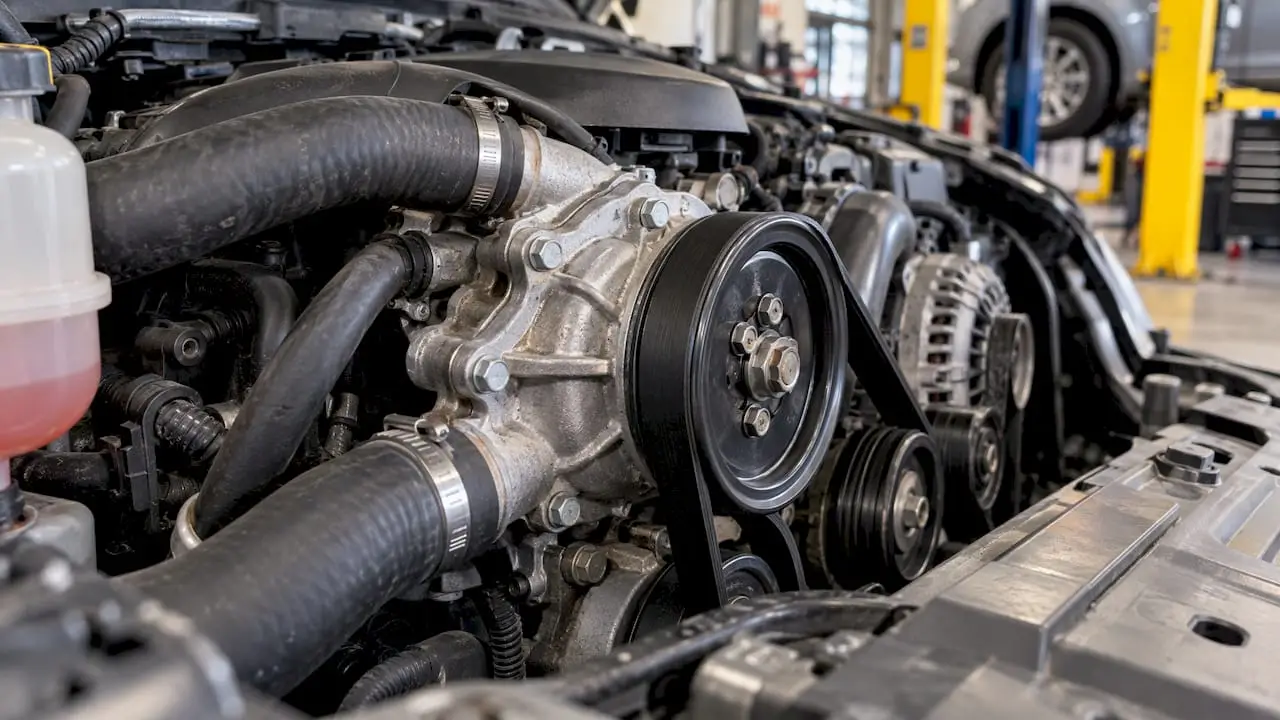
The water pump is the heart of your engine’s cooling system. It pushes coolant through the engine block and cylinder head, out to the radiator, and back again. That flow carries heat away from the engine so it stays in its working range.
Most pumps are driven by the serpentine belt or the timing belt. Some are driven by a chain, and some are electric. Inside the pump, an impeller moves the coolant, a shaft bearing lets it spin, and a seal keeps coolant from reaching the bearing.
When any of those parts wears out, the pump moves less coolant or leaks it. HELLA’s technical guide groups failures into noise, loss of coolant, and weak cooling that leads to overheating. That is a useful way to organize the symptoms below.
The main water pump failure symptoms
1. Coolant leaking near the front of the engine
A leak at the front of the engine is one of the most common clues. AutoZone explains that it usually comes from the gasket where the pump mounts to the engine or from the seal around the pump shaft.
A minor leak may never reach your driveway. Engine heat can dry the coolant first, leaving a white or colored trail of residue down the front of the engine. Look for a sweet smell after you park, or a coolant reservoir that keeps dropping.
Our guide to coolant leak warning signs covers how to spot leaks from other parts of the system too.
2. Overheating or a temperature gauge that wanders
A pump that cannot circulate coolant lets heat build up in the engine. The overheating can be gradual as the pump weakens, or sudden if it seizes. It may show up first at idle, such as in a school pickup line or stop-and-go traffic on US-75, when coolant flow matters most. This pattern comes from Your Motor Care’s symptom guide.
Sometimes the gauge rises, drops, and rises again. That can happen when an impeller slips on its shaft and moves coolant only part of the time. On some pumps the impeller is pressed onto the shaft, and corrosion from old coolant can loosen it. The pump then turns without moving coolant, according to the same guide.
Steam from under the hood, a hot smell, or a red warning light means the engine is already too hot. Pull over safely and shut it off.
3. Squealing, chirping or whining from the front of the engine
A bad shaft bearing is a common source of noise. A squeal or chirp that rises and falls with engine speed can be an early sign. AutoZone notes that a worn bearing can make the belt slip on the pulley, and that the pump may carry on this way for weeks or months before it seizes.
A whine that changes with RPM can also mean the belt is loose or the pulley is damaged. A pulley can crack between its bolt holes because of rust, so it no longer runs true. That is mostly an issue on older cars.
A deeper grinding or rumbling that is present whenever the engine runs points toward bearing wear. Your Motor Care says a bearing with noise or play can seize with little further warning, and a seized pump on a serpentine belt can shred the belt. When that happens, every belt-driven accessory stops at once. Treat bearing noise as a reason to book a check soon.
4. Rust, crust or corrosion on the pump
White, green or rusty crust around the pump or down the timing cover means coolant has been escaping and drying. Underhood Service lists white or rusty streaks on the block or timing cover among the findings that justify replacing the pump.
Corrosion can also be a cause, not just a symptom. HELLA’s guide says stale coolant with high chloride content combined with high temperatures can pit the impeller, housing, seal and shaft.
5. Other clues
A few quieter signs deserve attention:
- A sweet odor from the engine bay after a drive.
- Weak heat from the cabin vents.
- A coolant level that keeps falling without obvious overheating.
- Repeated low-coolant warnings.
Engine Repair Zone’s triage table puts sweet odor, dried residue, weak cabin heat, intermittent temperature swings and falling coolant in the “schedule prompt diagnosis” category. Red gauge, visible steam or rapid coolant loss belong in the “stop driving” category.
Normal weep-hole moisture or a failing pump?
Many pumps have a small weep hole. It is a designed vent between the main coolant seal and the bearing seals. US Motorworks explains that it lets a little coolant or moisture escape if the seal starts to wear, which protects the bearing and warns you early.
That means a trace of residue is not automatically a failure. A 2020 NHTSA technical bulletin says a small amount of coolant discharged to lubricate the seal, which then evaporates, is normal and does not require replacing the pump.
Liquid coolant is a different story. A 2024 NHTSA bulletin from FCA says trace residue at the weep hole area may be normal, but liquid coolant dripping from it is unacceptable, and the pump should be replaced.
| What you see | What it usually means | What to do |
|---|---|---|
| Faint, dry residue near the weep hole, stable coolant level, no noise | Normal seal lubrication or a past, temporary leak | Clean it and recheck at your next fluid check |
| Residue that turns a paper towel wet | Active leak | Have the cooling system inspected promptly |
| Steady dripping or pooling, frequent top-ups | Failed seal or pump | Avoid driving and get professional help |
| Grinding or whining plus any leak | Bearing and seal wear | Book a diagnosis right away |
The table follows the temporary versus active distinction in the US Motorworks bulletin. The exact limits vary by manufacturer, so a technician should judge what is acceptable for your vehicle.
How to check a water pump without removing it
These checks help you describe the problem to a technician. They do not replace a pressure test or a professional diagnosis. Work only on a cool engine, and keep hands and clothing clear of the belt and fan.
- Look for the source. With a flashlight, check the front of the engine around the pump, the weep hole, the hoses and the thermostat housing. Confirm the coolant is not coming from somewhere else first.
- Do the paper towel test. The NHTSA bulletin from 2020 says to press a dry paper towel against any dried deposits. If it stays dry, the leak was temporary. If it picks up wet coolant, the leak is active.
- Check for play. With the engine off and cold, and the belt removed or the engine safely secured, grip the pump pulley and try to rock it sideways to the shaft. Any wobble suggests bearing wear. The NHTSA bulletin also advises checking that the pulley turns smoothly.
- Listen. A mechanic’s stethoscope, or a long screwdriver with the handle held to your ear and the tip against the pump housing, can help isolate a bearing noise from other front-of-engine sounds.
- Check the coolant. Our guide to checking car fluids shows how to read the reservoir safely. Never open a hot radiator cap.
If any of this feels unsafe or unclear, skip it and have the car inspected.
What else can look like a bad water pump
The pump gets blamed for a lot. Underhood Service notes that coolant from hoses, the thermostat housing or the intake manifold can mimic a pump leak. Leftover coolant after a recent service can also drip for a while, and weep-hole seepage is different from a leak at the housing gasket.
Overheating has many causes. Your Motor Care points out that a stuck thermostat, a blocked radiator and a failed cooling fan produce the same symptom. Engine Repair Zone adds trapped air, a faulty radiator cap, and internal leaks where coolant enters a cylinder or mixes with oil.
A few related problems and where to read more:
- Radiator leaks show up as puddles near the front of the car. See what causes radiator leaks.
- A sweet smell with white exhaust or milky oil can point to a head gasket issue.
- A worn belt can squeal and slip even when the pump is fine. Belts, hoses and timing belt service is part of what we offer.
This is why we diagnose first. Replacing a part on a guess costs you money and may leave the real fault in place.
Can you drive with a bad water pump?
The safe answer is no. Driving on a failing pump can cause overheating and severe damage, including to the head gasket and cylinder head. GMB’s guidance is to stop driving if you suspect a problem and replace the pump as soon as possible.
The damage comes from heat. AutoZone warns that repeated overheating can blow a head gasket, warp a cylinder head or seize the engine. Allied Motor Parts stresses that the time spent above a safe operating temperature matters more than the distance, and that conditions like ambient temperature, speed and load change the outcome. In a Texas summer, that margin shrinks.
Do not judge the risk by the size of a puddle either. Engine Repair Zone cautions that a small puddle does not tell you how much coolant is left or whether the leak worsens under pressure.
A practical way to think about it:
- Gauge in the red, steam, or rapid coolant loss: pull over, shut off the engine and arrange a tow.
- Active drip or a coolant level that keeps falling: avoid driving beyond what is needed to reach a shop, and ask for advice by phone first.
- Dry residue, a faint noise or weak heat: schedule a diagnosis soon rather than waiting for the next oil change.
Do water pumps fail suddenly?
Sometimes, but they often give notice. A leaking, noisy or weakening pump usually shows something first. A pump with a seized bearing, stripped shaft or destroyed impeller moves no coolant, and that is a different situation. Allied Motor Parts’ distinction between a failing pump and a broken pump is useful here: a broken pump leaves the engine with almost no heat removal.
The practical lesson is not to wait for the second warning. A squeal that tracks engine speed can persist for a long time, as AutoZone notes, but you cannot know which day the bearing will finally seize.
Why water pumps fail
No single cause fits every vehicle, but the usual ones are:
- Seal and bearing wear. Over time, the shaft seal lets coolant reach the bearing, and the bearing then loses its lubrication.
- Old or wrong coolant. Coolant additives wear out. Stale coolant can corrode internal parts, as HELLA describes.
- Corrosion and blockage. Rust or sealant can narrow passages and reduce flow.
- Cavitation. HELLA says damage can come from steam bubbles forming and collapsing around the impeller.
- Belt or pulley problems. An over-tight or misaligned drive belt, or a damaged pulley, adds stress.
- Electrical faults. On electric pumps, short circuits or interruptions can stop the pump.
Follow your vehicle manufacturer’s schedule for coolant changes and belt inspection. Intervals differ widely between makes and engines, so your owner’s manual is the right starting point. Our routine maintenance checklist can help you stay on track.
What happens when you bring the car in
A proper diagnosis looks at the whole cooling system, not just the pump. At a minimum, that means checking coolant level and condition, inspecting hoses, belts and the radiator, looking for external leaks, and confirming the fan and thermostat work. A pressure test helps find leaks that only appear under load.
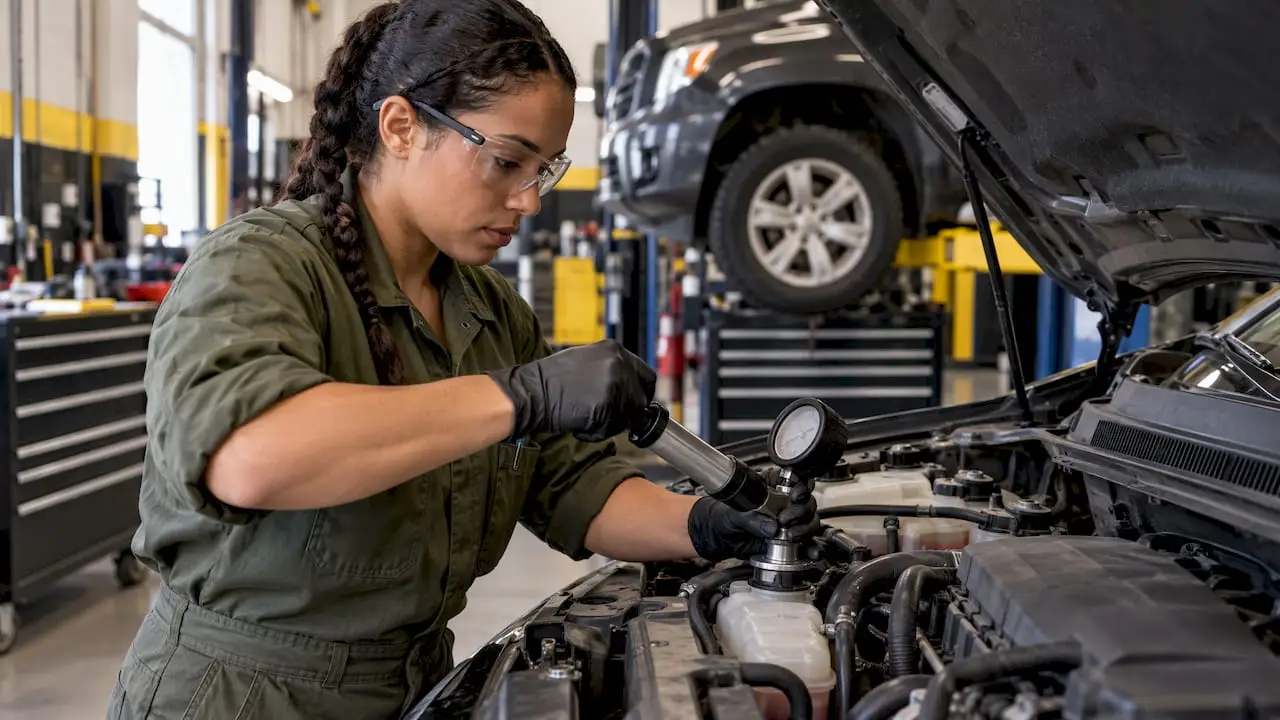
If the pump is the problem, replacement often involves the belt, and sometimes the timing belt or chain, depending on the engine design. A technician can tell you what your specific vehicle needs. Our overview of cooling system repairs and typical costs explains the common jobs.
Once you have a recommendation, we explain what we found and why, and you decide how to proceed. We do not treat every finding as urgent. Some are watch items, and some are stop-driving items, and we say which is which.
Cooling system service in Richardson
Kwik Kar Oil Change & Auto Care offers radiator and cooling system repair, along with belts, hoses and engine diagnostics, at our Richardson location. Our technicians are ASE-certified, and our ASE and RepairPal certification page has more detail.
Qualifying repairs may be covered by our 24-month/24,000-mile limited warranty. Not every service or inspection is covered, so ask us what applies to your repair.
If your car is running hot, leaking or making a new noise up front, call (972) 644-1851.
Our perspective: diagnose the cause, not just the symptom
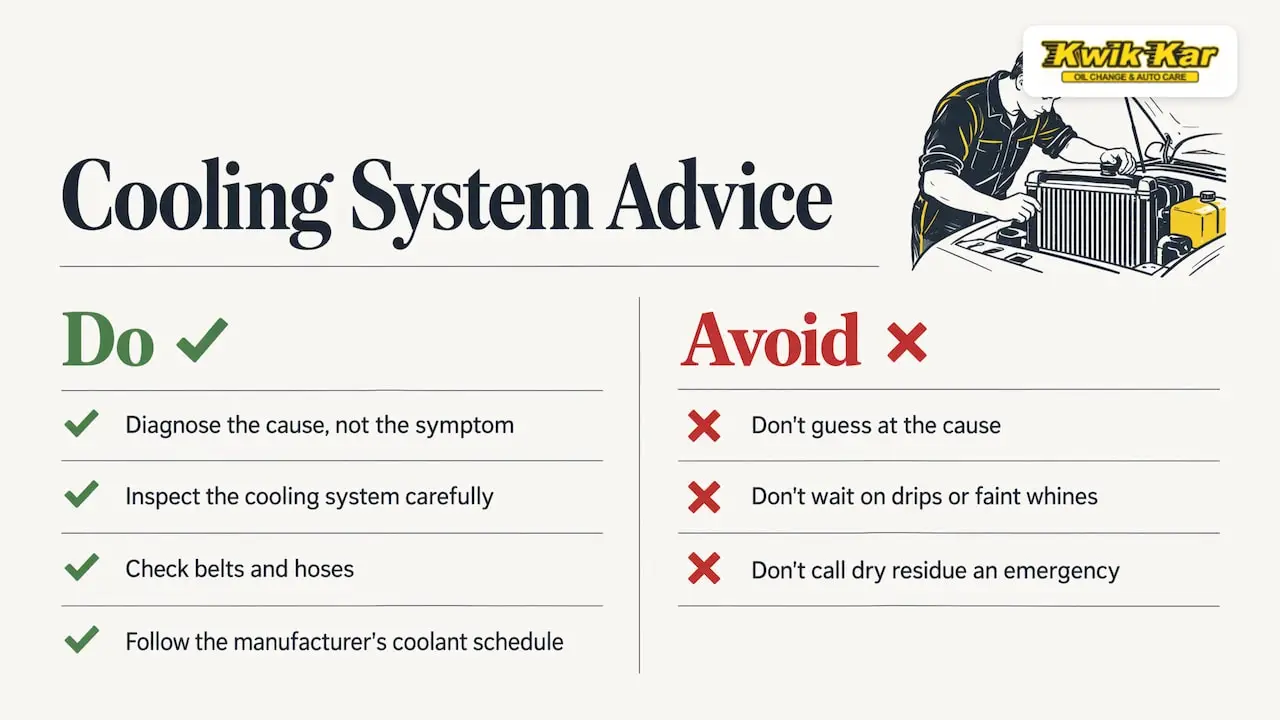
We see the same pattern often. A driver notices a small drip or a faint whine, decides it can wait, and the next time the car shows up it is on a tow truck. The water pump rarely fails without telling you something first, but the message is easy to miss.
Our approach is to treat the cooling system as a system. A hot gauge can come from the pump, the thermostat, the fan, the radiator or a pressure problem, and guessing is the expensive way to find out. We start with a careful inspection and explain what we find in plain terms.
We also think proportion matters. A dry trace at a weep hole is not an emergency, and we will not call it one. A steady drip, a grinding bearing or a gauge in the red is, and we will tell you that just as plainly.
For Richardson drivers, the heat makes the stakes higher. Cooling system care, fresh coolant on the manufacturer’s schedule, and a quick look at belts and hoses are some of the cheapest ways to protect an engine.
Kwik Kar
FAQ
What are the first signs of a bad water pump?
The earliest signs are usually a faint squeal or whine from the front of the engine that follows RPM, or dried coolant residue near the pump. A temperature gauge that drifts up at idle is another early clue. Any of these is worth a diagnosis before it becomes overheating.
How long can you drive with a bad water pump?
There is no safe distance you can count on. Heat damage depends on how long the engine runs above its normal temperature, and that varies with weather, speed and load. If the gauge is rising or coolant is leaking, stop driving and call a shop.
How do I know if it is the water pump or the thermostat?
Both can cause overheating, so the symptom alone cannot tell you. Leaks, noise or play at the pump point to the pump, while a gauge that climbs quickly and heat that stays cool in the upper hose often point to the thermostat. A technician can confirm with a pressure test and temperature checks.
Is a little coolant at the weep hole a problem?
Not always. A trace of dry residue can be normal seal lubrication, but liquid coolant dripping from the weep hole means the pump should be replaced, according to a 2024 NHTSA bulletin. Have a technician judge it against your manufacturer’s specifications.
Can a failing water pump damage the engine?
Yes, if the engine overheats. Repeated overheating can blow the head gasket, warp the cylinder head or seize the engine. Catching the pump early is far less costly than repairing that damage.
Book a cooling system check
If you have noticed any of these symptoms, we can inspect the cooling system and explain what is going on. Call Kwik Kar Richardson at (972) 644-1851 or schedule an appointment online.
Sources
- Symptoms & Signs of a Bad Water Pump, AutoZone
- Defective water pump, HELLA
- Faulty Water Pump Symptoms: 7 Signs to Watch, Your Motor Care
- Water Pump Leaks: Technician Tips, Underhood Service
- Water Pump Leak Inspection and Diagnostic Tips, NHTSA (2020)
- Suspected Engine Coolant Leak, NHTSA (2024)
- Technical Bulletin, US Motorworks
- Auto Cooling System Repair: Diagnose First, Engine Repair Zone
- Water Pump FAQs, GMB
- Can You Drive With a Bad Water Pump?, Allied Motor Parts