You hear a sharp squeal pulling into a parking lot. Or you start the car and notice a brake symbol on the dash that wasn’t there yesterday. Most drivers have the same first thought. “Can I still drive this, or do I need to stop right now?”
A brake pad indicator is your car’s early warning system. It’s there to tell you the pads are getting thin enough that you need to pay attention. That part is helpful. The part that confuses people is this: the warning only tells part of the story.
As an ASE-certified mechanic, I’ve seen plenty of brake systems where the indicator did its job and plenty where the brakes had a problem the indicator couldn’t catch. That’s why it helps to know what the warning means, what it doesn’t mean, and when a hands-on inspection matters more than the light on the dash.
That Sound or Light on Your Dash What It Means for Your Brakes
You back out of the driveway, tap the brakes, and hear a light screech that was not there yesterday. Or you start the car and spot a brake warning light on the dash. That gets your attention fast, and it should.
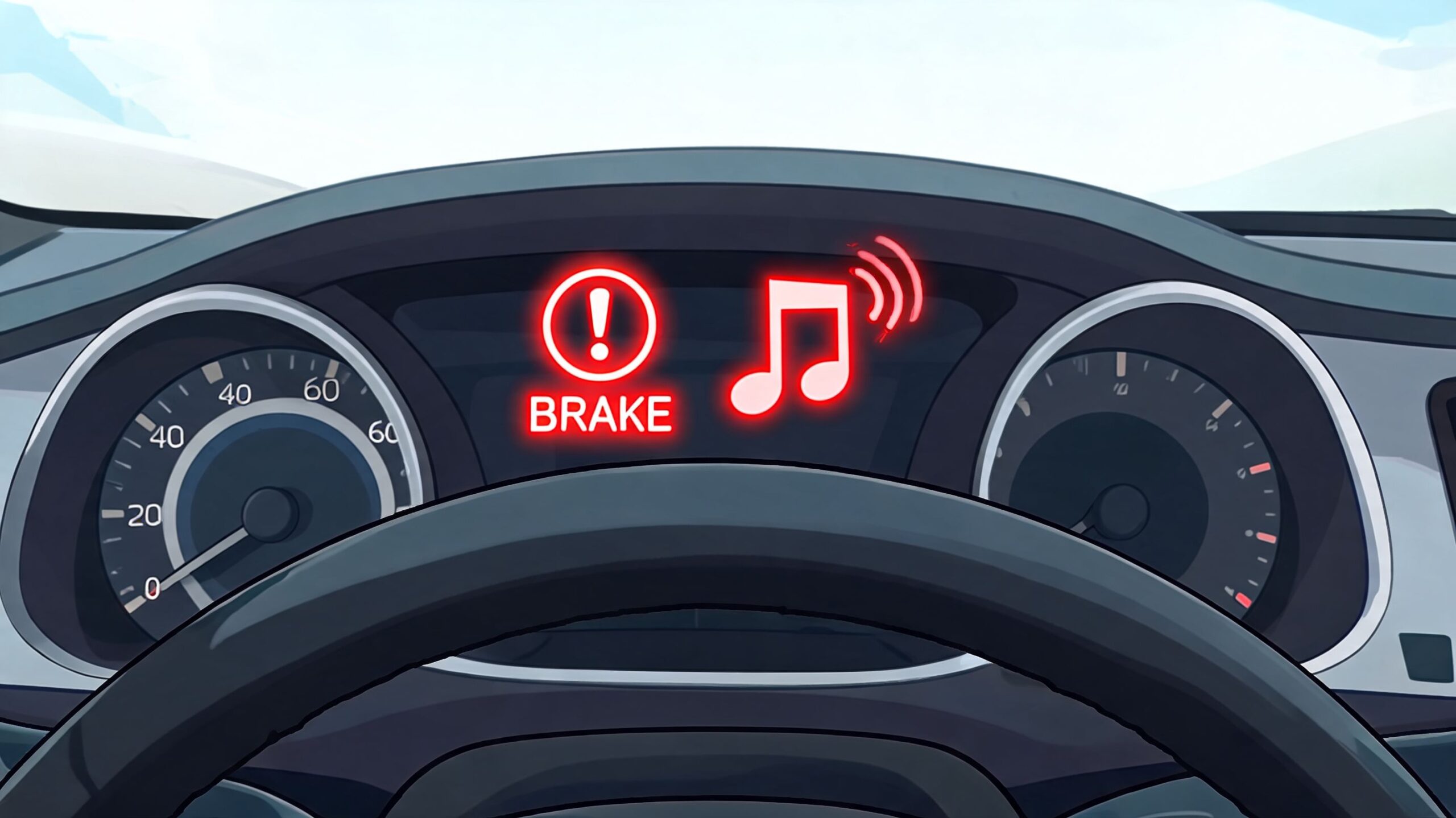
In plain language, your car is telling you the brake pads have worn down enough to need service soon. Pads get thinner a little at a time every time you slow down, so the warning is there to catch wear before metal starts contacting metal.
Some vehicles do this with a squeal. Others use an electronic sensor and a dashboard light. Newer models may even estimate remaining brake life. Helpful, yes, but there is a catch. These systems usually track pad thickness at one point. They do not give you a full picture of the whole brake system.
What the warning is really saying
The message is simple. Your brake pads are getting low, and it is time to schedule an inspection.
That does not mean the brakes have failed. It also does not mean you can safely wait until the next oil change and forget about it. The warning is more like the low-fuel light. It tells you action is needed soon, but it does not inspect the rest of the system for you.
If you want a better sense of timing, our guide on when to replace brake pads explains what technicians look for and why waiting too long gets expensive.
Practical rule: A brake pad indicator is a prompt to book service soon. It is not a full safety check.
Why a light or squeal can miss a real brake problem
This is the part many drivers do not hear often enough. Electronic indicators can fail without warning.
A sensor may only monitor one wheel or one pad. If the inner pad is wearing faster than the outer pad, or if a caliper is sticking on one side, the system may stay quiet while braking performance gets worse. I see this in the shop more than car owners expect. From the driver’s seat, the brakes may feel mostly normal until the wear gets severe.
The same goes for a squealer tab. It warns that a pad has reached a wear point. It does not confirm that wear is even, that the rotor is healthy, or that hardware is sliding the way it should.
That is why you should not guess from the icon alone. The warning is useful, but your brakes are a system with pads, rotors, calipers, slide pins, fluid, and hardware all working together. A hands-on inspection is the only way to catch uneven wear, dragging parts, and other problems the sensor never reports.
How Your Car Tells You Its Brake Pads Are Low
Cars warn you about low brake pads in a few different ways. The easiest way to understand them is to think of each one as a different kind of alarm.
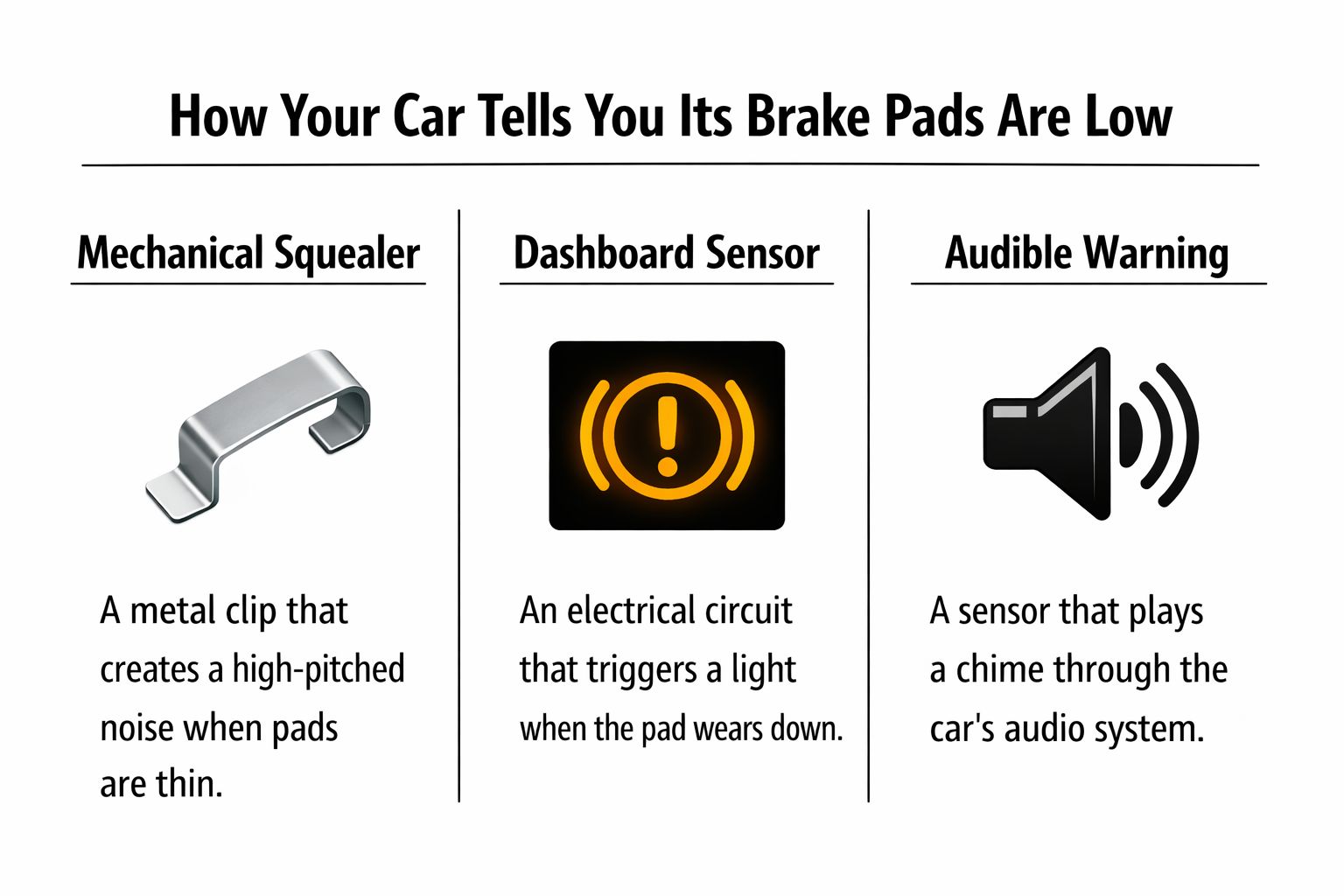
Mechanical squealer
This is the old-school warning. A small metal tab is attached to the brake pad. As the friction material gets thin, that tab touches the rotor and creates a high-pitched squeal.
It’s simple and effective. No computer needed. No dashboard message needed. Just noise.
You’ll often hear it lightly at first, especially during gentle braking. Drivers sometimes mistake that sound for “morning moisture” or road dust and put it off longer than they should.
Electronic pad sensor
Many modern vehicles use an electronic brake pad indicator instead. In plain terms, it works like a switch in a circuit. The sensor is built into the pad at the wear limit. When the pad gets thin enough, the sensor contacts the rotor and triggers a warning through the vehicle’s system.
Some newer systems go further. Advanced vehicles now use two-stage electronic sensors, with one stage activating at approximately 50% pad wear and a second stage at end-of-life, and the system can send that information to the ECU so the car can estimate remaining brake pad life in miles, as described in this overview of brake wear indicator systems.
General brake warning light
This one causes a lot of confusion because it isn’t always just a pad warning. A general brake light can relate to pad wear on some vehicles, but it can also point to other brake system concerns.
That’s why it’s important not to guess based on the icon alone. The owner’s manual helps, and a proper inspection helps even more.
Brake pad indicator types at a glance
| Indicator Type | How It Works | The Alert You Get |
|---|---|---|
| Mechanical squealer | A metal tab contacts the rotor when the pad gets thin | A high-pitched squeal during braking |
| Electronic sensor | A wear sensor in the pad triggers a circuit and sends a signal | A dash warning light or brake service message |
| Integrated vehicle alert | The brake system communicates wear status through the vehicle display | A warning light, message, chime, or estimated pad life display |
If you’re trying to figure out whether your current warning means “soon” or “now,” this guide on when to replace brake pads gives a useful owner-level overview of common replacement timing and symptoms.
A squealer tells you the pads are thin. An electronic sensor tells you a wear point has been reached. Neither one gives a full health report on the entire brake system.
Beyond the Indicator Signs Your Brakes Need Inspection
The most dangerous misunderstanding I see is this: no warning light doesn’t mean your brakes are healthy.
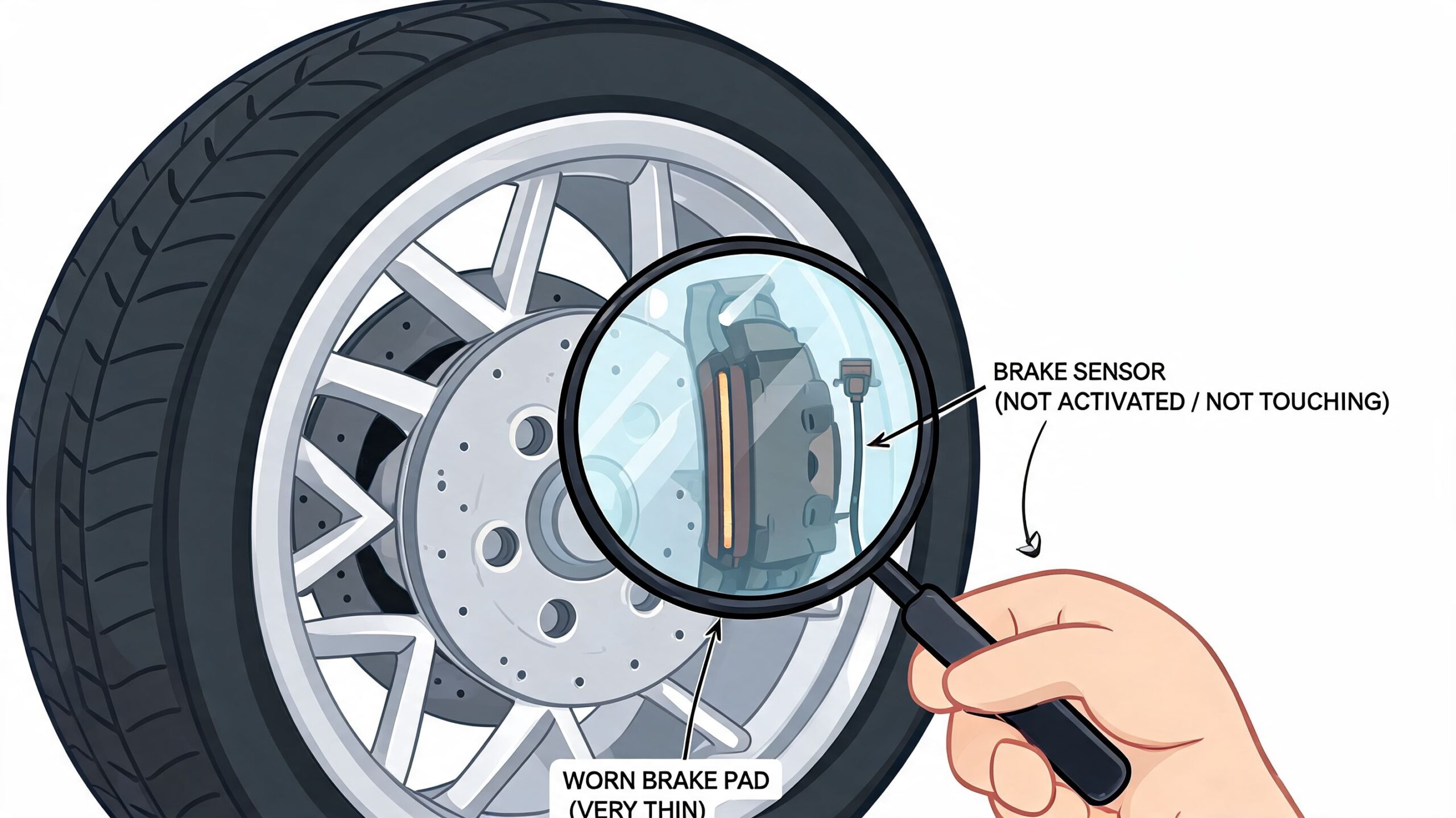
A brake pad indicator only measures one thing. It reacts when pad material reaches a wear point. It does not inspect caliper movement, slider condition, rotor condition, or whether one pad is wearing much faster than the other.
The silent failure problem
Electronic systems are threshold-based safety devices, not diagnostic tools. That distinction matters. A vehicle’s warning light may come on when one side is badly worn while the opposite side still has significant material left, or the reverse can happen with no warning when wear is uneven due to caliper issues, as explained in this article on diagnosing uneven pad wear with basic tools.
That means one pad can be wearing itself into trouble while the sensor-equipped pad hasn’t yet reached its trigger point. Drivers assume they’re safe because the dash is quiet. The brake system may be telling a different story.
Signs that matter even without a light
If you notice any of these, get the brakes checked:
- Grinding instead of squealing means the friction material may be gone and metal may be contacting metal.
- Pulling to one side while braking can point to uneven pad wear, a sticking caliper, or hardware trouble.
- A pulsating brake pedal can signal rotor issues or uneven contact.
- A burning smell near a wheel may suggest a brake is dragging and not releasing correctly.
- Reduced confidence when stopping is reason enough for an inspection.
Don’t judge your brakes by the dashboard alone. Judge them by the whole pattern. Sound, feel, stopping behavior, and visual condition.
If you’re shopping for a used vehicle, this matters even more because you don’t know the maintenance history. A good guide for used car shoppers can help you build a smarter inspection checklist before you buy.
A Quick Visual Brake Check You Can Do at Home
You pull into the driveway after a normal trip to the store. The car seems fine. No warning light. No squeal. This is a good time for a quick brake look, because electronic indicators can stay quiet while one pad wears faster than the one the sensor is watching.
A home check cannot confirm the whole brake system is healthy, but it can help you catch a problem before it turns into rotor damage or a metal-on-metal brake job.
Before you start
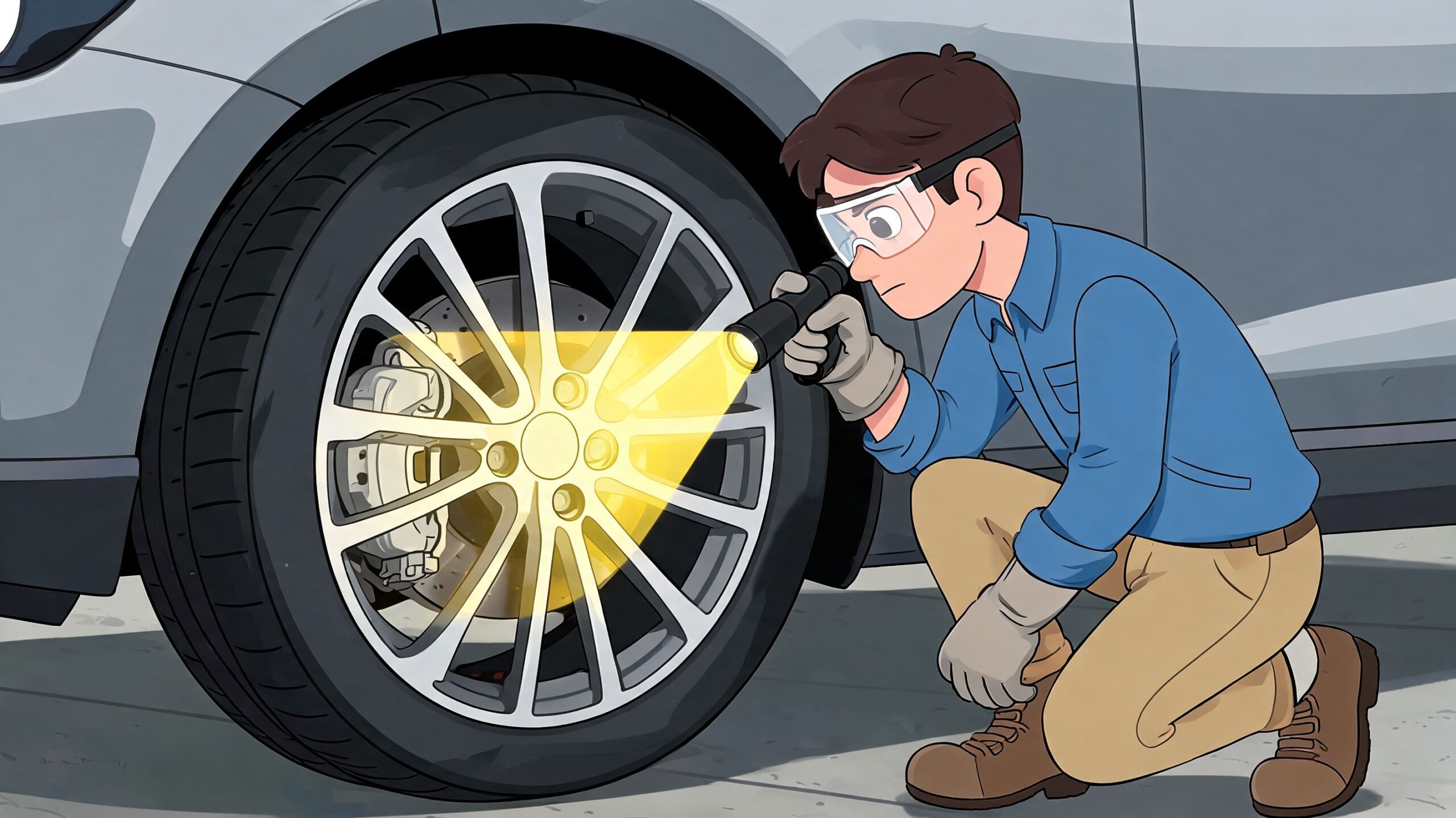
Park on level ground. Put the vehicle in park. Make sure the engine is off and the brakes have had time to cool.
Remember, you are only looking. Do not reach into the brake area, and do not do this right after driving when the rotor may still be hot.
What you’re looking at
Look through the wheel spokes with a flashlight if needed. The rotor is the smooth metal disc. The brake pads sit on both sides of that disc, and the part you care about is the friction material, not the metal backing plate.
The friction material is the part that gets used up, like the eraser on a pencil. If you mistake the backing plate for pad material, the pad can look thicker than it really is.
What thin looks like
If the pad material looks very thin compared with the backing plate, or if you can barely see any friction material at all, set up an inspection soon. Do not wait for a light or noise to give you permission. The warning system only tracks pad thickness at one point, and it may miss uneven wear on the inner pad or the opposite wheel.
It also helps to check the rotor surface while you are there. Deep grooves, heavy scoring, or blue heat spots can point to a brake problem that a pad sensor will never report. For a closer look, read this guide on how to inspect brake rotors.
A short visual walkthrough can make the parts easier to identify:
What a home check can miss
The biggest limitation is visibility. The outer pad is often easier to see, but the inner pad may be the one wearing faster. If a caliper is sticking or the slides are not moving freely, one pad can wear down much more quickly than the one you can see through the wheel.
You also cannot confirm sensor condition, hardware movement, or brake fluid-related issues from a driveway glance.
Use this check as an early warning. For safety, a manual inspection by a technician is still needed when pad thickness looks low, wear looks uneven, or the car gives you any reason to doubt its stopping power.
Getting Your Brakes Serviced What to Expect
A proper brake service should be more than swapping old pads for new ones. If someone only looks at the friction material and ignores the rest of the hardware, the job may solve the noise for now but not the cause of the wear.
What a thorough service includes
A technician should inspect the full brake assembly, including pad condition, rotor condition, caliper operation, guide pins, slides, boots, and any wear sensors. The goal is to find out whether the pads wore normally or whether something else created the problem.
That matters because brake wear isn’t always even. If a caliper sticks or the slides bind, one pad can do much more work than the other.
Why hardware matters
It is rare to find a caliper that has worn out brake pads without wear or degradation happening to the guide pins or slides as well, and replacing pads without servicing that hardware often leads to the same uneven wear pattern returning within 6-12 months, according to Brake & Front End’s discussion of brake pad wear patterns.
That’s the “pad slap” problem. New pads go in. Old sticking hardware stays. The car leaves quieter, but the new parts start wearing badly for the same reason the old ones did.
Shop question to ask: “Are you inspecting the guide pins, slides, boots, and sensors, or only replacing the pads?”
What can affect the repair
Brake service can vary based on the vehicle, the pad material it uses, whether the rotors can still be used, and whether the system has electronic sensors that also need attention. Newer vehicles often need a more careful electronic and mechanical check than older squealer-style setups.
If you want a clearer idea of what a complete local brake visit should involve, this page on brakes and rotors service near me outlines what drivers should expect from a full service rather than a minimal parts swap.
Frequently Asked Questions About Brake Pad Indicators
Can I still drive with a brake pad indicator on
Usually, the warning means the pads are low, not gone. The system is designed to alert you before complete failure. Still, you shouldn’t treat that as a long-term condition. If the brakes are noisy, feel different, or the vehicle doesn’t stop normally, get it checked right away.
Why did my light come on after a recent brake job
A few things can cause that. The sensor may also need replacement, the warning may need to be reset on vehicles that track brake wear electronically, or there may still be a wiring or contact issue in the system. On vehicles with electronic sensors, the pad and the warning circuit work as a pair.
Do brake pad indicators monitor every pad on the car
Not always. Electronic brake systems commonly use 2 or 4 warning contacts per axle, and the sensor is usually placed on the inner pad, which often wears 20-30% faster than the outer pad due to direct piston force, according to HELLA’s technical explanation of brake pad wear indicators. That’s why a complete inspection of all pads matters, even when no warning has appeared.
Is a squeal always a brake pad indicator
No. Some squeals come from moisture, rust film, or vibration. But a repeating high-pitched noise during braking is worth checking because that’s exactly how many mechanical indicators are designed to get your attention.
What if my brakes feel fine
That’s good, but feel alone isn’t enough. Uneven wear and hardware issues can develop without notice. Brakes should be inspected as a system, not judged by one symptom.
If your brakes are making noise, showing a warning, or just haven’t been checked in a while, schedule a professional inspection with Kwik Kar Oil Change and Auto Care. Our ASE-certified technicians inspect the full brake system, explain what they find in plain language, and help Richardson drivers make safe, informed decisions without guesswork.